The government is facing mounting pressure from the African Court on Human and Peoples’ Rights to compensate the Ogiek community for past violations of their rights.
It now risks further sanctions if it fails to comply with previous judgements by the Arusha-based court.
The court has criticised Kenya for failing to implement landmark rulings protecting the Ogiek community’s human rights. In its latest judgement on December 5, the African Court ordered Kenya to urgently pay Sh157.85 million to members of the Ogiek community as compensation for the loss of their ancestral lands in the Mau Forest Complex.
The ruling noted that the Kenyan government had failed to comply with two earlier judgements aimed at protecting the community’s land rights, cultural survival and recognition as an indigenous people.
"Despite the landmark judgement in 2017 and a reparations ruling in 2021, Kenya remains defiant. This court directs, for the second time, that the Kenyan government take all necessary administrative, legislative, and other measures to compensate the Ogiek, paying Sh57 million for material damages and Sh100 million for moral damages as previously ordered," reads part of the ruling.
The court arrived at its findings following a compliance hearing that reviewed reports submitted by both the Ogiek and the Kenyan government. It examined Kenya’s adherence to the 2017 merits judgement and the 2021 reparations ruling.
While Kenya claimed to have established various task forces to advance compliance, the court held that such measures “fall short of the legally required level of compliance.”
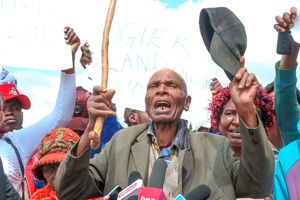
Members of the Ogiek community participate in a peaceful protest in Molo, Nakuru County on December 9, 2024 over a land dispute.
Photo credit: Boniface Mwangi | Nation Media Group
Specifically, the government had not established the Ogiek Community Development Fund or a committee to administer it, nor had it completed the identification, delimitation, demarcation, and collective titling of Ogiek ancestral lands.
The court also noted that consultations regarding land concessions and leases affecting Ogiek ancestral lands had not begun. It stressed that discussions with both the Ogiek and relevant third parties must commence without delay.
On recognition of the Ogiek, the court clarified that mere acknowledgement as an indigenous people is insufficient without practical steps to ensure they can fully exercise their rights. The court found Kenya’s consultations with the Ogiek inadequate and below the threshold required for meaningful, continuous engagement.
Despite Kenya arguing that it had engaged the Ogiek through inter-ministerial committees and other consultations, evidence presented by the applicants showed that critical decisions—such as lifting restrictions on land transactions—were made without genuine community participation.
Violations against the community
The Ogiek reported continued evictions, destruction of homes, and denial of land rights. The court directed that the latest judgement be implemented immediately.
On June 23, 2021, the African Court awarded the Ogiek Sh157 million in a land rights case, dismissing objections from the Kenyan government. The ruling required Sh57 million for material damages and Sh100 million for moral damages and mandated the establishment of the Ogiek Community Development Fund within 12 months.
However, the government has largely failed to comply, leaving justice elusive nearly ten years after the May 26, 2017, landmark judgement, which ordered Kenya “to take all appropriate measures within a reasonable time frame to remedy all the violations against the community.”
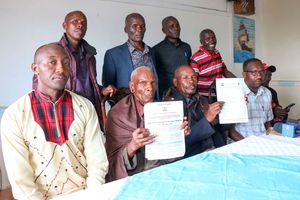
Daniel Kobei, Executive Director of the Ogiek Peoples’ Development Programme (OPDP), said justice for the community has been delayed and remains elusive.
An Ogiek elder addresses journalists after a peaceful protest in Molo, Nakuru County on December 9, 2024.
Photo credit: Boniface Mwangi | Nation Media Group
He urged President Ruto to prioritise implementation of court directives, return the Ogiek’s ancestral land in the Mau Forest Complex and issue title deeds.
"Once resettled, we shall protect and care for the Mau Forest water tower through community forest protection associations," Mr Kobei told the Daily Nation on Sunday adding the need to end frequent land conflicts.
“We have lived an impoverished life, mostly day to day, on land with a caveat and without title deeds. We cannot engage in development as we do not own the land. We cannot send our children to school or secure loans because we do not have title deeds. We deserve to be treated like the rest of Kenyans and given our land,” Mrs Jennifer Cheruiyot
The community is also fighting to preserve their culture, language, and sacred sites and seeks recognition as a distinct tribe to avoid assimilation.
Ms Margaret Sironga from Nessuit, Nakuru County called for the the need for government intervention to safeguard the dignity of the Ogiek as one of Kenya’s 40-plus tribes.
Historically, the Ogiek survived through wild fruits, roots, game hunting, and traditional beekeeping. The lack of secure land rights has hindered economic development, education, and cultural preservation.
The 2017 landmark judgement marked a historic victory for the Ogiek after a nearly five-year court battle. The African Court found that the 35,000-member forest-dwelling community had been illegally evicted from the Mau Forest, violating their rights to life, property, religion, culture, development, and non-discrimination. The court ordered Kenya to take remedial measures within a reasonable timeframe and report progress within six months.
Members of the Ogiek community perform during a past Mashujaa Day fete.
Photo credit: Jared Nyataya | Nation Media Group
However, implementation has stalled. Efforts by the government to issue title deeds, including a multi-agency process led by then Interior Cabinet Secretary Dr Fred Matiang’i, floundered after the Ogiek withdrew, citing lack of proper consultation and secrecy.
Mr Kobei insisted that the government should follow the 2017 judgement to resettle the community in the Eastern Mau, arguing that the current process lacked transparency and excluded local leaders.
Despite repeated court rulings, evictions continue, most recently in November 2023, when over 700 Ogiek were evicted from Sasimwani and Nkareta areas of Narok County, leaving them homeless.