Nurse Jacobeth Jeptoo is among Kenyans honoured during this year’s Mashujaa Day celebrations for risking her own safety to help victims of the helicopter crash that killed Emurua Dikirr MP Johana Ng’eno and five others in Nandi County on February, 2026.
Jeptoo was recognised during the 2026 national heroes’ event at State Lodge in Eldoret on Tuesday, following Mashujaa Day celebrations at Kipchoge Keino Stadium.
She attracted national attention after rushing to the crash site in Chepkiep, Mosop Constituency, carrying gloves and attempting to assist the victims despite the danger and devastation.
Her citation praised her courage, compassion and quick response.
She is honoured for her extraordinary courage and selflessness in safeguarding the right to life” during the tragedy. Her brave first response and life-saving assistance under perilous circumstances” exemplified “exceptional humanity, compassion, and unwavering respect for human dignity” the citation read.
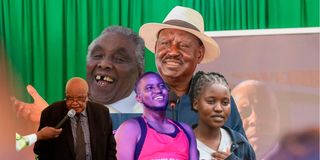
A scene where a chopper crashed at Chepkiep Village in Mosop Sub-County of Nandi County on February 28, 2026, where six occupants died on the spot. MP Johana N'geno (inset) was one of the chopper passengers.
Photo credit: File | Nation
Former Prime Minister Raila Amolo Odinga, democracy champion Philomena Mutai Chelagat, liberation activist Pio Gama Pinto, renowned historian Professor Bethwell Allan Ogot, scientist Professor Calestous Juma and former Cabinet Minister John Michuki are among 264 heroes and heroines honoured during the 63rd Mashujaa Day celebrations at Kipchoge Keino Stadium in Eldoret, Uasin Gishu County.
The honourees are recognised by the National Heroes Council for their contributions to Kenya’s liberation struggle, democracy, constitutional reform, scholarship, cultural preservation, environmental conservation, sports and socioeconomic development.
President William Ruto paid tribute to the men and women whose sacrifices secured independence and whose subsequent contributions helped shape the modern Kenyan state.
The President said honouring its heroes must go beyond remembrance to safeguarding the freedoms they secured and building a more inclusive future for generations to come.
“Our independence in 1963 was won at an immense cost: land, liberty and lives. We honor those who fought, the families who sustained them, and the countless patriots whose names history did not record,” he said.
Among the freedom fighters remembered was Nandi resistance leader Koitalel Arap Samoei, who was assassinated by a British colonial officer on October 19, 1905, during a meeting held under the false promise of peace. The President noted that the commemoration came 121 years after his death.
Other liberation heroes included Mekatilili wa Menza, who defied colonial rule; Dedan Kimathi, executed for his resistance; and Field Marshal Muthoni wa Kirima, who fought courageously for Kenya’s freedom.
President Ruto also honoured founding President Mzee Jomo Kenyatta and the Kapenguria Six - Bildad Kaggia, Achieng’ Oneko, Kungu Karumba, Fred Kubai and Paul Ngei- who endured imprisonment and detention during the struggle for independence.
The Head of State said the liberation struggle was about more than transferring political power from colonial authorities to African leaders.
“Their struggle was not merely to replace one authority with another, but to secure for every Kenyan the freedom, dignity and right to determine their own destiny,” he said.
The President also announced the launch of Achieng’ Oneko’s autobiography, The Price of Freedom, describing it as an important publication preserving the legacy of the independence struggle.
The late Raila Odinga was honoured posthumously for his contribution to multiparty democracy, constitutional reform and social justice. He played a central role in challenging one-party dominance during the 1990s and expanding political freedoms.
As Prime Minister from 2008 to 2013, Raila participated in a period of significant political and constitutional reforms that culminated in the promulgation of the Constitution of Kenya, 2010. He was also recognised for his longstanding advocacy for electoral justice, political inclusion and the rights of marginalised communities.
Constitutional scholar Professor Yash Pal Ghai was also honoured for his contribution to constitutional reform and democratic governance in Kenya and internationally. Widely regarded as one of the leading architects of Kenya’s constitutional transformation, Ghai chaired the Constitution of Kenya Review Commission from 2000 to 2004, steering a process of public participation that laid important groundwork for the 2010 Constitution.
His constitutional expertise extended beyond Kenya, with contributions to the development of constitutions in several countries, including Papua New Guinea, Fiji, Nepal and Afghanistan. He also served as the United Nations Secretary-General’s Special Representative on human rights in Cambodia and contributed to the drafting of the Asian Human Rights Charter.
His recognition highlighted the role of constitutional scholarship, public participation and institutional reform in strengthening democracy and protecting fundamental rights.
Former Eldoret North MP Philomena Mutai Chelagat was similarly honoured posthumously for her contribution to democracy, good governance, the rule of law, gender equality and the rights of marginalised people.
Ms Chelagat, a journalist, student leader and outspoken parliamentarian, challenged corruption, land injustice, political intimidation and abuse of power during the administration of former President Daniel arap Moi. Her political activism exposed her to imprisonment, persecution and exile.
Her legacy remains an important chapter in the history of women’s participation in politics and the struggle for democratic freedoms.
Pio Gama Pinto, the journalist and political activist of Goan-Kenyan heritage, was recognised posthumously for his contribution to the liberation struggle and social justice. He used journalism as a tool for political mobilisation, championing workers’ rights, equality, socialism and resistance to colonial rule.
Former Cabinet Minister William Odongo Omamo was also honoured posthumously for his contribution to agricultural and educational development, while former Sotik MP Anthony Kipkoskei Sotet Kimeto and former Bomet Governor Joyce Cherono Abonyo Laboso were recognised for their contributions to democracy, political tolerance, good governance and transformative leadership.
Scholars and cultural custodians recognised
The honours extended to scholars whose work has advanced African history, scientific innovation and the preservation of Kenya’s heritage.
Prof Bethwell Allan Ogot was honoured posthumously for his outstanding contribution to African historiography, higher education and research. A pioneering historian, he helped advance African-centred interpretations of the continent’s past and contributed to UNESCO’s General History of Africa.
Professor Calestous Juma was recognised posthumously for his work in science, technology, innovation and sustainable development. His scholarship explored how technological advancement could support agricultural transformation, food security and economic growth across Africa.
In the cultural heritage category, former Cabinet Minister William Ole Ntimama was honoured posthumously for preserving and promoting Maasai culture. Professor Gideon Saulo Were was recognised for documenting and advancing Kenya’s heritage, while Dr Shadrack Kiptanui Moimet was honoured for preserving indigenous knowledge of the Talai community, particularly in herbal medicine.
The recognitions highlighted the importance of documenting Kenya’s diverse histories and safeguarding indigenous knowledge for future generations.
Michuki, conservationists and community builders
Environmental conservation was another key area of recognition, with former Cabinet Minister John Michuki honoured posthumously for his contribution to environmental protection and the conservation of the country’s water towers.
Hillary Kiplagat Kibiwot was recognised for planting 23,326 indigenous trees within 24 hours at Kesup Forest in Elgeyo-Marakwet County. Dr Festus Ngeno was also honoured for his contribution to forest conservation, climate action and sustainable natural resource management.
In entrepreneurship and industry, retired Colonel Hussein Ahmed Farah was recognised for his contribution to aviation, while Joel Onditi was honoured for developing artificial intelligence-driven solutions.
Livingston Gachohu and John Gatonye Kimani were among those honoured posthumously for their contributions to socioeconomic development, community welfare and traditional leadership.
Sports heroes carry the baton forward
Kenya’s sporting achievements also featured prominently, with athletes, coaches and administrators recognised for advancing the country’s international reputation.
President Ruto recalled the achievements of Wilson Kiprugut, who won Kenya’s first Olympic medal, a bronze in the 800 metres at the 1964 Tokyo Olympics, and Kipchoge Keino, who won gold in the 1,500 metres at the 1968 Mexico City Games.
He also celebrated Charles Asati, Hezekiah Nyamau, Robert Ouko and Julius Sang, who won Olympic gold in the 4 × 400 metres relay at the 1972 Munich Games.
Among the sports honourees were world 3,000 metres steeplechase record-holder Beatrice Chepkoech, middle-distance runner Timothy Cheruiyot, long-distance runner Sebastian Kimaru Sawe and coach Carolyne Anyango Kolla.
The awards also recognised achievements in disability sports, including those of amputee football team manager Hashim Kamau Athman, deaf chess medallist Janet Atieno Otieno and para-dance athlete Travis Kimani Njoroge.
The selection reflected the diversity of Kenyan sporting talent and the contribution of those working to expand opportunities for athletes with disabilities.
A responsibility to future generations
In his address, President Ruto described Mashujaa Day as a reminder that the freedom won by earlier generations must be protected and given practical meaning by those who follow.
“The freedom we enjoy, the democracy we cherish and the rule of law that guides our Republic are the fruits of their sacrifice,” he said, adding that freedom was not merely an inheritance to be enjoyed, but a responsibility to be fulfilled.
Drawing a comparison with a relay race, the President said freedom fighters had carried the baton through sacrifice, subsequent generations had built national institutions, and those who defended constitutional freedoms had continued the work.
“Our freedom fighters carried the baton through sacrifice. Those who built the Republic carried it through nation-building. Those who defended our constitutional freedoms carried it through courage and conviction. Today, the baton is in our hands,” he said.
He urged Kenyans to protect their freedoms, uphold the Constitution, respect their differences and build a nation in which every community had a fair opportunity to prosper.
“Our heroes fought to give every Kenyan a country to call their own. Our duty is to build a Kenya in which every citizen has a fair opportunity to make something of their own,” President Ruto said.