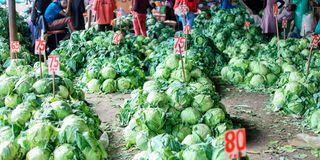
For years, cabbage has been the ultimate fallback food for Kenyans when money is tight; cheap, filling and usually abundant, especially in January. Together with dagaa (omena ), it has long carried the tag of the “poor man’s meal”.
But across much of Western Kenya today, that reputation has collapsed under the weight of soaring prices, even as farmers in Nyandarua count rare profits from the same crop.
In Kisumu, a single head of cabbage that sold for Sh40 or Sh50 just months ago now retails at between Sh100 and Sh170, depending on size and market. In supermarkets, prices are only marginally lower, with some outlets selling a head at Sh129.
Kevin Onyango, a vegetable vendor, arranges cabbages at Muthurwa Market in Nairobi on December 29, 2025.
Photo credit: Wilfred Nyangaresi | Nation Media Group
Yet in Kinangop South, Nyandarua County, one of the country’s key cabbage-growing zones, farmers are selling the same produce at between Sh30 and Sh40 per piece, prices they describe as the highest they have ever received.
At Kibuye Market in Kisumu, wholesaler Benson Kayesi says prices began climbing in October and November after a prolonged dry spell disrupted production.
“At the farm, a cabbage now goes for Sh40, up from Sh20. By the time it gets here, I sell it at Sh80 wholesale,” said Mr Kayesi, who sources his supply from Molo and Laikipia.
Retailers then pass on the costs to consumers, selling at between Sh100 and Sh170 depending on demand and transport costs.
Traders warn prices could rise further in January as schools reopen and institutional demand picks up.
“With schools opening, demand will go up and prices may increase,” said trader Brian Omollo.
At Kondele Market, Mr Martin Wafula says distance and transport costs are a major factor.
“I get mine from Nyeri and irrigated farms in Naivasha. I buy at Sh100 and sell at Sh150,” he said.
He rarely sources cabbages from Western Kenya, arguing that some farmers harvest immature produce that spoils quickly.
In sharp contrast, farmers in Nyandarua say the current prices are a welcome reversal after years of losses.
Cabbages with price tags on display at Muthurwa Market in Nairobi on December 29, 2025.
Photo credit: Wilfred Nyangaresi | Nation Media Group
In Kinangop South, cabbages are selling at between Sh30 and Sh35 at the farm gate, compared to less than Sh5 per piece during July and August last year.
“The highest price I had ever sold a cabbage before was Sh15. Now I’m selling at up to Sh40,” said Ms Margaret Njeri, a farmer in Njabini.
She supplies traders from Soko Mpya along the Nairobi–Nakuru highway, a major aggregation point that feeds markets across the country, including Western Kenya.
Traders at Soko Mpya sell cabbages at between Sh35 and Sh70 to buyers from Western and Eastern Kenya, depending on size.
“This year there is a shortage. Few farmers planted,” said trader Samuel Karanja.
Farmers attribute the shortage to erratic weather, high production costs and widespread abandonment of the crop after prolonged losses.
“Cabbages are heavy feeders. Production costs are between Sh12 and Sh15 per piece,” said farmer Joel Murimi, who abandoned the crop last season after losing more than Sh400, 000 worth of produce to market gluts.
Back in Kisumu, the high prices are reshaping household and business choices.
At Kibuye Market, hotelier Wilfrida Agutu Ochieng says she now buys cabbages at Sh120, up from Sh40 last year.
A client samples cabbages at Muthurwa Market in Nairobi on Monday, July 14, 2025.
Photo credit: Dennis Onsongo | Nation Media Group
Rather than raise prices, she has reduced portions.
“A plate of ugali and cabbage still goes for Sh70, but we serve less,” she said.
Some households are improvising. In Manyatta, Ms Rosebella Okello opted to buy sliced cabbage portions at Sh20 instead of a whole head when hosting guests over the New Year.
“It was cheaper to buy just what I needed,” she said.
Farmers and traders say the price disconnect between Nyandarua and Western Kenya highlights deeper structural issues — over-reliance on rain-fed farming, poor crop timing and weak irrigation infrastructure.
Nyandarua Mega Farmers Association chairperson Chege Kahuni says most farmers plant during the long rains, creating gluts later in the year and shortages early in January.
“The solution is irrigation so farmers can time production properly,” he said.
As rains slowly return in some regions, traders expect prices to ease by February.
Until then, cabbage, once the cheapest item on the menu, remains a symbol of how climate shocks and supply chain costs can turn a humble vegetable into a luxury for low-income households.