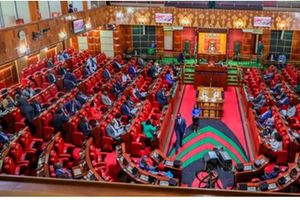
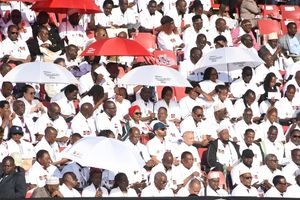
Victims of the 2007–08 post-election violence on Wednesday accused the government of consistently ignoring their plight.
Appearing before the Supreme Court, some survivors of sexual and gender-based violence (SGBV) said they were unfairly denied compensation despite the lower courts acknowledging that their rights had been violated. The victims argued that there should be no differential treatment of survivors without constitutional justification.
The appeal was filed by eight petitioners who survived SGBV committed during the 2007–08 post-election violence following Kenya's 2007 General Election. They sued the government for failing to protect them from the violence.
While the Court of Appeal directed the government to pay Sh4 million each to four survivors who had reported the attacks to police, it declined to award compensation to the others.
The petitioners faulted the appellate court for overlooking the State's failure to investigate violations against survivors, despite being aware that the abuses had occurred. They urged the judges, led by Chief Justice Martha Koome, to send a strong message that sexual violence committed during periods of conflict cannot be treated as an ordinary criminal offence.
According to the petitioners, many survivors continue to live with the physical and psychological consequences of the violations.
"Those who suffer sexual violence are often among the first and most vulnerable victims in conflict, yet remain the first to be ignored, including within compensation frameworks," they submitted.
Widespread and systematic attacks
The petitioners also argued that the Court of Appeal failed to consider the broader context in which the sexual violence occurred, saying the attacks were widespread and systematic.
They contended that, as a result, thousands of other survivors were denied the structural remedies sought in the case, including the establishment of a database of post-election violence victims to facilitate broader reparations.
Opposing the appeal, the Attorney-General argued that the Court of Appeal did not err in declining to compensate victims who failed to report the violations to police. The Attorney-General further submitted that the petitioners were seeking to apply the Constitution retrospectively to events that occurred during the 2007–08 post-election violence.
The court heard that approximately 318 cases of sexual violence were reported and investigated during the period. It was argued that those who failed to report the offences could not subsequently hold the State liable for failing to investigate incidents that had not been reported.
The Court of Appeal had, in a judgment last year, found that the government's failure to classify SGBV-related offences committed during the 2007–08 post-election violence as crimes against humanity violated the Constitution.
Justices Daniel Musinga, Francis Tuiyott and George Odunga held that the State also violated the Rome Statute, international human rights law and domestic law by failing to effectively investigate and prosecute crimes against humanity, including rape, torture, persecution, sexual violence and other inhumane acts. The appellate court further found that the government's failure to establish independent and effective investigations and prosecutions of SGBV-related crimes breached Kenya's obligations under the Rome Statute.
In a significant victory for the survivors, the judges faulted the High Court for adopting a narrow interpretation of the reparations available to victims — one that failed to reflect the State's broader obligations under international human rights law. The judges held that reparations should go beyond financial compensation to include rehabilitation, public acknowledgment of the harm suffered, and guarantees of non-repetition.
"By failing to consider these critical elements of restorative justice, the court overlooked fundamental aspects of the victims' right to an effective remedy. Consequently, it is our view that the learned judge erred in limiting the State's obligations to the SGBV victims of the PEV, in respect of the 5th, 6th, 8th and 9th appellants, to monetary compensation alone," the judges said.
The Court of Appeal further held that the State's obligations to its citizens are not suspended during periods of civil unrest or conflict, including before or immediately after a general election. According to the judges, the recurring pattern of election-related violence should have placed the State on high alert to protect its citizens.
"The State's failure to act on this constructive notice amounted to a breach of its due diligence obligations under both local and international law," the judges said.
The appellate court also held that the State has an obligation to provide victims with adequate reparations, including restitution, rehabilitation, satisfaction and guarantees of non-repetition. The judges explained that restitution seeks to restore victims, as far as possible, to the position they were in before the violations — including through measures such as secure housing or reinstatement of employment.
"Finally, states have an obligation to implement guarantees of non-repetition, which could include legal reforms, police and judicial training, and institutional changes to prevent the recurrence of similar violations," the judges said.
However, the Court of Appeal acknowledged that although the State had intelligence reports warning of possible post-election violence, the sporadic nature of the unrest, its rapid spread across different parts of the country, and coordination challenges among security agencies made it difficult to effectively contain or prevent the crisis.
"Given the above, we have no hesitation in agreeing with the learned judge's assessment that, due to the true scale of the 2007–2008 PEV and its spontaneous nature, it was impossible for the police to be present at every corner of the country," the judges said.