Premium
Phoebe Asiyo, the brains behind two-thirds gender rule, dies at 93
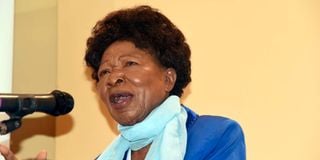
The patron of Maendeleo Ya Wanawake Phoebe Asiyo.
Phoebe Asiyo –a trailblazer in the fight for gender equality, and former Karachuonyo Member of Parliament – is dead.
Ms Asiyo died on Thursday, July 17, 202,5, in North Carolina, United States of America, her family announced.
“With heavy hearts, the Asiyo family shares the profound loss of our cherished mother, Hon Dr Phoebe Muga Asiyo, who has peacefully passed away in North Carolina, USA. Her presence and love will be deeply missed by all who knew her,” said the family. “We kindly ask for your understanding and patience as we navigate this difficult time. Details regarding the memorial services and funeral arrangements will be communicated soon.”
Ms Asiyo was the first black president of Maendeleo Ya Wanawake Organisation (MYWO), having been elected in 1958.
She is credited with many rights that women enjoy today, including their active involvement in elective politics. She was elected twice as MP for Karachuonyo Constituency in 1982 and 1992.
The cover of former MP Phoebe Asiyo's memoir, It's possible: An African Woman Speaks.
It was during her stint in Parliament that she pushed for major reforms for the inclusion of women in the country’s politics and leadership.
Through her initiative, the Affirmative Action fund, which disbursed Sh1,000,000 to women contesting for political seats, was established.
In 1997, while serving as an MP, she tabled an Affirmative Action motion in the seventh parliament.
The motion was designed for female victims of domestic abuse, widows disinherited of their family property and female politicians subjected to violence during elections.
It also sought to assist women political aspirants facing different hurdles such as inadequate resources, cultural hindrance and patriarchal norms.
The motion would address child marriage, widow inheritance, limited access to health services and female genital mutilation.
She also proposed an amendment to the old constitution to permit the setting aside of at least two parliamentary seats for women in each of the then eight provinces.
Phoebe Asiyo; she has has challenged Kenyans to consider gender as part of the priority areas to consider when voting tomorrow.
The proposed amendment also included the conscious and deliberate action in the Ministry of Education to reduce national school and university admission points for female students in arid and semi-arid areas and sought to reserve most slots in national schools for children in public schools.
The motion was eventually defeated in Parliament but had a ripple effect in the years that followed.
In her memoir, It is Possible: An African Woman Speaks, she narrates how women had increasingly become restless. Due to the enduring failure of successive governments in constituting laws that empowered them.
Former First Lady Margaret Kenyatta and former MP Phoebe Asiyo at State House, Nairobi, during the launch of Ms Asiyo’s memoir, It is Possible: An African Woman Speaks, on August 23, 2018.
A young leader
Her road to success started right from the day she graduated from high school at Kamagambo, in Migori County, and later at Kangaru Teachers College in Embu County.
Her childhood dream was to become a nurse but her Seventh Day Adventist church leaders and parents thought otherwise and preferred the teaching profession.
Maendeleo ya Wanawake Patron Phoebe Asiyo, during an event at her home in Homa Bay County on December 14, 2021. She says women have demonstrated that they can lead and the organisation is fronting candidates for political seats for next year's election.
According to Asiyo, her decision to plunge into politics in 1979 was boosted by a nod from the influential Luo Council of Elders who deliberated on the matter for two days; and the tacit backing of Jaramogi Oginga Odinga, who was then a Vice-President and a force to reckon with in Nyanza politics.
“This is the story of my life, a journey replete with experiences that have left an indelible mark on the lives of women of this country. My experiences have been a source of immense and near devastating despair, as I encountered human triumph over different forms of diversity, or their caving into base instincts that led to unnecessary human suffering,” she says.
Asiyo taught briefly at Pumwani School in Nairobi before resigning to work at Nairobi Municipal Council as a social worker.
Later, she joined Maendeleo Ya Wanawake Organisation and in 1953, one year after it was formed, was elected as its first African President 1958, where she served for four years.
But four executive members who were white opposed her election on the grounds that: “The leadership was being left in the hands of a young, inexperienced, African woman who could not manage or even comprehend the magnitude of the responsibilities of the office.”
Looking back, Asiyo, who was married to Richard Asiyo and had five children — three girls and two boys — recalls that with the assistance of other leaders, they immediately embarked on the process of reviewing the mission of MYWO and giving it new objectives, apart from baking cakes, embroidery and learning domestic science and housewifery.
“I led women through MYWO in the direction of economic empowerment, women’s self-worth and self-esteem, learning new and better farming methods, the establishment of small-scale businesses and lobbying for the improvement of women’s healthcare, especially maternal child health, nutrition, hygiene, political empowerment and representation in the three arms of government.”
In 1960, the MYWO president and Priscilla Abwao, a nominated MP, mobilised fellow women leaders from each of the eight provinces, to travel to Kapenguria in West Pokot County to visit Mzee Jomo Kenyatta and five other freedom fighters who had been detained by the colonial government.