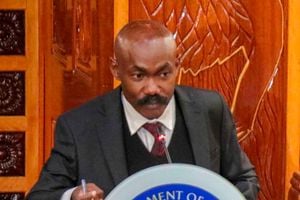
When Elisha Ongoya rose to cross-examine a key witness during the impeachment hearings of former Deputy President Rigathi Gachagua, few outside the legal fraternity knew his name.
Fewer still could have predicted that his clipped questions, calm intensity and forensic patience would turn him into a viral sensation, especially among Gen Z audiences on TikTok.
Months later, the advocate who insists he values privacy above all else has been conferred the rank of Senior Counsel- the legal profession’s highest honour. In this conversation with Nation’s NDUBI MOTURI , Mr Ongoya reflects on recognition, ethics, power, public life and what he hopes will endure long after the cameras move on.
Congratulations on your appointment as Senior Counsel. What does the recognition mean to you?
I am deeply grateful. This is recognition by one’s senior peers, and recognition is something all human beings aspire to. It is at the heart of pride, anger and shame — those emotions that arise from how we think others see us. To receive positive recognition for the investment I have made in this profession is humbling. It affirms that our daily labour is not in vain. More importantly, it inspires me to work harder and to live up to the confidence that has been placed in me.
Law seems like a deliberate choice for you. Was it always your plan?
Law was an intentional choice, but not an early one. Like many students in the 8-4-4 system, I initially aspired to be a medical doctor, largely under parental influence. As I matured, and as teachers exposed me to both sciences and the humanities, I considered accountancy and other paths. By the time I filled out my university application, law was my clear first choice. Given my academic performance, I was confident I would be selected — and I was.
Lawyer Ongoya grills MP Mutuse over claim that DP Gachagua bullied Kemsa to get tender
Your cross-examination during the Gachagua impeachment went viral. How have you processed that attention?
I am naturally a very private person. I enjoy my privacy. And I guess, courtesy of the publicity that the number of cases I've handled in the recent past has attracted, I have lost a part of that privacy. Loss of privacy is just like any other loss, like loss of a parent or loss of a valuable (laughs). And I guess once you lose, you get to live with your loss. If you got pickpocketed in town, tracking the person who has pickpocketed you will not get you anywhere. Over time, you learn to live without your valuables. Even if you lost a loved one, over time, you learn to live with it. Similarly, I am coming to terms with the fact that I may never regain my privacy in the foreseeable future. So as a result, I have accepted it as my present-day reality. I try as much as I can to trace some of those young people and host them for lunch. And I get to understand what inspires them. And guess what? That young people use my imagery, use my tone, use my work performance in their creative arts. And as a consequence, they make a living. It's something that really is making me very proud. I think it's a contribution I am making to society. I would have been happier if I retained the privacy I enjoyed all along. That's a loss I have suffered. And I am comfortable now. I am coming to terms with it increasingly. I know my daughter keeps wondering why I can't put on masks as I walk with her through town. Because she can't imagine how many stares we receive, how people shout at us, how people call me out. But it's a reality that the people around me are now coming to terms with. And we have to accept it as our new reality. It's something we can't beat, so we have to join it and accept it as our newfound reality.
Mwengi Mutuse: I have not tabled evidence against company owned by DP Gachagua
The phrase “Are you with us?” became iconic online. What was going through your mind at that moment?
Now unfortunately, all of you can't believe what I am about to say, but truth is truth, and it is self-defending and self-standing. So, I will dare any one of you to go and take the one hour and 10 minutes that I took Mwengi Mutuse through cross-examination because they are available on your channels and ask at what point the question “Are you with us” arose and the answer “Yes, I am with us” arose. You will discover it never arose. It was a creation of social media, but I have had to live with it. Every time I walk through supermarkets, somebody shouts from a corner are you with us and I have to live with it. I have to live with it. I know in serious boardrooms, in serious blue-chip companies, when people want to break the ice, they ask are you with us and people laugh. So, I'm happy to the extent that I have started to heal emotionally, but that question never arose, and that answer never arose, at least not in the trial of the impeachment of the second deputy president of the Republic of Kenya
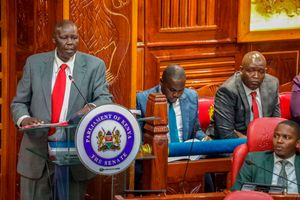
Kibwezi West MP Mwengi Mutuse testifies during the impeachment trial of Deputy President Rigathi Gachagua at the Senate on October 17, 2024.
Photo credit: Dennis Onsongo | Nation Media Group
How have these high-profile cases shaped your career?
Generally, those who raised me in this profession taught me that in this profession, the only thing we sell is reputation and trust. And the way you build reputation and trust is through your own behaviour and the manner in which you interact and treat others. I therefore, within the parameters of human fallibilities, endeavour to be an extremely ethical person. I run my life generally as ethically as is humanly possible. I've said within the parameters of human fallibilities, I'm only human and I have my own weaknesses. But I try to run a very ethical life. Largely, those who interact with me know that I'm a person of my word. I promise only that I can deliver and try as much as I can to deliver. I try to make my word my bond. I try not to tell lies. I actually detest liars. I can stand many wrongdoers but those who I can't trust their words, are people I don't take very seriously. So that, I guess, is the origin of the much public confidence that I have enjoyed and that has enabled my career to grow to the extent that it has grown. It is still a work in progress. I still hope it can go slightly, slightly higher. And I guess the number of clients who have come and continue to come to me to seek my counsel when they are confronted with high stakes cases may be evidence that I continue to enjoy that public confidence. I look forward to continue inspiring them. I hope I will not stumble and fall.
Advocate Elisha Ongoya during an interview at Thika Greens Phase 3 in Muranga County on December 9, 2025.
Photo credit: Bonface Bogita | Nation
Have you ever come close to compromising your ethics in a difficult case?
Trust me, actually, it is not possible for anyone to shape my ethical role. I have something I call enlightened self-interest. Enlightened self-interest enables me to have a very long-term view of life. People who engage in unethical behaviour are inspired by a short-term view of life. What benefits they can derive now. Fortunately for me, this far, I am yet to get a moment where the short-term benefit outweighs the ethical concern. So, for the last two decades that I have been at the bar, I have not had one case where someone has succeeded or gotten the confidence to attempt to push the envelope slightly further in getting me to compromise ethics. Take this to the bank. I have never compromised a judge. I have never compromised a magistrate. I have never even bribed a policeman on the road. No. If a policeman arrests me and I'm speeding, they take me to court. It has happened multiple times. I know, as another Kenyan knows, the easier route is to give the policeman something and get off the hook. I don't do that. It is because I have a long-term view of life. And so far, that perspective has served me well. So, I can't possibly contemplate a single case or a single client who has shaken my ethical foundations and perhaps pushed me closer to compromising on ethical standards. It's not something I'm looking at myself or foreseeing myself doing in the foreseeable future.
Advocate Elisha Ongoya during an interview at Thika Greens Phase 3 in Muranga County on December 9, 2025.
Photo credit: Bonface Bogita | Nation
Corruption in the judiciary remains a major concern. What is the real solution?
You know, there is a paper I have written with a colleague of mine. It never got to be published, but it exists. The paper is entitled, A Transformative Constitution in a Bad-Mannered Society
Advocate Elisha Ongoya during an interview at Thika Greens Phase 3 in Muranga County on December 9, 2025.
Photo credit: Bonface Bogita | Nation
As a law lecturer, are you concerned by the growing number of lawyers?
Your question raises two distinct though related concerns. The first concern is the concern of numbers. The second concern is the concern of quality. Numbers in and of themselves do not bother me. Numbers bother me only to the extent that they compromise quality. Because at the end of the day, lawyers render services that affect people's lives people's liberties and people's properties. Every day, people's lives are in the hands of lawyers. Every day, people's liberties are in the hands of lawyers. Every day, people's property is in the hands of lawyers. And therefore, it is only fair that when we generate a new cadre of lawyers, we are generating men and women who are competent and who are ethical and who deserve to be put in charge of those four attributes of human life. So to the extent that numbers compromise quality, that certainly bothers me. And that will bother me even if the numbers were less. Because quality is something we shall never compromise. But so long as quality is guaranteed, is high, higher numbers don't bother me even if all Kenyans became lawyers. Because it just means that they are more conscious of rights and attendant obligations, which is a positive contribution to society.
So how do you insulate your loved ones from the intense scrutiny that comes with high-stakes political litigation?
Let me just say, I insulate them so much. None of you knows any of them. And that's just how much I insulate them. I am extremely intentional in my philosophy that my public space burdens are singularly mine. My public space pressures are singularly mine. They are not pressures I will carry on the back of my spouse, on the back of my parents, on the back of my children. And therefore, I have very intentionally kept my family away from the spaces where my public interactions are felt. The only people who get to miss them are the one-on-one people who meet them in supermarkets, in the other public spaces, where we inevitably have to visit in restaurants, in other eating spaces, who then have no doubt they will take a bit of the time that my family thought they would have with me through the greetings, through the calling out. And I think that's something we can live with. But in terms of all other public spaces, I have been extremely intentional in protecting my family from public scrutiny. And so far, I think I have been successful. I look forward to continue being successful.
What advice do you give young lawyers?
I would encourage them to have a long-term view of life, to look at life with a futuristic lens, to ask themselves, if God were to give me full life, what would this profession and this art say of me, 30 years down the line, 50 years down the line? Among the men who are recommended for conferment of the rank of senior counsel in the recent nominations is a person who was called to the bar in 1961. That is approximately 64 years ago. Society has recognized him, that 64 years down the line, he has been doing a good job. I would want the incoming lawyers, the young lawyers, to have that long-term view of life, to ask themselves, what will the world say of me 50 years later? The people who have lived life of honour in this profession have been celebrated. I remember like senior counsel Pheroze Nowrojee. The city council of Nairobi is now discussing naming some street or some streets after him. I mean, that kind of recognition is something you can't buy with money. It's recognition that endures. People like the late C.M.G. Argwings-Kodhek after whom Argwings road is named, are people whose name endure, because they live moral, ethical lives. So that once young people have that long-term view of life, chances are, when it demands, they will do the right thing. When they do the right thing, they build their reputations, and in the process, society benefits. That is my take for the young lawyers.
Advocate Elisha Ongoya during an interview at Thika Greens Phase 3 in Muranga County on December 9, 2025.
Photo credit: Bonface Bogita | Nation
You’ve been labelled an “impeachment maestro.” How has that affected your practice?
I am not a politician and have no political ambitions. I serve clients across the political divide, guided by law and principle. During the Gachagua impeachment, I was assigned the role of cross-examining the motion mover. And therefore, I would guess that part of the fortune for me was just being in that space at that time and nothing more. And let me say this, actually. I did nothing more than what I do every day, whether I'm doing a simple traffic case in Kibera Law Courts or I'm acting for a deputy president at the Senate. I do it that way. I do it in that manner. I do it with that kind of passion. Because for me, this is a professional calling that I must do as if my life depends on it. Why must I do it as if my life depends on it? Because at stake are people's lives, are people's limbs, are people's liberties, are people's property. So, once I am conscious of that fact, I can't hold back anything in terms of the discharge of my duty. Certainly, a lot more Kenyans got to know me than they knew me before. And certainly, a lot more Kenyans therefore sought my counsel and seek my counsel than they sought prior to that. From a business perspective, that is something I don't take for granted. That is something positive. So that is the extent to which this has impacted my career. But I don't do it any less or any more. I do it the same way.
Have MCAs abused impeachment powers under Article 181?
It is common knowledge that MCAS really abused impeachment power. Anyone who knows how counties work properly knows that a lot of MCAS in this country will invariably go to governors with political or economic demands that they want to be given some money or they want to be given some favours. Then if that is not given, they will fish through the happenings in the county and ask, throughout these happenings, can we find some fault? Coach it as a legal argument and take this governor out through an impeachment. So that happens and there has been abuse of power. It's not unique to MCAS. Power is a very easy thing to abuse for anyone who wants to abuse it. In fact, the old wisdom was that power corrupts and absolute power corrupts absolutely. So, there's a tendency to abuse impeachment power just as other power can be abused. I hope that moving forward, actors in our governance space will know the weight of responsibility that they carry and thereby use the respective powers they have, including the impeachment power, more responsibly than we are currently using it.
Advocate Elisha Ongoya during an interview at Thika Greens Phase 3 in Muranga County on December 9, 2025.
Photo credit: Bonface Bogita | Nation
The BBI judgment was pivotal. What was your key argument?
I joined the case at the Court of Appeal. One major issue was the attempt to create 70 constituencies outside the constitutional framework. The process ignored public participation and bypassed Article 89, which clearly assigns that mandate to the IEBC with judicial oversight. Courts consistently agreed that this was a fatal flaw. The judgment reinforced constitutionalism and placed meaningful limits on executive power.
How do you want to be remembered?
Life teaches us basic lessons in a fundamental way. At the end of it all, power fades, beauty fades, fame fades, and all these attributes we pick in the public spaces fade. At the end of it all we just return back to our family, beaten by the rigours of the world out there and we just want a shoulder to lean on. We return back to village mates and ask our pastors to pray for us and ask our bible study groups to join us in consoling us where we have been beaten.
Finally, what is your message to Gen Z Kenyans engaged in governance?
Let me say this very passionately. Every generation has a generational challenge that it has to confront. Every generation. There was a generation that dealt with slavery; you and I were born post-slavery, Gen Zs were born post-slavery; they never dealt with that challenge. There was a generation that dealt with colonialism as a challenge. You and I were born post-colonially; we never had a chance to die the way the Kenyattas had to do. We never had to spend time in prison the way Jomo Kenyatta had to, the way Nelson Mandela had to. There is a generation that has had to deal with the one-party dictatorships in Africa, now virtually all countries in Africa are multi-party democracies. So, every generation must define its generational challenge and fashion appropriate reliefs to that generational challenge. Today's generation has a very clear challenge to my mind. The young people who are unemployed, for example, is a huge generational challenge. Our young people must now craft a question that they have a right to be meaningfully engaged by society and put society to task to come up with economic, social and other programs that make it possible, that open up opportunities for young people to be meaningfully engaged. And they must fight for that right because history teaches us that political actors don't carve in easily. Political actors respond to only one aspect, a threat to their political power and therefore, Gen Zs must remain a threat within lawful means to the political power of political actors. Only then will political actors use their political power responsibly and open up opportunities for young people, including the Gen Zs and the alphas and we shall in future say that this generation defined this generational challenge and lived true to the demands of that challenge.