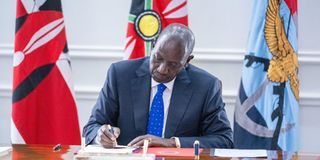
The government can now use 90 percent of the Railway Development Levy Funds to secure additional financing for railway infrastructure projects after President William Ruto assented to the Miscellaneous Fees and Levies (Amendment) Bill.
The Bill is among three pieces of legislation that President Ruto signed into law at State House on Friday morning (March 13), with others including the Coffee Bill, 2023 and the Meteorology Bill, 2023
The signing of the Miscellaneous Fees and Levies (Amendment) Bill into an Act means that the funds can be used to attract further investment and financing to support railway development and infrastructure in the country.
The Act amends section 8 of the Miscellaneous Fees and Levies Act Cap. 469C in order to expand the scope of the Railway Development Levy in order to cover a broader range of railway transport infrastructure beyond the construction and operation of the Standard Gauge Railway (SGR).
Through the new Act, the government’s policy objective is to mobilise sustainable financing for strategic railway transport infrastructure and strengthen the institutional framework for the management and utilisation of the Railway Development Levy.
The new Act now establishes the Railway Development Levy Fund into which all monies collected and received from the Railway Development Levy shall be paid.
“The purpose of establishing this Fund is to ensure that the money collected from the levy is properly managed and used specifically for the development of railway infrastructure,” reads the Act.
A cargo train arrives at the Mombasa SGR Miritini Station on October 24, 2025. Though economically significant, the SGR path through wildlife corridors has been criticised for disrupting natural processes and increasing human-elephant conflict, a clear example of how traditional infrastructure spending can inadvertently harm the natural capital we aim to protect.
Photo credit: Wachira Mwangi I Nation Media Group
President Ruto has promised to extend SGR from Naivasha to Malaba border, through Kisumu.
According to the Act, proceeds from the levy shall also be used to support the safety and economic regulation of railway infrastructure, as well as the rehabilitation of existing railway infrastructure.
The fund shall be managed and administered by the Railway Development Fund Board which will be created by the new Act.
To bring a raft of reforms in the coffee sector, President Ruto also assented to Coffee Bill, 2023 into law, a move that will see re-organisation of the management of the coffee industry in the country.
Co-sponsored by National Assembly Majority Leader Kimani Ichung’wah and Kirinyaga Senator James Murango, the Bill proposes to reorganise the coffee industry by transitioning the regulatory and commercial roles currently undertaken by the Agriculture and Food Authority (AFA) to the Coffee Board of Kenya.
It seeks to transition the research on coffee currently undertaken by the Coffee Research Institute under the Kenya Agricultural and Livestock Research Organisation to the Coffee Research and Training Institute.
The Coffee Board will be mandated to regulate and promote development of the coffee industry through processing permits and licenses’ applications, registering coffee dealers and overseeing the implementation of strategies, policies and funding models.
A picture showing Kenyan coffee.
The board will be mandated to collect and maintain industry data, conduct market intelligence and surveys, and promote Kenyan coffee in local and international markets.
In undertaking its duties, the board will develop industry standards and codes of practice in collaboration with the Kenya Bureau of Standards.
The new law will also see the creation of the Coffee Research and Training Institute that will undertake coffee research, a role currently being done by the Coffee Research Institute.
According to the new Act, the newly created institute will also coordinate research on coffee diseases and the development of new crop varieties.
It will also be tasked with the facilitation and adoption of improved technologies within the coffee sector.
Another key milestone for the country is the signing of the Meteorology Bill, 2023, which will now see the establishment of Kenya Meteorological Service Authority, which shall be the principal technical advisor to the National and county governments.
The Act will ensure that Kenya fulfils its obligations as enshrined in various treaties and conventions, and in particular, the Convention of World Meteorological Organization, consequently improving the standards and service delivery in the meteorology field.
The new authority will be responsible for establishing and maintaining meteorological management systems for data processing, analysis, forecasting and archival.
A woman jumps over a flooded a section of a road in Nairobi's CBD following heavy rains on February 22, 2026.
Photo credit: Dennis Onsongo | Nation Media Group
It will also be responsible for preparing and disseminating weather forecasts, as well as issuing advisories and warnings for disaster risk reduction through a multi-hazard early warning system.
Under the new Act, there will also be the Meteorology Training and Research Directorate as the successor of the Institute for Meteorological Training and Research Directorate.