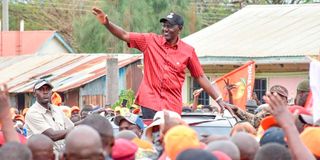
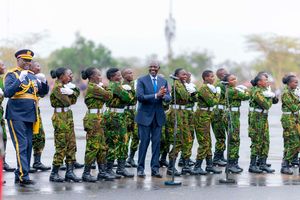
President William Ruto is increasingly turning construction sites into political battlegrounds, criss-crossing the country to launch, inspect and commission projects.
He has placed a multibillion-shilling development bet on his 2027 re-election, counting on a growing list of roads, railway lines, housing units, markets, water projects and public facilities to speak louder than the attacks directed at his administration.
The strategy was on display during his five-day tour of Nyanza that concluded on Thursday, where he was in Kisumu, Siaya, Migori and Homa Bay inspecting roads, commissioning public facilities, visiting markets and unveiling or reviewing projects in water, health and education.
The itinerary took him from the Mamboleo-Miwani-Muhoroni-Kipsitet road and Lake Victoria water projects in Kisumu to roads, bridges, markets and water schemes in Siaya, Migori and Homa Bay.
President William Ruto flags off the electrification project targeting 4,248 households in Kuria West and Uriri constituencies on September 16, 2026.
Photo credit: Alex Odhiambo | Nation Media Group
But the tour was more than a showcase of projects, offering a glimpse into the development strategy the President is taking into the final stretch before the 2027 General Election.
Rather than relying on mega-projects, he is presenting a web of investments intended to touch daily economic activities – better roads for farmers and traders, markets for small businesses, water infrastructure, affordable homes, electricity, hospitals and technical training institutes at the grassroots.
Across the country, the administration is pointing to the Rironi-Mau Summit road, the extension of the standard gauge railway (SGR), housing and modern markets as evidence of an investment-led agenda.
Observers, however, say the bet carries an equally important question: whether the projects will translate into improved household incomes before the elections.
“That is the biggest challenge we have as a nation – the cost of living, pesa mfukoni (money in the pocket),” he said in a recent interview with the Daily Nation.
For the President, infrastructure must create jobs, lower the cost of doing business and open markets.
The Nyanza tour covered projects, including the Kisumu airport control tower and police headquarters; Dhogoye bridge, roads, Siaya Hospital, a stadium and water projects in Siaya; roads and an electricity sub-station in Migori; and markets, Sindo KMTC and roads in Homa Bay.
Siaya has been allocated Sh1 billion for blue-economy infrastructure, including Sh600 million for Usenge pier and Sh400 million for a fish market, alongside 16 markets costing Sh2.5 billion and Sh1.6 billion for last-mile electricity connections.
Projects in Kisumu include Lake Victoria water and sanitation, airport infrastructure, Kibos rice mill, the 2,384-housing unit in Lumumba estate, maritime rescue facilities and roads.
Homa Bay’s portfolio includes the 53-kilometre Mfangano Ring road, Mbita-Sindo-Sori road, maritime infrastructure, Sindo KMTC, markets, water, sanitation and housing.
“The political significance of such projects lies partly in their visibility. Unlike policy announcements whose effects may take years to measure, a road under construction, a market being occupied or a bridge being completed provides a physical marker residents can see,” says Mr Chris Omore, an advocate.
The most conspicuous national projects are the Rironi-Mau Summit road and the Naivasha-Kisumu-Malaba SGR extension.
The first phase of the Sh200 billion Rironi-Mau Summit project covers the Nairobi-Gilgil section and is being implemented through a Public-Private Partnership (PPP).
“It is a milestone in transforming Kenya’s transport infrastructure. This project will help ease congestion, improve safety, cut travel time and unlock economic opportunities across the country,” Kenya National Highways Authority Director in charge of PPP Charles Obuon says.
The Sh700 billion SGR extension is an even larger bet on the Western corridor. The railway will run from Naivasha, Narok, Bomet, Kericho and Kisumu towards Siaya, Kakamega and Busia before reaching Malaba.
President William Ruto during his development tour of Kendu Bay, Homa Bay County, on September 17, 2026.
Photo credit: Alex Odhiambo | Nation Media Group
“The SGR extension will position Kenya as the regional trade and logistics hub, linking Uganda, Rwanda, Burundi, South Sudan and the Democratic Republic of Congo to the port of Mombasa while unlocking the economic potential of Western Kenya,” he said.
The government has placed roads at the heart of its development narrative, with the President promising to accelerate the tarmacking of 6,000 kilometres already contracted.
Among the corridors are Rironi-Mau Summit; Mau Summit-Kericho-Kisumu; Kisumu-Busia; Kericho-Kisii-Migori-Isebania; and Kisii-Oyugis-Ahero.
In his Madaraka Day address, the President said 1,800 kilometres of new tarmac roads had been built over two and a half years, alongside maintenance of more than 134,800 kilometres.
Affordable housing is another of the administration’s signature programmes. President Ruto says the government is building 300,000 housing units, 180,000 student hostels and 500 markets at a cost of Sh93 billion.
In August last year, he said 161,000 housing units were under construction as part of a 700,000-home pipeline, adding that the programme had become a source of employment.
In February, he commissioned 500 units at Roysambu military camp and said more than 13,000 units were planned for the Kenya Defence Forces.
He has framed housing as shelter and a job-creation programme, saying nearly 300,000 units were at different stages, alongside hundreds of markets and student hostels.
The development portfolio spans all the counties. In the Coast, Mombasa has the Dongo Kundu Special Economic Zone, Mzizima and Buxton Point affordable housing projects, port and blue-economy infrastructure, Kenya Navy facilities and a dam.
Kwale has Mwache dam, Shimoni fish port, the Wasini-Mkwiro electricity mini-grid and irrigation, while Kilifi has Mtwapa-Kilifi road and Mtwapa market.
Tana River and Lamu are linked to roads, bridges, irrigation and Lapsset investments. Taita-Taveta has the Voi-Taveta railway, Voi dry port, electricity and roads as well as a Sh11 billion iron-ore pelletisation and steel plant.
In northern Kenya, Garissa, Wajir, Mandera and Marsabit are linked to the Isiolo-Mandera and Horn of Africa corridors, livestock infrastructure, solar power and irrigation.
Isiolo has an export abattoir, county hospital, aggregation and industrial park and housing.
In Mt Kenya, Tharaka-Nithi is associated with the planned High Grand Falls dam, while Embu has irrigation, housing, markets, roads and electricity programmes.
Kitui is linked to the High Grand Falls, last-mile electricity targeting 16,500 households and irrigation. Machakos and Makueni feature housing, markets, roads, water, electricity and agricultural value-chain investments.
Nyandarua, Nyeri, Kirinyaga and Murang’a have county headquarters, hospitals, housing, markets, roads, water, irrigation and agricultural programmes, while Kiambu has the Karimenu II dam water supply project and housing and urban infrastructure in Thika.
Turkana has electricity and grid expansion, solar, water, irrigation and livestock programmes. West Pokot, Samburu, Elgeyo Marakwet and Baringo have roads, schools, health, electricity, security and agricultural projects, while Laikipia has an electricity connectivity programme targeting more than 9,000 households.
Trans Nzoia and Uasin Gishu are linked to the SGR corridor, agriculture, housing, markets and digital-economy programmes.
Nandi has Emgwen affordable housing while Nakuru is central to the Naivasha Special Economic Zone, the SGR and Rironi-Mau Summit corridor.
Narok is tied to the SGR, agriculture, irrigation, housing and markets. Kajiado has investments in housing, roads, water, electricity and livestock value chains.
Kericho and Bomet sit along SGR and road corridors, with Kericho also featuring tea sector reforms and Bomet hosting road, housing, electrification, sewerage and urban infrastructure projects.
Western Kenya has become a major component of the development pitch. Kakamega has an announced Sh14 billion housing project, Sh2.5 billion for modern markets, Sh2 billion for student hostels, a Sh1.5 billion gold refinery, airstrip improvements, Bukhungu stadium, the county referral hospital and sugar sector investments.
Vihiga has college hostels and roads, housing and electricity projects. Bungoma is tied to the SGR corridor and investments in agriculture, housing, markets and electricity, while Busia is linked to the railway, Lake Victoria maritime infrastructure, the Kisumu-Busia road and agricultural value addition.
Kisii has road, water, health and industrial projects, including a Sh3 billion cancer treatment centre and Nyaribari Masaba affordable housing.
In Nairobi, the portfolio includes Talanta Sports City, Bomas International Convention Centre, affordable housing, markets, digital infrastructure and the JKIA terminal.
Talanta Stadium in Nairobi that will serve as a primary venue for the 2027 Africa Cup of Nations.
Photo credit: Billy Ogada | Nation Media Group
“The projects amount to a nationwide development narrative built around three themes – transport connectivity, physical infrastructure and economic opportunity,” says Mr Dismas Mokua, a political analyst.
The President says maize production has risen from about 40 million bags to between 73 million and 74 million, while farmers have higher incomes.
The President is asking Kenyans to judge his administration by what it has delivered while launching projects whose impact could extend well beyond the current electoral cycle.
“The test before 2027 will not simply be how many projects have been launched, commissioned or inspected. It will also be whether those investments are completed, become functional and are felt in the daily lives of households,” says Multimedia University of Kenya don Gitile Naituli.
The President has cited housing, digital work, overseas employment and agricultural reforms as examples of expanded economic opportunities, saying 1.1 million people have benefited from government programmes, including 400,000 in digital jobs and 660,000 working abroad.
Critics, however, say construction statistics do not automatically translate into improved welfare.
For Safina Party leader Jimi Wanjigi, Kenya’s problem is not just the speed of borrowing but the legitimacy and utilisation of the debt. He has called for an audit of public debt.