President William Ruto and Deputy Prof Kithure Kindiki emerged from Thursday’s by-elections with renewed political momentum, tightening their grip on the ruling coalition and redefining the stakes of the 2027 contest.
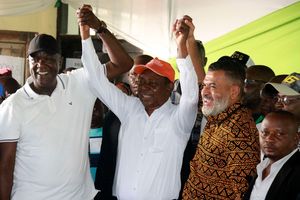
The UDA-ODM victories in all constituencies under their broad-based framework were secured against an aggressive push by the united opposition, marking an early consolidation of the Ruto-Kindiki-ODM political axis post-Raila Odinga.
For the President, the results offer a powerful narrative of grassroots endorsement, while for Prof Kindiki, an enhanced stature within the ruling coalition.
The united opposition, meanwhile, is scrambling to reinterpret the losses, arguing the contests were tilted by state machinery. But on the ground, the results have already begun to reset the 2027 battlefield, with Dr Ruto and Prof Kindiki firmly in the driver’s seat.
The broad-based coalition clinched all parliamentary seats – Mbeere North, Kasipul, Malava, Ugunja, Banissa, and Magarini – and the Baringo Senate race.
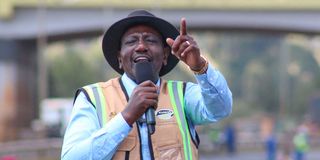
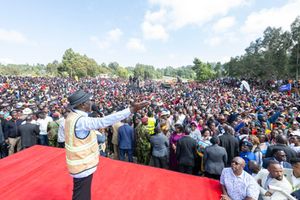
“This shows Kenyans believe in my idea of unity and the prosperity of this nation. I will continue uniting all Kenyans as this is the surest way to progress,” President Ruto said at Rironi, Kiambu County, during the launch of the Rironi–Mau Summit Highway and the Rironi–Maai Mahiu–Naivasha road expansion.
President William Ruto address residents of Rironi in Kiambu County, during the launch of the Rironi–Mau Summit Highway and the Rironi–Maai Mahiu–Naivasha road expansion.
Photo credit: PCSU
He dismissed the united opposition, steered by his former deputy Rigathi Gachagua , for what he called “agenda-less politics,” warning that Kenyans would punish leaders who rely on ethnic mobilisation and anti-government rhetoric.
Within the United Democratic Alliance (UDA), the results triggered jubilation and a fresh assertion that the government retains grassroots legitimacy despite mounting political noise.
UDA Secretary-General Hassan Omar said the broad-based coalition had won 18 out of 24 by-election contests held across the country, describing it as “a clear sign of national acceptance” of the government’s agenda.
“We are grateful for those who voted for us and those who did not. This is a clear sign that the country accepts the broad-based government.”
Senate Majority Leader Aaron Cheruiyot said the results defied global trends where mid-term polls hurt incumbent administrations.
“That the broad-based coalition won all parliamentary seats tells you it will be a clean sweep in 2027,” he said.
Dr Mukhisa Kituyi, spokesperson and head of the united opposition secretariat, accused the State of orchestrating “a coordinated deployment of resources, security personnel and political intimidation” to tilt the contests.
“We are witnessing a state ready to use excessive resources to sabotage the democratic will,” Dr Kituyi said.
“If the public believes that this financial and material doping is anything to go by, then trust in the due process will be very diminished.”
He faulted the IEBC for failing to curb violence, disruption, and interference by uniformed and plainclothes security personnel.
“The inability of the commission to control the violence demonstrates their incapacity to run a competent election process,” he argued.
Advocate Edward Muriu said the Malava and Mbeere North by-elections must be “nullified immediately.”
He warned that letting such results stand would “entrench impunity and push the country toward a failed state.”
Mbeere North UDA candidate Leo Muthende casts his vote at Siakago Social Hall in the Mbeere North by-election on November 27, 2025.
Photo credit: Joseph Kanyi | Nation Media Group
The Mbeere North contest, decided by only 494 votes, became the epicentre of a political earthquake in Mt Kenya.
UDA’s Leonard Muthende, backed by DP Kindiki, beat Newton Kariuki of the Democratic Party, Gachagua’s candidate, 15,802 against 15,308.
Both men camped in the constituency for days, each determined to prove they command supremacy in Mt Kenya.
Mr Gachagua told voters to “punish President Ruto” for impeaching him, but Prof Kindiki countered fiercely.
“For many days, this bully called Rigathi has harassed our leaders. By Thursday, we will teach him a political lesson of his lifetime,” he said.
“For the avoidance of doubt, I am the senior-most political leader in this region.”
For 10 days, Prof Kindiki traversed the constituency—holding up to six rallies a day—and focused on water access, roads, electricity connectivity, and agricultural support. He told residents Mr Gachagua never visited or lobbied for projects when he was Deputy President.
Deputy President Kithure Kindiki flanked by Mbeere North UDA candidate Leonard Wamuthende during a campaign rally in Mbeere North Constituency.
Photo credit: DPCS
The victory cements Prof Kindiki’s place in Mt Kenya politics and strengthens his positioning as President Ruto’s key regional anchor and possibly preferred running mate in 2027.
Despite losing, Mr Gachagua’s ability to mobilise and secure competitive results shows he retains pockets of influence. His allies insist he remains a potent force.
Embakasi Central MP Benjamin Gathiru, a Gachagua ally, said the government had deployed overwhelming force in Mbeere North.
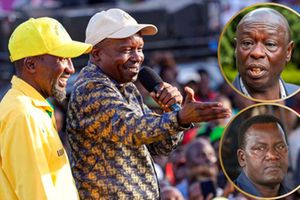
“The entire government was in Mbeere North. In 2027, they won’t have resources to fight like this. The snake they are feeding now will bite them,” he warned.
The by-elections may have produced winners and losers, but analysts say their deeper significance lies in how they have illuminated the emerging architecture of Kenya’s 2027 politics.
According to political analyst and advocate Joshua Nyamori, the results point to the consolidation of a new political centre of gravity, one shaped by President Ruto’s disciplined, countrywide mobilisation following the passing of opposition doyen Raila Odinga.
Mr Nyamori argues that the broad-based arrangement has shifted from political theory to lived electoral reality, with the victories reflecting a maturing acceptance of the President’s message of inclusivity, stability, and economic renewal.
“In many ways, 2027 has already begun, and the terrain is tilting unmistakably toward the Broad-Based coalition,” he said.
The electorate, he added, appears to be moving away from personality cults toward issues, systems, and national cohesion.
But Prof Macharia Munene of the United States International University (USIU) offers a cautionary note, saying the contests also exposed internal vulnerabilities.
“This makes it more difficult for Ruto to ditch Kindiki in 2027,” he said. “Given the thin victory margins and campaign dynamics, Kindiki barely survived. There was more at stake for him than for Gachagua – and he survived. Neither side should relax, for political fortunes can swing either way.”
Both analysts agree the broad-based coalition should neither gloat nor whine. Mr Nyamori says this is not a moment for triumphalism but for “quiet consolidation.” He insists the President’s camp must treat the results as a confirmation of direction, not a guarantee of destination.
The by-elections were also a test of political realignments in Western Kenya and Mt Kenya, two regions that could shape the 2027 presidential outcome.
Prime Cabinet Secretary Musalia Mudavadi, eager to retain relevance and prove loyalty to Dr Ruto, invested heavily in Malava, once an ANC stronghold. A win here was crucial for him to demonstrate he still commands the region.
“Mudavadi has no elected political portfolio and must prove he can deliver Western,” says Prof David Monda. “Malava was as much about his future as it was about the election.”
In Mt Kenya, the Kindiki-Gachagua duel has now reshaped the succession debate.
In 2022, Mt Kenya delivered 2.9 million votes for Ruto; the Rift Valley added 1.6 million.
If Mt Kenya fractures and Western becomes the fallback, Dr Ruto must hold both regions carefully.
“Should Mt Kenya drift and Western fail to consolidate, 2027 becomes an uphill climb,” warns political analyst Javas Bigambo.
And in a double blow to his critics, Moses Wetang’ula’s Ford-Kenya candidate also stumbled in Kabuchai, while Trans-Nzoia Governor George Natembeya’s Tawe Movement failed to bear results in Malava.