Court battle over ANC resurrection freezes late MP's replacement for a year

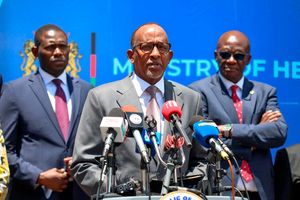
Prime Cabinet Secretary and Cabinet Secretary for Foreign and Diaspora Affairs, Wycliffe Musalia Mudavadi, delivers his remarks during the second day of the Trust Summit 2026 at Glee Hotel in Nairobi on Thursday, October 22, 2026.

A high-stakes legal feud over the resurrection of Prime Cabinet Secretary Musalia Mudavadi’s former party, Amani National Congress (ANC), has frozen the replacement of its late-nominated MP Joseph Dena, leaving the National Assembly seat empty nearly a year after his tragic death.
Dena died on December 6, 2025, just months after his party had folded to join President William Ruto’s UDA, following a road accident in Nairobi.
Although the Office of the Registrar of Political Parties (ORPP) formalised the dissolution in March 2025, the High Court subsequently reversed the dissolution in a January 22, 2025 ruling declaring it unconstitutional, as it ordered the parties’ registrar to fully reinstate the ANC to the register of political parties.


The filling of the vacancy was complicated when PCS Mudavadi, also the Cabinet Secretary for Foreign and Diaspora Affairs and the party’s former Secretary-General, Omboko Milemba, countered the ruling in an appeal.
This means that the National Assembly seat remains vacant as the Independent Electoral and Boundaries Commission (IEBC) cannot gazette a successor until the Court of Appeal determines whether ANC is legally dissolved or reinstated.
This is if the decision is not challenged in the Supreme Court. IEBC chairman Mr Erastus Ethekon said that until the appeal in court is settled, “the commission cannot move on this matter.”
“This matter would have been addressed by now had it not found its way in court. But we wait until all the appeal mechanisms have been exhausted,” said Mr Ethekon.
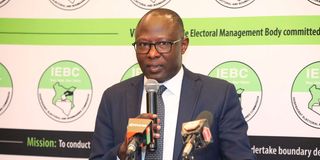
The Independent Electoral and Boundaries Commission Chairperson, Erastus Ethekon.
Despite the appeal, ANC was reinstated to the register of political parties, as demonstrated by records at the ORPP, which show that the party was allocated Sh25.4 million in political parties funding from the exchequer for the current fiscal year, 2026/27.
In the financial year 2025/26, the period immediately after the dissolution, ANC was not allocated any political parties fund; instead, what was due to the party was distributed to the other qualifying political parties as “balance from dissolved Amani National Congress Party.”
In the 2024/25 period, when the dissolution happened, ANC had been allocated Sh25.7 million in funding from the exchequer.
According to city lawyer David Ochami, the matter is uncharted waters for the IEBC, “but we hope that the court will give direction.”
“It is a grey area that our laws did not contemplate. Shall we assume that because the ANC party is in UDA, its assets, benefits and votes devolved to UDA as its successor? On what basis can such a determination be made?” asked Mr Ochami, “assuming that the dissolution is upheld.”
The filling of a nominative seat in the legislature at the national or county level is an election on its own, undertaken by the IEBC based on the party lists submitted by the parties to the commission.
Article 101 (2) of the Constitution, the election of MPs, provides for the process of filling a vacancy in the office of a nominated member in the National Assembly and the Senate whenever it arises.
The Article states that whenever such a vacancy occurs, the respective Speaker shall, within 21 days of the occurrence of the vacancy, give notice in writing of the vacancy to the IEBC and the political party on whose party list the member was nominated.
The Article goes on to state that the vacancy “shall be filled within 21 days of the notification by the respective Speaker.”
However, in the event the vacancy has occurred three months immediately before a general election, the Constitution, in Article 101 (4) (b), states that such a vacancy shall not be filled. The next general election will be held on August 10, 2027.
On March 7, 2025, former Registrar of Political Parties Ms Anne Nderitu, now a commissioner with the IEBC, formally announced the voluntary dissolution of ANC, a culmination of the process that started in 2024.
The decision was formally carried in the gazette notice of March 14, 2025.
“Amani National Congress (ANC) stands dissolved,” the gazette notice read, while making reference to the party’s decision that was taken at its Special National Delegates Congress (SNDC) on February 7, 2025.
“ANC resolved to voluntarily dissolve in line with its party constitution,” the gazette notice added.

Justice Bahati Mwamuye during a court proceeding at Milimani Law Court on December 18, 2024.
However, on January 22, 2026, High Court Judge Bahati Mwamuye nullified the gazette notice, rendering the dissolution null and void, meaning that it has no legal effect.
Justice Mwamuye went on to order the ORPP to immediately update the official parties’ register to reflect that ANC remains a distinct, lawfully registered political entity.
The court established that the Special National Delegates Congress held at the Bomas of Kenya on February 7, 2025, violated the Constitution of Kenya and the Political Parties Act.
This was based on the fact that the notice for the meeting was issued via SMS and the party website 15 hours before the event, which the judge ruled was highly unreasonable and denied party members a fair opportunity to participate.
Justice Mwamuye also issued protective orders strictly barring any transfer, disposal, or outside interference with any of ANC’s assets or records to the UDA after the folding began.
This order was backdated to February 6, 2025, the day before the flawed SNDC took place, to capture everything owned by the party prior to the attempted dissolution.
To prevent operational chaos, the court granted a 45-day window for ANC and UDA to pursue alternative legal remedies, including lodging appeals, before the asset return.
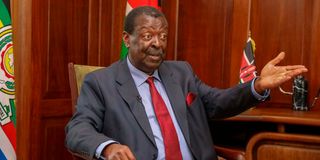
Prime Cabinet Secretary and CS for Foreign and Diaspora Affairs, Musalia Mudavadi during an interview in his office in Nairobi on May 22, 2025.
Mr Ochami notes that because former ANC leader PCS Mudavadi decided to self-immolate, he is currently at the mercy of UDA.
This, he says, goes against Article 91 of the Constitution of Kenya and the Political Parties Act, which intends to enable the establishment of strong and distinct political parties based on ideology.
“It was never envisaged that a political party would be created solely to contest an election and dissolve immediately thereafter at the whim of its party leader. The law was created to avert this political prostitution,” says Mr Ochami.
The city lawyer noted that the defunct ANC and its followers “must be ready to suffer the consequences of its past prostitution, self-immolation and voluntary slavery without expecting the law to rescue them, because that opportunity to complain does not exist.”
IEBC records show that the ANC presented a party list of 12 nominees in conformity with the zebra principle.
The fallen MP ranked first, followed by Ms Petronilla Ogoti, Mr Salim Mohammed Busaidy, and others in that order, including former Mudavadi’s private secretary and close ally, Mr Kibisu Kabatesi, at position seven.
Had the ANC party not wound up, the slot would have easily gone to Mr Busaidy because it was a seat allocated to the category of men in the party list.
Follow our WhatsApp channel for breaking news updates and more stories like this.