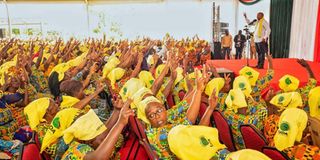
Close to 300,000 United Democratic Alliance Party (UDA) members will on Saturday battle for grassroots positions in a political quest to control the ruling party ahead of the 2027 elections.
President William Ruto’s UDA is scheduled to conduct polling centre level elections in its two bastions of Mt Kenya and Rift Valley in an exercise that promises to be the largest grassroots party election, marked by unprecedented interest.
Official party data shows that 310,651 candidates have registered to contest various grassroots positions across 20 counties, far surpassing the 237,940 party offices available. The exercise will be conducted in 12,000 polling centres countrywide.
An estimated three million UDA members are expected to turn out to vote, meaning each polling centre will, on average, serve about 250 voters, underscoring the scale and organisational depth of the ruling party.
The Mt Kenya region counties, including Meru, have emerged as the major focal point of the UDA grassroots exercise, posting the highest number of candidates and the most competitive contests.
Meru County recorded 35,343 candidates against a projected 21,000, placing it among the top counties nationally. Kiambu followed with 21,000 candidates, surpassing the projected 11,300.
Murang’a registered 20,880 candidates compared to an expected 11,900, while Nyandarua has recorded 18,665 candidates against a projected 8,100. Nyeri recorded 16,448 candidates, exceeding a projected 11,500. On its part, Kirinyaga has registered 14,000 aspirants against a projected 6,400, while Embu recorded 15,881 candidates compared to a projected 3,800.
UDA officials say these figures reflect deep-rooted party structures and intense grassroots mobilisation in the Mt Kenya bloc.
Nakuru County has also emerged as a major point of interest for the ruling party's grassroots aspirants, registering 27,863 candidates against a projected 20,800, reinforcing its status as a strategic county within UDA’s Rift Valley base.
Laikipia County registered 2,958 candidates across 348 polling centres, with contests in 111 centres.
In Western Kenya, Kakamega County attracted 32,677 candidates against a projected 19,500, one of the highest tallies in the country. Vihiga registered 7,327 candidates, slightly above the projected 7,220.
Trans Nzoia recorded 7,825 candidates against a projected 7,360, across 368 polling centres, with 289 contests.
Across the rest of the country, Bomet County registered 25,350 candidates against a projected 12,750.
Nandi recorded 15,220 candidates against an expected 13,640, spread across 682 polling centres, with 478 centres contested.
Uasin Gishu County posted 13,570 registered candidates against a projected 9,680, across 484 polling centres, with 477 centres seeing contests.
Kericho County registered 5,967 candidates across 599 polling centres, with 266 centres contested. Baringo County recorded 11,842 candidates across 975 polling centres, with 473 centres contested.
Samburu County posted 4,386 candidates across 309 polling centres, with 229 centres contested.
Elgeyo/Marakwet County registered 7,236 candidates across 492 polling centres, with 377 centres registering more than one candidate for various positions.
Overall, 223,425 candidates will face contests, while 80,038 are unopposed, reflecting both intense competition and strategic consolidation within the party.
With more than 310,000 candidates seeking UDA party office, millions of members voting, and thousands of polling centres operational, Saturday’s elections are expected to set a new benchmark for internal party democracy, firmly positioning the ruling party as the most grassroots-driven political entity in the country.
“There is a lot of interest in the party. We anticipate a fierce competition for party positions in both Mt Kenya and Rift Valley,"said UDA National Elections Board Chairman Anthony Mwaura.
At the polling centre level, the ruling party seeks to elect a total of 20 officials.
A document by the party titled ‘Grassroot Election Guide’ shows that at the polling centre level, party members will elect three representatives of religious groups, four representatives of traders, three representatives of professionals, four representatives of youth, a representative for Special Interest Groups, three individuals to represent farmers, as well as two party members – a woman and a man.
In a recent interview with Daily Nation , Mr Mwaura said they have no intention of blocking members from contesting for various seats, but noted that they do not expect those who have publicly declared support for Mr Gachagua to seek UDA party positions.
Some of the UDA leaders currently backing Mr Gachagua had, before his impeachment in October 2024, indicated plans to run for top party positions. Embakasi North MP James Gakuya, who had declared interest to run for Nairobi branch chairperson, are some of the perceived allies of Mr Gachagua.
“Those associating with other political parties should do the honourable thing and resign from the party. They should not try to run for UDA positions,” said Mr Mwaura.
UDA national elections board’s Chairman Anthony Mwaura.
Photo credit: File | Nation Media Group
UDA started its ambitious grassroots elections in April 2024, but was forced to abandon the polls following the June nationwide Gen Z protests after concluding the exercise in only two counties of Busia and Homa Bay, out of the initial five that were scheduled in the first phase.
In April this year, the party conducted grassroots elections in another 22 counties, bringing the total so far to 27. In this final phase, polling centre elections will be conducted in 20 counties.
Turnout in the exercise and the number of aspirants seeking the party’s leadership positions will be crucial in gauging UDA’s influence amid the perception that Mt Kenya has become hostile towards the ruling party.
In the Rift Valley stronghold, tension is building up ahead of the elections.
The elections that will be conducted in 20 counties have reignited political rivalries between leaders in the region with eyes on the 2027 General Election.
Governors, Deputy Governors, Senators, Members of the National Assembly, Members of the County Assembly, former elected leaders and those aspiring for various positions are angling for a piece of the pie in the grassroots elections.
Those not gunning for the positions have fronted their allies for key positions up for grabs in a bottom up approach to the leadership.
The delegates elected at the polling station level will later proceed to elect ward, constituency and county level leaders.
Nakuru Governor Susan Kihika addressing constituents before she donated foodstuff at her residence in Ngata, Nakuru County, on December 25, 2025.
Photo credit: Boniface Mwangi | Nation Media Group
A minimum of 20 officials will be elected at the polling station level, who will then pick delegates to the ward level, who in turn will pick delegates to the county constituency level, then county and those at the national level.
It provides for at least three religious leaders at the polling station level, youth representatives, the disabled, women, youth, business and professional groups, among other stakeholders.
In Nakuru, the fight will be between supporters of Governor Susan Kihika and Senator Tabitha Karanja, even as Cabinet Secretary Lee Kinyanjui’s influence at the grassroots cannot be underrated.
In Kericho, supporters of Governor Erick Mutai and his political archrivals – Speaker of the County Assembly Dr Patrick Mutai and former Cabinet Secretary Charles Keter will be angling for positions.
Uasin Gishu Governor Jonathan Bii supporters will face off with those of businessman and new arrival Mr Zedekiah Bundotich Buzeki among others, keen on controlling the grassroots, ahead of a fight for party ticket in the 2027 poll.
In a pointer to the building undercurrents ahead of the poll, elected leaders in Bomet county are divided on the manner in which the polling station delegates will be picked by the members.
On Monday, the leaders were invited to a consultative meeting chaired by the Secretary General Omar at the UDA party headquarters on the emerging issues.
Suspicion stems from the fact that some of the leaders will be contesting against each other in the next general election.
There are also claims that some of the politicians had paid registration fee for most of their supporters seeking elective positions in a bid to skew the process.
Governors, Deputy Governors, Members of Parliament and Members of the County Assembly will automatically be picked as delegates in their respective zones in the UDA grassroots poll.
In the Mount Kenya region, Ward representatives have intensified mobilisation amid fears of poor turnout and boardroom negotiations.
Last Sunday, deputy president Kithure Kindiki met more than 200 MCAs affiliated to the party from Nakuru, Nyandarua, Nyeri, Laikipia, Meru, Tharaka Nithi, Embu, Kirinyaga, Murang’a and Kiambu Counties to ramp up preparations.
Prof Kindiki said the party was keen on conducting inclusive, free, fair and transparent grassroots elections.
At the same time, UDA will also conduct nominations for the Muminji and Evurore ward by elections, which will be held on February 26, 2026, on the same day, with Prof Kindiki saying the exercise will be conducted in a transparent manner.
The seats were left vacant after the MCAs, Newton Kariuki (Muminji) and Duncan Mbui (Evurore), resigned to contest the Mbeere North seat by-election, which was won by UDA’s Leonard Muthende.
“We don’t have a preferred candidate and the party will conduct free and fair nominations with members allowed to elect their candidate. We will also ensure that those who don’t clinch the party ticket work together during the campaigns to make sure UDA wins both seats,” the DP said in a statement sent by his communication team.
On Thursday, January 8, the deputy president hosted MPs from Meru, Embu and Tharaka Nithi counties to finalise arrangements for the upcoming elections.
In Nyeri, a resident allied to the party said the region was less enthusiastic about the exercise.
“Since the impeachment of former Deputy President Rigathi Gachagua, many aspirants withdrew, leading to a decline in politicians eying the ruling party ticket,” a local party official said.
Additional reporting by Vitalis Kimutai, David Muchui, Mercy Mwende, Mwangi Muiruri and George Munene.