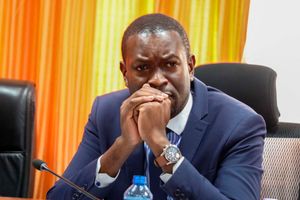
A new war front has emerged in the broad-based government, with a section of Orange Democratic Movement (ODM) leaders alleging that President William Ruto is raiding its ranks to assemble 2027 regional campaign teams, even before any formal agreement with the ruling United Democratic Alliance (UDA).
Led by ODM co-deputy party leader Godfrey Osotsi, they alleged a well calculated political incursion into its ranks, claiming that Orange legislators are being quietly absorbed into regional campaign teams as part of the President’s early push for re-election in 2027.
This, Mr Osotsi said is a systemic effort by President Ruto to hollow out ODM party’s grassroots machinery and repurpose it for the 2027 re-election campaign.
ODM co-deputy party leader Godfrey Osotsi.
Photo credit: Dennis Onsongo | Nation Media Group
At the centre of the dispute is Western Kenya, long regarded as a political swing bloc and now emerging as a key battleground in the absence of Raila Odinga’s unifying influence.
ODM leaders say what is unfolding is not routine political poaching but a coordinated “hostile takeover” designed to weaken the party from within as President Ruto quietly assembles regional campaign teams populated by Orange legislators.
The claims were laid bare in a statement issued on January 8, 2026, by Mr Osotsi, who accused UDA of exploiting the broad-based government arrangement to infiltrate ODM structures.
According to Mr Osotsi, the latest trigger was a meeting held on January 6 at the Golf Hotel in Kakamega, where several MPs and officials elected on ODM tickets reportedly attended strategy sessions convened by senior UDA figures.
“ODM legislators and officials in Vihiga and Kakamega counties have been incorporated into UDA electoral and campaign strategy meetings,” Mr Osotsi said, describing the engagements as a violation of the Political Parties Act and the ODM constitution.
He alleged that ODM members were being encouraged to participate in UDA grassroots elections under the false impression that ODM and UDA had entered into a formal cooperation pact extending to party structures.
For ODM, the distinction is critical. Party leaders insist that the 10-point reform agenda signed in March 2025 — was never meant to dissolve party identities or provide a pathway for joint electoral operations.
“The reform agenda, like the broad-based government itself, is work in progress meant to expire in 2027,” Mr Osotsi said. “It does not amount to a cooperation agreement or pact between ODM and UDA.”
In his telling, UDA’s strategy is to leverage ODM’s two-decade-old grassroots networks to “soften the ground” in Western Kenya, marginalise dissenting ODM officials and eventually neutralise the party without provoking a popular backlash.
The struggle for Western Kenya underscores the stakes. With Raila Odinga gone, analysts say the region has become politically fluid — a reality President Ruto appears keen to exploit.
“Western, in the absence of Raila, is now a free-for-all, and that’s exactly what Ruto is exploiting,” said political analyst Dismas Mokua, pointing to ongoing realignments cutting across party lines.
However, UDA Secretary General Hassan Omar dismissed Mr Osotsi’s claims as misplaced, saying the president had no interest in interfering with ODM’s internal affairs.
UDA party secretary general Omar Hassan.
Photo credit: File | Nation Media Group
“The problem I have with people like Osotsi is that they live in a fairy tale world. They need lessons on realpolitik. They are hollow in their approach to politics, they assume that political space is stagnant. There’s place for healthy political competition. If some of his party members are desirous of supporting the president for second term-we welcome that, it’s their democratic right to do so,” Omar said.
On Tuesday, Bungoma Governor Kenneth Lusaka, who is also the Ford–Kenya deputy party leader and Kakamega Deputy Governor Ayub Savula led what was branded the Western Kenya Two-Term Movement meeting in Kakamega town, openly campaigning for President Ruto’s 2027 re-election.
Bungoma Governor Kenneth Lusaka.
Photo credit: Boniface Mwangi | Nation Media Group
That Lusaka-led caucus is only one part of a broader reorganisation of Dr Ruto’s campaign architecture.
Sources say parallel regional teams are being quietly assembled in Nyanza, Eastern, Coast and Nairobi, each anchored by local political heavyweights, some of them drawn from opposition ranks.
In Nyanza, pro–broad-based government figures have been moving across Luo Nyanza urging voters to “consider continuity” under Ruto, while in the Coast, a parallel mobilisation has been unfolding under the cover of development forums and fundraising drives.
“At Raila’s posthumous 81st birthday commemoration held in Kilifi on Wednesday, several leaders spoke passionately about Mining and Blue Economy Cabinet Secretary Hassan Joho’s “long sacrifice,” in the party, which they insisted must be rewarded.
Some urged Mr Joho to take over the reins of the party and vie for the top seat, or effectively deputise president Ruto in the coming election.
But as debate rages on in ODM over an alleged hostile takeover, some leaders have described the situation as a mere “broad based gesture where ODM and UDA leaders are working together.”
“There is no evidence of a takeover. That’s just fear of the unknown,” Mr Majiwa said. “ODM remains ODM and UDA remains UDA. What we have is a broad-based arrangement.”
He argued that the late Raila Odinga was clear about the 10-point agenda he signed with President Ruto, and that cooperation within government should not be misread as surrender.
But within ODM, suspicion is deepening — fueled by a wave of exit threats and increasingly blunt warnings from senior figures.
Suba South MP Caroli Omondi has gone furthest, declaring that he will not seek re-election on an ODM ticket in 2027.
Suba South MP Caroli Omondi.
Photo credit: Dennis Onsongo | Nation Media Group
“I will not run on ODM. I have reflected on this issue for long,” Mr Omondi told Daily Nation, citing bungled nominations, zoning rules and what he called the absence of strong leadership following Raila’s death.
He accused the party of attempting to expel him for visiting President Ruto at State House and said his experience with ODM nominations — from 2014 through 2017 and 2022 — convinced him the party no longer offered a fair platform.
“When Oburu announced he had accepted to be party leader, he said he did not even know there was a process,” Mr Omondi said. “That worried me. It suggests ODM is getting directions from somewhere else.”
Saboti MP Caleb Amisi, Kisii Senator Richard Onyonka and Kitutu Chache South MP Anthony Kibagendi have all warned they would quit ODM should the party formally back President Ruto’s re-election.
Mr Amisi said critics of the Kenya Kwanza administration risk being “fixed” if ODM aligns itself fully with UDA.
“If ODM continues working with Ruto, I will have no option but to seek re-election on another party or run as an independent,” he said.
Mr Kibagendi accused the administration of abandoning the ideals that drew him to ODM, including human rights and equitable development, while Mr Onyonka warned that continued ties with UDA would trigger a mass exodus.
Kisii Senator Richard Onyonka.
Photo credit: Dennis Onsongo | Nation Media Group
The emerging fault line pits ODM traditionalists — who see the party as an ideological vehicle for social justice and opposition politics — against pragmatists who argue that engagement with power delivers resources and protection for constituents.
Cooperatives Cabinet Secretary and ex- Kakamega Governor Wycliffe Oparanya’s remark at the burial of former Lugari MP Cyrus Jirongo, that he was ready to quit ODM if that was what it took to unite the Mulembe nation, captured the dilemma facing many leaders torn between party loyalty and regional arithmetic.
At the heart of the turmoil is Raila’s absence. For decades, he absorbed contradictions, imposed discipline and provided moral authority. Without him, disagreements that once stayed internal are now erupting publicly.
Amid the recriminations, Raila’s widow, Ida Odinga has stepped in with an emotional appeal for dialogue.
Speaking during Raila’s posthumous 81st birthday commemoration, she urged ODM leaders to reflect on the values her husband stood for.
“What would Baba do under these circumstances?” she asked. “I am sure he would tell us, let us sit down and talk.”
She warned that ODM’s survival — and Raila’s legacy — depended on preserving the party as a vehicle of consultation, fairness and service to the nation.
Mama Ida Odinga, the widow of former Prime Minister Raila Odinga, speaks during celebrations marking what would have been Odinga’s 81st birthday at his home in Karen, Nairobi, on January 7, 2025.
Photo credit: Bonface Bogita | Nation Media Group
For President Ruto, the ODM implosion is both an opportunity and a risk. Absorbing opposition figures into his campaign machinery could broaden his electoral coalition, particularly in Western and Nyanza.
But it also feeds accusations that the broad-based government is a Trojan horse designed to neutralise dissent.
For ODM, the coming months may determine whether it remains a coherent national party or fragments into competing tendencies — some aligned with Dr Ruto, others drifting into new formations.
As one senior ODM official put it privately: “This is not just about 2027. It’s about whether ODM survives Raila.”
But the battle lines are no longer merely between government and opposition, but within ODM itself — at a moment when its founder’s voice is absent, and its future hangs in the balance.
ODM board of Trustees Chairman Timothy Bosire, also the party’s National Treasurer has called for restraint and responsibility among political leaders, warning that weakening institutions like ODM party undermines democracy.
He said institutions must be managed strictly in line with the law, the Constitution and guiding principles, stressing that destroying institutions has never been part of ODM’s beliefs or political culture.
Mr Bosire, who serves as ODM’s National Treasurer and chair of the party’s Board of Trustees, described ODM “as a model modern institution that operates transparently and is funded through public resources.”
He said unity within the party remains critical, adding that internal cohesion strengthens not just ODM but the wider democratic ecosystem.
He urged leaders across the political divide to speak responsibly and be accountable for their actions, arguing that strong political parties are essential for a healthy democracy.
Mr Bosire said ODM, alongside other parties, should be supported to grow and institutionalise democratic practices, noting that resilient parties are the backbone of a stable and vibrant multiparty system.