On January 30, 2018, Kenya witnessed one of the most dramatic and defiant moments in its political history when Raila Odinga , then leader of the opposition and a four-time presidential contender, swore himself in as the “People’s President” at Nairobi’s Uhuru Park.
The self-declared inauguration, attended by thousands of his supporters, was both an act of political rebellion and a cry for justice. It was an event that captured the frustration of a people who felt robbed of their electoral voice.
The path to that extraordinary event began months earlier with the contested 2017 presidential election. The Independent Electoral and Boundaries Commission (IEBC) had declared President Uhuru Kenyatta the winner of the August vote, but Raila Odinga’s National Super Alliance (NASA) challenged the outcome, citing massive irregularities in the transmission and tallying of results. In a historic move, the Supreme Court nullified the election, marking the first time in Africa that a court had annulled a presidential poll.
The repeat election held in October, however, was boycotted by Odinga, who insisted that the IEBC had failed to reform and could not be trusted to deliver a credible vote. In the tense aftermath, the country was deeply divided between those calling for a fresh election and others urging a return to normalcy.
Odinga chose to channel that anger and disillusionment into a symbolic act of defiance: a swearing-in that would, in his words, “restore the people’s sovereignty.”
The state moved quickly to warn against any parallel inauguration. Attorney General Githu Muigai cautioned that such an act would amount to treason, a capital offence under Kenyan law. Government officials labelled NASA’s plans as an attempted subversion, while opposition leaders framed the ceremony as a legitimate expression of the people’s will.
It was in this charged atmosphere that Odinga made his way to Uhuru Park on that Tuesday afternoon. Thousands of supporters had already gathered, waving flags and chanting his name, undeterred by the heavy police presence and the government’s warning that the event was illegal. Many television stations had been switched off that morning under government orders, preventing live broadcasts of the event, in what later came to be condemned as an assault on press freedom.
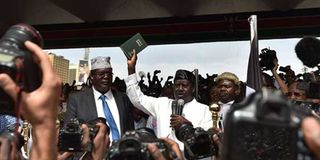
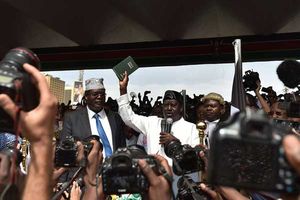
At precisely 2:45 pm, Odinga appeared on stage dressed in a white shirt and black cap, holding a Bible. Standing beside him was Ruaraka MP, T.J. Kajwang’, who donned a lawyer’s robe to administer the oath, and lawyer Miguna Miguna, who helped officiate the brief but symbolic ceremony.
In front of a roaring crowd, Raila raised his right hand and declared:
“I, Raila Amolo Odinga, do swear that I will protect the nation as the People’s President, so help me God.”
The crowd erupted in cheers, singing liberation songs and chanting “Baba! Baba!”
For many of his followers, this was not just theatre, it was a declaration of dignity, a restoration of voice after what they saw as a stolen democracy.
Noticeably absent from the ceremony, however, were Odinga’s co-principals in NASA; Kalonzo Musyoka, Musalia Mudavadi, and Moses Wetang’ula who were meant to be sworn in alongside him. Their absence sparked speculation and disappointment among supporters.
The man of the hour, however, brushed it off, promising that they remained united in the struggle for justice. Later, Kalonzo would cite security concerns, claiming that intelligence reports had warned of possible attacks or arrests. The government dismissed the event as a “publicity stunt,” but its reaction betrayed its alarm.
In the days that followed, the state cracked down on those involved. Interior Cabinet Secretary Fred Matiang’i declared NASA’s “National Resistance Movement” an organised criminal group.
Miguna Miguna was arrested, detained, and later deported to Canada in a highly controversial move that raised questions about his citizenship. Mr Kajwang’ was also detained briefly and charged with participating in an illegal oath. The opposition’s offices were raided, and the homes of senior NASA officials were placed under surveillance. The media blackout persisted for days, drawing condemnation from rights groups and international observers. For many, it seemed Kenya was once again slipping into the shadows of political repression reminiscent of the single-party era.
Critically looking at this incident in the broader political narrative, the opposition chief’s self-swearing achieved something profound. It was, in many ways, the climax of decades of struggle; a statement that power belongs to the people, not the establishment.
It drew parallels to his earlier defiance against one-party rule in the 1980s and 1990s, when he was jailed and tortured for demanding multiparty democracy. This time, however, the battleground was electoral justice and the integrity of institutions. While critics dismissed the oath as reckless and unlawful, supporters saw in it a moral victory, a reaffirmation that resistance could be peaceful yet potent.
The legal implications of the act remained a matter of debate until November 2019, when Chief Magistrate Stephen Mbungi ruled that Raila’s oath as “People’s President” was not unlawful. The court determined that the oath did not amount to treason, since Odinga did not attempt to usurp the powers of the President of the Republic of Kenya.
The ceremony, the court said, was symbolic, lacking any practical attempt to seize authority. This legal interpretation underscored the thin line between protest and insurrection and offered a precedent for political expression in contested democracies.
Kenya's opposition National Super Alliance (NASA) coalition leader Raila Odinga (2-L) holds up a bible as he swears-in himself as the 'people's president' on January 30, 2018 in Nairobi.
Photo credit: Photo | Nation
“From the content of the oath, Hon Raila Odinga swore himself to the office of the people’s president, which does not amount to any crime. He would have only breached the law if he swore himself in as the president of the Republic of Kenya,” Mbugi ruled.
Barely six weeks after the Uhuru Park event, the unexpected happened.
On March 9, 2018, Odinga and President Uhuru Kenyatta appeared together on the steps of Harambee House, shaking hands and declaring an end to hostilities. The moment, instantly dubbed “The Handshake”, stunned the nation. It marked a dramatic turnaround from confrontation to cooperation and paved the way for the Building Bridges Initiative (BBI).
Odinga explained that the Handshake was about healing a divided country, while critics accused him of betraying the opposition’s struggle. But few could deny that the self-swearing stint had forced the political establishment to reckon with the depth of national division.
Looking back, the 2018 swearing-in was not just a political stunt- it was a defining episode in Odinga’s long career as a reformist and a symbol of resistance. It encapsulated his lifelong refusal to yield to state power, his willingness to stake everything on what he believed was right.
It was also a vivid demonstration of the fragility of Kenya’s democracy, how easily faith in institutions can crumble when citizens lose trust in their impartiality. The event, in retrospect, exposed the limits of electoral law, the contradictions of constitutionalism, and the enduring struggle to align political legitimacy with public will.
As the country comes to terms with Raila Odinga’s passing, memories of that day at Uhuru Park have resurfaced. It was perhaps the most visible manifestation of the spirit that defined his political life, the courage to challenge authority and the conviction that justice must be pursued.
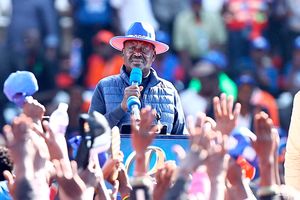
Prime Minister Raila Odinga addresses Kisumu residents while carrying a bible presented to him at Kondele grounds on April 5, 2013. Photo/JACOB OWITI
His ardent supporters recall that even in the face of intimidation, arrests, and media censorship, he stood unbowed. His critics, too, acknowledge that it was an audacious act, one that tested the limits of Kenyan democracy.
The self-swearing of Odinga as the People’s President remains a historical marker, a symbol of how far Kenya has come and how much further it must go in perfecting its democracy. It was an act of protest born of disillusionment, but also of hope, the hope that someday, elections would no longer divide the nation, and that power would flow genuinely from the will of the people.
In his own words that day- the fallen veteran of opposition politics who was never in power but somehow always in power- promised that “the struggle for greater democratic space, liberty and freedom has just begun.”
Seven years later, as Kenya mourns him, those words ring louder than ever. They remind the nation that democracy is not a gift bestowed by rulers, but a right fought for by citizens.
Whereas his defiant oath did not make him President in law, it made him something perhaps more enduring; a symbol of the unyielding Kenyan spirit. In life, he stood for justice, equality, and unity.
In death, his legacy of the man who embodied resistance and hope for millions continues to challenge and inspire a nation still striving to live up to the ideals he so fearlessly championed.