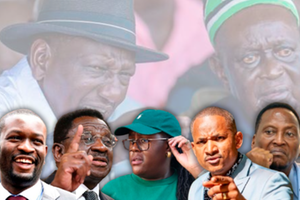
A new political formation is stirring the country’s political waters ahead of the 2027 General Election, threatening to disrupt the traditional two-horse race that has long defined Kenya’s presidential contests.
Unlike the broad-based government arrangement or the emerging United Opposition coalition, this grouping is made up of youthful lawmakers seeking to step out of the shadows of their political parties and complicate President William Ruto’s re-election bid.
For months, the 2027 contest had appeared to be shaping up as a straight duel between President Ruto and a yet-to-be-named United Opposition flagbearer.
But the Linda Mwananchi movement, loosely translated as “Protect the Citizen”, led by Nairobi Senator Edwin Sifuna, is positioning itself as an alternative voice, challenging the dominant political formations.
The movement is gradually evolving into a potential third force, drawing significant crowds and amplifying criticism of both the broad-based government and the traditional opposition.
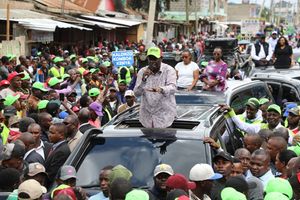
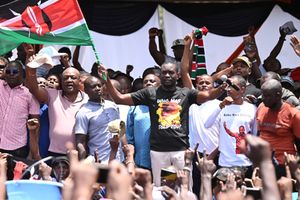
Edwin Sifuna observes a moment of silence for Vincent Ayomo, who was shot in Kitengela Rally during the Linda Mwananchi Rally at Amalemba grounds in Kakamega on February 21, 2026.
Photo credit: Alex Odhiambo | Nation
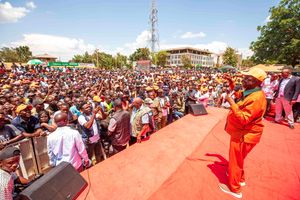
Buoyed by receptions at rallies in Kitengela and Kakamega, the group appears keen on unsettling Kenya’s conventional political arithmetic.
What began as a defiant voice in the aftermath of the 2024 Gen Z protests and the subsequent formation of the broad-based government has since transformed into an organised political platform.
Recent developments within the Orange Democratic Movement (ODM), including internal disputes and the party’s engagement with President Ruto’s United Democratic Alliance (UDA), have further energised the outfit.
Apart from Senator Sifuna, prominent figures associated with the movement include Embakasi East MP Babu Owino, Vihiga Senator Godfrey Osotsi, Siaya Governor James Orengo, Saboti MP Caleb Amisi and Winnie Odinga.
The leaders, largely drawn from ODM, have been vocal critics of the broad-based government arrangement, arguing that it dilutes the party’s opposition credentials.
“We don’t want the deputy president position; we want Sifuna to go for the presidency. He is State House material,” Kabuchai MP Majimbo Kalasinga said over the weekend.
Senator Osotsi echoed the sentiment: “We have capable leaders like Sifuna, Orengo, Babu and myself who can lead this country. As a party, we are going to have a presidential candidate.”
Mr Amisi, speaking to Nation , dismissed the notion that the outfit is merely a third force.
“We are not a third force but the only force. There isn’t any other credible alternative. We are not rebels; we are working within democratic principles,” he said.
Mr Owino struck a similar tone, insisting the movement represents a generational shift.
Edwin Sifuna speaking to Linda Mwananchi Rally at Amalemba grounds in Kakamega on February 21, 2026.
Photo credit: Alex Odhiambo | Nation
The group has crafted its message around issues such as the high cost of living, taxation, governance standards and youth unemployment, topics that resonate strongly with young voters.
Gen Z, those born between 1997 and 2012, are expected to form a decisive voting bloc in 2027. The Independent Electoral and Boundaries Commission (IEBC) projects that youth will make up nearly 70 percent of voters in the next election.
In 2022, voters aged between 18 and 34 accounted for 39.84 percent of registered voters—about 8.81 million people. President Ruto won that election with 7.17 million votes out of 14.3 million cast.
A recent study by OdipoDev and Tribeless Youth suggests that seven out of 10 Gen Z voters intend to participate in the 2027 polls, raising the prospect of the highest youth turnout in over a decade.
Historically, youth mobilisation has proven decisive. The 2002 General Election demonstrated how a unified youth vote can significantly influence outcomes.
While Linda Mwananchi has hinted at working with like-minded leaders to build a broader front against President Ruto, its leaders maintain that unity must transcend personal ambition.
“All formations working toward change are welcome, but they must recognise that Kenya and its people are bigger than individual ambitions,” Mr Sifuna said previously.
Political commentator and a professor of History and International Relations at the United States International University, Macharia Munene, argues that the movement is gaining traction because it appears authentic.
“The group appears believable in addressing people’s concerns. Sifuna is emerging as a significant political player whose influence is expanding rapidly,” Prof Munene said.
He described the Kitengela rally as a turning point, with the Kakamega gathering consolidating the group’s momentum.
Embakasi East MP Babu Owino, Nairobi Senator Edwin Sifuna and Saboti MP Caleb Amisi in Nairobi during World Teachers Day celebrations on October 5, 2025
Photo credit: Lucy Wanjiru | Nation Media Group
Another political analyst, Javas Bigambo, observed that the movement’s strength lies in its mobilisation capacity, particularly among voters who feel disconnected from both the broad-based government and the United Opposition.
However, Mr Bigambo cautioned that mounting a presidential challenge may be premature.
“They can field a presidential candidate, but not necessarily from within their ranks. They may eventually align with an existing political force,” he said.
“They might simply be positioning themselves as a compelling bloc that others will have to negotiate with,” he added.
Whether Linda Mwananchi evolves into a fully-fledged third force or becomes a strategic bargaining chip in coalition politics remains to be seen. But its emergence has undeniably added a new variable to Kenya’s 2027 political equation.