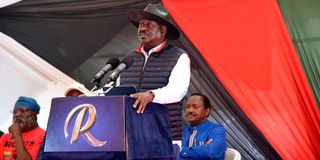
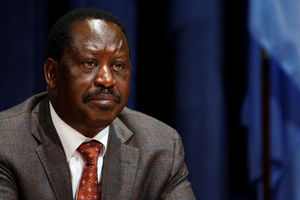
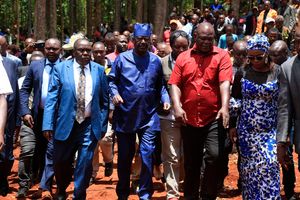
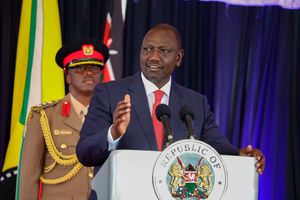
Raila Amolo Odinga and Kalonzo Musyoka were among Azimio la Umoja top brass whose State-provided security detail was withdrawn on July 17, 2023.
The coalition, which emerged second in the previous year’s Presidential election, was at the time planning anti-government protests as it maintained that the polls were rigged and that Odinga was the true winner.
Governors Gladys Wanga (Homa Bay), James Orengo (Siaya), Anyang Nyong’o (Kisumu) and Ochilo Ayacko (Migori) had lamented at their security withdrawal, a directive that the Nation learned affected at least 50 other elected officials in the opposition.
The Azimio leaders faulted then Inspector-General of Police Japhet Koome for the withdrawal of their security.
President William Samoei Ruto had been declared winner of the election with 7.1 million votes, against Odinga’s 6.9 million votes.
All General Service Unit officers guarding Odinga’s Karen and Opoda Farm homes, and his private offices in Upper Hill, Nairobi, had been directed to leave that evening and report to police headquarters nearest to them.
Only two bodyguards stood by Odinga’s side, but they were the former Prime Minister’s most trusted men – George Oduor and Maurice Ogeta.
Raila Odinga's bodyguards follow proceedings in Thika during a NASA rally on July 13, 2017.
Photo credit: File | Nation
Odinga was at the time allocated at least a dozen police officers to guard his homes and Upper Hill offices.
Hours earlier, Odinga claimed on social media that the Kenya Kwanza administration had hatched a plan to harm Azimio leaders during the planned demonstrations.
Undeterred by the security withdrawal, Odinga posted on his X account: “Starting on Wednesday, be ready for the game-changing maandamano. Tumechoka.”
A section of government operatives saw this as a war call, and immediately started plotting a pushback. The Azimio coalition maintained that it would proceed with a three-day protest.
That resolve, led by Odinga, sent a chill down the spine of Kenya’s top security organs. Police bosses were in panic.
Senior police officers at Vigilance House had for hours tried to contact Odinga, hoping they could talk the Azimio flagbearer to suspend the protests. Odinga did not pick any calls, and did not as much as acknowledge receiving any of the several text messages sent to his mobile phone.
Very few of the Vigilance House bosses were chummy with Odinga, and dreaded that they were cornered into calling him.
The Vigilance House bosses had one last arrow in their quiver, but it was in the form of a retired veteran in former senior assistant Inspector-General King’ori Mwangi.
Mwangi had cultivated a relationship with Odinga when serving as the Nairobi County police boss. Odinga had given Mwangi his fair share of headaches stemming from ODM-led street protests.
After wide consultations, it was resolved that Mwangi be contacted to reach out to Odinga or his wife, Ida, and find a way to broker a deal whose outcome would be calling off the three-day protests.
One of the senior officers who was present on that night told the Nation that Mwangi finally got hold of Odinga on phone.
But the former Prime Minister was not willing to call off the protests. In equal measure, the negotiation team was not willing to drop their mission. The team resolved to go and try to deal with Odinga in person, which meant visiting his Karen home.
The Kenya Kwanza administration was at this point worried that public and private business in the country would grind to a halt if the protests were to proceed.
A senior officer, who still serves in the police service, said that the negotiation team arrived at the Odinga home in Karen past midnight.
Former Prime Minister Raila Odinga (right) with his bodyguard Maurice Ogeta.
Photo credit: Pool
But the man they were hoping to see was not there. His wife, Ida, let them in as she had spotted Mwangi, who was a foe-turned-friend of the family.
After exchanging pleasantries, the negotiators pleaded with Ida to talk Odinga into calling off the protests.
The talks with Ida would continue until around 1am, when she agreed that their message would reach Odinga once he got home.
The Azimio flagbearer got home at around 3am, and the message was passed.
The following day at around 9am, Ida called Mwangi and informed him that the message had been passed, but that Odinga also had one of his own – the protests would proceed as planned.
However, he was willing to ask protesters to remain peaceful and avoid destruction of property.
As the protests continued, security personnel attached to the Azimio leaders started to slowly, but quietly, resume duty with their respective VIPs.
It was not the first time the State had used this tactic to, unsuccessfully, intimidate the opposition leader.
In 2017 and 2018 when Uhuru Kenyatta was President, State-provided security attached to Odinga and other opposition leaders was withdrawn or scaled down.
The first incident was in September 2017 when Odinga called for protests after announcing that he would boycott the Supreme Court-ordered repeat Presidential election. They were later restored.
Four months later, the National Security Advisory Committee resolved to withdraw Odinga’s official police protection, and that of other opposition leaders.
The police protection was only restored starting March 12, 2018 – three days after Odinga and Uhuru publicly shook hands and announced a truce that would see the two leaders work together, much to the chagrin of then Deputy President William Ruto and his supporters.
Odinga maintained his stance and belief on the State-provided security – they were necessary, but could not be trusted to keep secrets, especially when he was at loggerheads with the government of the day.
The former Prime Minister, however, was not very fond of the State-provided security detail despite appreciating that the complex nature of his work and life required their presence.
The police officers attached to his detail, Odinga felt, could easily be coerced into being government moles, especially when situations like the protests required a bit of deception.
Hence, he preferred to keep privately hired individuals as his personal bodyguards and last line of defence.
Oduor was the former Prime Minister’s longest serving bodyguard. He was a police reservist whose services were cut after the attempted coup in 1982.
George Oduor (circled), a long-serving bodyguard of ODM leader Raila Odinga.
Photo credit: Francis Nderitu | Nation Media Group
A friend of the Odinga family who also worked with the former Prime Minister said that Oduor joined the security detail of Kenya’s first Vice-President Jaramogi Oginga Odinga after the failed coup.
Upon Jaramogi’s death, his son hired Oduor as a bodyguard.
The then young and firebrand Odinga facilitated Oduor’s training in Israel and other countries over the next years.
In the mid-2000s, Odinga hired Ogeta as his physiotherapist and gym instructor. Impressed with the man, Odinga impressed upon him the opportunity to join the soon-to-be Prime Minister’s personal security detail.
Ogeta accepted the offer, and would also be flown to Israel for VIP protection training.
Oduor died on April 2, 2025 – barely six months before his boss and having served Odinga for over 30 years.
Ogeta was with Odinga in India when the former Prime Minister collapsed during an early morning walk after suffering a heart attack.
Maurice Ogeta, the bodyguard of former Prime Minister Raila Odinga, outside Parliament Building in Nairobi on October 17, 2025.
Photo credit: Bonface Bogita | Nation
On the day that the senior police officers visited Odinga’s home, Ogeta was abducted by State security agents who were seeking to avert further planned protests by the Azimio la Umoja coalition.
Over the three days he was in custody, Ogeta was questioned on Odinga’s plans and whereabouts. The agents also wanted to know Ogeta’s security background, asking whether he was a former police or military officer.
Even with the intelligence gathering apparatus at the State’s disposal, it was difficult to verify the background of Odinga’s personal security detail.