Nyayo National Stadium has always been the nation’s stage for farewells to greatness. It was here that Kenyans last gathered to see off Presidents Daniel arap Moi and Mwai Kibaki, whose names defined eras. But the air on Friday morning felt different.
The chants were louder and the grief more personal. Raila Odinga, who had so often stood on this very ground to bid farewell to others of his caliber, is now the one being seen off.
For the thousands of mourners who had witnessed his resolve, not even the light showers would stop them from seeing the sendoff of a man who has shaped Kenya’s democracy for decades.
Men and women clad in branches and twigs thronged into the historic stadium to witness the departure of the father of democracy at Nyayo Stadium.
Mourners gather at the Kasarani International Complex, Nairobi to view the body of Kenya's former Prime Minister Raila Odinga on October 16, 2025.
Photo credit: Reuters
Nyayo lies within Langata constituency- the soil that first sent him to Parliament in 1994, shaping his long journey as a lawmaker and opposition figure. But the gathering today marked the end of that very path.
On Saturday, he will return to his people by the lake — to the Luo heartland — closing the circle of a life that began in struggle and ends in history. The Friday ceremony marked the end of the beginning of the long journey to take him to his final resting place in Bondo.
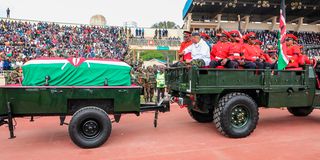
At a quarter to ten, a ripple of silence swept through the stadium as the military convoy snaked in. Then the emotion broke. Some people wailed uncontrollably; others fainted as some pushed against the National Youth Service officers’ cordon for a clearer view.
The procession moved with solemn precision - military police outriders in formation, ceremonial guards flanking a full military band whose slow, heavy drums echoed across the terraces.
Mourners lined the route, waving national flags, olive branches, and twigs - symbols of both peace and struggle. Phones rose into the air as the gun carriage, draped in the Kenyan flag, rolled past, flanked by Kenya Defence Forces officers and a long tail of military vehicles.
Behind the casket walked Maurice Ogeta, Odinga’s long-serving aide, his face hidden behind dark shades, his frame wrapped in a navy-blue Kaunda suit - the same quiet dignity his boss often carried.
The late former Prime Minister Raila Odinga’s bodyguard, Maurice Ogeta, outside Parliament Building in Nairobi, heading to Nyayo Stadium for the State Funeral on October 17, 2025.
Photo credit: Bonface Bogita|Nation Media Group
The old saying “till death do us part” seemed to lose its meaning. Step by slow step, Ogeta followed the body of the man he had shadowed for years - through rallies, arrests, and the unending turbulence of Kenyan politics. His silence spoke more than words could; it was a walk of loyalty, grief, and a bond that even death could not fully sever.
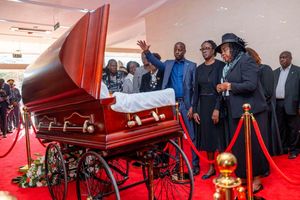
At the dais, senior government officials, clergy, and family members waited to receive Raila Odinga’s body, which was then placed in the main foyer for a brief lying-in-state - a final pause before the nation bid him farewell. For many, the thought that the enigma of Kenya’s political scene was finally exiting the stage felt unimaginable. “I will forever miss him,” said 45-year-old Asha Hamali, who had traveled from Lamu to pay her last respects.
Family of the late former Prime Minister Raila Odinga, led by his wife Mama Ida Odinga, daughters Rosemary Odinga and Winnie Odinga and son Raila Odinga Jr, at Nyayo National Stadium on October 17, 2025, for his state funeral.
Photo credit: Lucy Wanjiru | Nation Media Group
“He sacrificed his life and fought for justice - especially for some of us who have always been marginalized,” she said, her voice breaking as she clutched a small flag and a white handkerchief.
One by one, Heads of State stepped forward to pay their respects, led by Foreign Affairs Cabinet Secretary Musalia Mudavadi. Bishop David Hellington Kodia of the Anglican Diocese of Bondo message was as much a tribute as it was a rebuke.
He urged the leaders present to use power wisely, warning against those who “walk around with money and big cars,” dishing out handouts to the electorate. He described Odinga as “a humble man who supported the church,” contrasting him with politicians who flaunt their generosity for show.
“That which the right hand gives,” he said, “let not the left hand know.” Bishop Kodia praised Odinga’s commitment to justice and his willingness to use his influence to speak truth to power — a pointed message to the political class seated in front of him.
Supporters of the late ODM Party Leader Raila Odinga mourn him along Ngong Road in Nairobi on October 15, 2025.
Photo credit: Bonface Bogita | Nation
Raila Odinga Junior, wearing a ligisa - the traditional headdress once favored by his grandfather, Jaramogi Oginga Odinga - stepped forward, a white whisk in hand, and began with the familiar rallying cry, “Haya! Haya!” The crowd responded with thunderous cheers. In a steady voice, he spoke of his father’s legacy- of a man who had reshaped the country’s political landscape and paid dearly for justice and freedom. He vowed to carry that legacy forward, to protect the family name, and to stand as the new pillar of the Odinga household.
But it was Oburu Oginga’s eulogy to his younger brother that broke through the solemnity of the day, leaving mourners in stitches. With his trademark wit, the elder Oginga remembered Raila as both a political mentor and a steadfast protector of the family. He spoke of their childhood with a fond smile — recalling how Raila was always the sharper mind in class, while he, Oburu, liked to think he was the better athlete.
The stadium rippled with laughter, a rare lightness in a day heavy with grief, as the elder brother’s stories brought the man behind the legend briefly back to life. Former President Uhuru Kenyatta also drew laughter from mourners as he recalled the lighter moments he shared with Odinga — often over what he jokingly described as “tea and porridge,” their coded reference to the drinks they enjoyed together.
Supporters of the late ODM Party leader Raila Odinga arrive at his residence in Karen, Nairobi on October 15, 2025 to mourn him.
Photo credit: Bonface Bogita | Nation
Shifting from humour to reflection, Mr Kenyatta said, “As we bury our brother, we must remember what he stood for. We will not allow our democracy and human rights to be violated — we will keep fighting.” He paused, his voice softening. “You know, after work, we would sit and talk. We used to wonder — those who have gone before us, what do they sit and talk about up there? My brother, as you go ahead, prepare a place for us — though I’m not in a hurry to join you yet.” The crowd erupted in warm laughter, the moment carrying both grief and grace.
Former President Uhuru Kenyatta arrives at Nyayo National Stadium for the State funeral of former Prime Minister Rail Odinga on October 17, 2025. He is received by Prime Cabinet Secretary Musalia Mudavadi.
Photo credit: Lucy Wanjiru | Nation Media Group
As the final hymn, Nyayo Stadium fell into a heavy silence as the dignitaries left the venue. The thousands who had gathered slowly began to line up to view his body. Some broke into song and dance as others left the venue in silence. It was the end of an era, the curtain fall on a man who had defined Kenya’s political heartbeat for half a century. Yet beyond the speeches, the tears, and the laughter, one truth lingered in the air: Raila Odinga’s story would not end here.
It would live on in the memories of those he inspired, in the ideals he fought for, and in the unyielding spirit of a nation still reaching for the freedom he never stopped believing in.