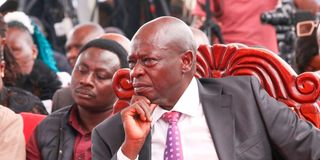
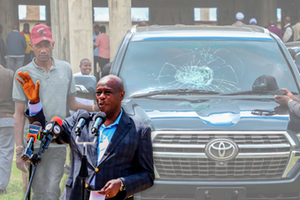
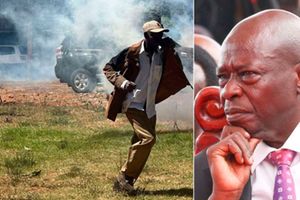
The repeated attacks on former Deputy President Rigathi Gachagua by suspected politically orchestrated groups of rogue police officers and civilian goons have raised serious questions about the use of power in Kenya’s politics.
Mr Gachagua, impeached in October 2024, has since re-emerged as a formidable political force forming the Democracy for Citizens Party (DCP) and winning key by-elections in Kariobangi, Kisa East and Narok Town wards within just seven months.
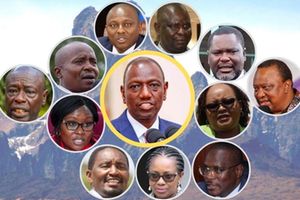
With his political support in the Mt Kenya voting bloc and alliances with influential politicians including Wiper’s Kalonzo Musyoka, DAP-Kenya’s Eugene Wamalwa, Trans Nzoia Governor George Natembeya, and Kajiado Senator Kenar Seki, he has positioned himself as a significant challenger to President William Ruto ahead of the 2027 General Elections.
Long-serving administrator Joseph Kaguthi told the Nation that to understand the persistent attacks, “words of former President Daniel Arap Moi would suffice”.
“He used to say that if an illegality persists despite public outcry, it is likely backed by someone connected to power,” Mr Kaguthi said.
Gachagua: I survived assassination attempt inside a church
Mr Kaguthi said the attacks illustrate how “brute states use instruments of power while the opposition relies on the people in search of liberation.”
Mr Gachagua’s stronghold of Mt Kenya has been the epicenter of the violence. Political commentator Harman Manyora observed that “wherever Gachagua visits in Mt Kenya, his presence transforms into a euphoric display of influence, triggering a popularity war.”
Historian Prof Macharia Munene added that the attacks appear to be orchestrated by individuals who understand the political dynamics of the region and stand to lose ifMr Gachagua’s political influence grows unchecked.
Local accounts indicate that many of the assailants speak Gikuyu, are transported in vehicles owned by regional investors and appear to be sponsored by politicians from the area.
Kikuyu Council of Elders Chairman Wachira Kiago condemned the attacks particularly those targeting women, children and the elderly, including incidents inside places of worship.
He warned that the violence is being imported into the region by actors seeking power. Political scientist Gasper Odhiambo noted that the stakes in Mt Kenya are high controlling the region can determine the outcome of the 2027 elections, including the presidency, deputy presidency and cabinet positions.
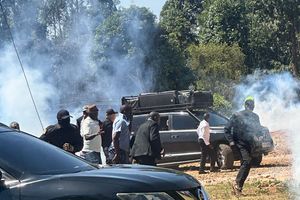
Residents scamper for safety after tear gas canisters were lobbed at Witima ACK Church in Nyeri County during a Sunday service that was attended by Rigathi Gachagua on January 25, 2026.
Photo credit: Pool
The conflict according to New Gema Chairman Isaac Mungai, pits factions loyal to President Ruto’s re-election against those aligned with Mr Gachagua, with young politicians also positioning themselves for long-term influence.
“What is shaping up is a dictatorship versus liberation battle line using people as instruments of violence, with the mountain as the battlefield,” he said.
Despite the attacks, Gachagua claims he is gaining political mileage.
“The violence is meant to intimidate me, but it will not derail my mission. If impeachment did not bring me down, this violence will not,” he said. He condemned the targeting of churches, children and the elderly, highlighting that rogue police officers, transport operators and violence brokers are profiting from the attacks.
However, experts argue that the chief loser is President Ruto, whose authority is questioned as the violence continues under his watch.
Political scientist Festus Wangwe said that as chair of the National Security Council, the responsibility ultimately rests with him. He warned that the unchecked use of violence in politics tarnishes both local and international perceptions of Kenya.
Political commentator Mixson Gitau urged decisive action calling on the President to overhaul security departments, disown rogue officers and publicly denounce the violence.