As the united opposition builds momentum towards making Dr William Ruto a one-term President, it faces 10 major hurdles in its 2027 quest.
The group has Democracy for Citizens Party (DCP) leader Rigathi Gachagua, Martha Karua of Peoples Liberation Party’s (PLP), Kalonzo Musyoka (Wiper Patriotic Front), Eugene Wamalwa (DAP-K), Trans Nzoia Governor George Natembeya and former Interior Cabinet Secretary Fred Matiang'i as key principals.
It is in that engagement that political pundits have identified 10 possible dangerous bridges to cross towards success.
Already, the opposition alliance is suffering from an entanglement over how fringe parties will behave. While Mr Gachagua's DCP is behaving like the king of the other friendly parties, the other members are resisting.
For example, Dr Matiang'i says, “We are still engaging on how to relate. Of importance to note is that the task of consensus building is not an easy one, but under whatever circumstances, I will be loyal to my own party.”
In the run-up to the Mbeere North by-election, it seems that former CS Justin Muturi's DP has won the right to field a candidate, while Mr Gachagua's party appears to have been reduced to the role of chief campaigner. This calls into question Mr Gachagua's ability to win the kingpin mantle if his party cannot field a candidate in a Mt Kenya constituency.
Gachagua fires back at Ruto over coup allegations
As expected, competing forces threatened by opposition formation are not asleep and are expected to infiltrate it on a large scale. This appears to be a well-known fact by Mr Gachagua, who recently told Obinna Live TV that: "I am sure we have been infiltrated and some people close to us are working for our enemies...We have been trying to detect them and kicking them out one by one, but it is a complicated scenario. “Nowadays, it is hard to trust".
In all high-stakes competition, one key element is that of wheeler-dealers who show up to bet. The opposition is feared to be attracting all manner of dealers, both local and international. They are willing to place their bets in the form of finances.
Political Scientist John Okumu says: “The opposition mostly comes up as a union of cash-strapped partners who have to be financed.
“An opposition staging a fight against the incumbent, in this case President William Ruto, should be well prepared to mobilise funds in a big way.
“There have been situations in the past where an incumbent sends financiers to the opposition, thereby crippling their chances.”
Mr Okumu cites international and local criminal networks as another danger. He says that, should they put their money in the campaign, there is a danger of watering down the liberation strategy.
With Mr Gachagua, Mr Kalonzo, Dr Matiang'i, Mr Wamalwa, Ms Karua and Mr Natembeya having already pitched for the presidency, this is bound to make consensus-building tougher.
Dr Matiang'i told Kameme TV on July 12, that: “It will not be easy...that one we know. Many detractors have since prophesied that we will not hold together but it is the voters telling us to stick together.”
“Obviously, all of us who have declared interest to contest the presidency ordinarily believe on individual superiority, but of course, only one can be the flag bearer. That is where the big issue is,” he added.
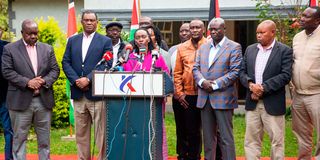
People’s Liberation Party leader Martha Karua (centre) addresses journalists flanked by (from left) Dr Fred Matiangi, former Attorney-General Justin Muturi, former Deputy President Rigathi Gachagua and other opposition leaders at SKM Command Center in Nairobi on July 8, 2025.
Photo credit: File | Nation Media Group
5. Satisfying ambitious voting blocks
Pundits observe that there will be immense pressure in various voting blocs when picking a flag bearer due to ethnic and regional biases.
Political commentator and scholar Prof Peter Kagwanja says that picking a serious presidential candidate in Africa is such a complicated exercise.
"These candidates come from ethnic backgrounds and the problem in Kenya is the presence of nearly 50 tribal bloc that can front an equal number of candidates," he says.
Prof Kagwanja adds:”Every candidate goes to the table, pushed by a group that is screaming that ‘it is its time to eat’.”
He says that such a scenario might present the country with a distorted discourse about leadership values, and sink it into tribal muscle-building just to knock out competition.
6. Satisfying the competition benchmark
For a presidential candidate to go the whole hog and win, key laws, especially those touching on integrity, must be observed.
Political commentator Prof Harman Manyora says: "Of course it is political, since none of these leaders are currently under any form of investigations. It is only Mr Gachagua who is battling an impeachment case in the court.”
However, he says, in politics, every bag of tricks is pulled to delimit competition.
Should the opposition hold and manage to front one candidate, the issue of satisfying the law of 50 percent plus one vote, as well as garnering at least 25 per cent endorsement in at least 24 of the 47 counties, will also crop up.
Opposition leaders (from left): Eugene Wamalwa, Kalonzo Musyoka, Fred Matiang’i and Rigathi Gachagua in Kisumu on July 3, 2025.
Photo credit: Alex Odhiambo | Nation Media Group
The process of negotiations for shared benefits, picking of a flag bearer, holding party primaries and formation of a contest lineup across the country is deemed to be a walk through a dangerous minefield, which will breed ugly fallouts.
Political scientist Festus Wangwe says: "Going through that process all the way to the ballot is considered as an act of political gods...it is never easy. It will not be easy for the opposition. It will be a miracle for them to reach 2027 while speaking in one voice. There will be fallouts. We saw it in all processes of forming an opposition ticket since 1992.”
8. Diplomacy and compromises
The opposition will certainly require a diplomatic team that will step to the plate and help arbitrate whenever fallouts occur, so as not to end up presenting opposition splinter groups that will not achieve its objective.
Embakasi North MP James Gakuya says: “For the opposition to win cohesion there must be many diplomatic negotiations to heal fallouts".
“That is how you end up having part of Cabinet formed in advance to promise disgruntled actors a guaranteed pie...the government being elastic, you find a formation going into an election while it has already shared out the spoils in advance".
He says that this requires experienced political heads, who know how to retain serious contenders, “while letting go those with nothing serious to offer".
Former Deputy President Rigathi Gachagua (front, second left) with other opposition leaders when they met in Nairobi.
Photo credit: Pool
9. Dealing with incumbency muscle at the finishing line
Dealing with an incumbent government, especially during the final bend of the contest, is always tricky. There have been some unsettling remarks by the President’s allies about the handover of power.
DP leader Mr Muturi says, "We as the opposition find these talk very disturbing, and which need vigilance even by the international community.”
“The express meaning of those utterances is that voting in 2027 will be null and void if President Ruto does not record an outright win, that he must win by hook or crook.
“While we shall remain vigilant and ready to deal with the threat, we need practical assurances from the Independent Electoral and Boundaries Commission, the National Police Service and the Judiciary that this is a country where a General Election matters.”
Police block Gachagua's allies from holding meeting in Murang'a
10. Post-election reality
Democratic Congress National youth leader Gladys Njoroge says: "This is where the opposition is called upon to show love for the country should it win or lose...Both results are very emotional happenings. Be peaceful in loss and also be sensitive if in a win. The two results are very important to the cohesion of this country.”
Ms Njoroge says all in the contest must go into it knowing that winning and losing are the two possible outcomes.
"Should there be a rerun, there will emerge another wave of realignment and should it be that the incumbent will be in the rerun, then another wave of horse trading will emerge. This opposition must plan even for a rerun," she said.