The push to remove Nairobi Woman Representative Esther Muthoni Passaris from office is now officially underway, marking the beginning of what could become Kenya’s first successful recall of a sitting Member of Parliament.
Leading the charge are four young Kenyans — Shakira Wafula, Mavin Mabonga, Dominic Omondi, and Sichei Soet — who on Monday walked into the Independent Electoral and Boundaries Commission (IEBC) offices in Nairobi and filed a formal petition seeking Ms Passaris's removal.
According to the group, the two-term legislator should be ousted for what they describe as sustained constitutional violations and abandonment of her representative duties.
The IEBC has confirmed receipt of the petition and is currently reviewing the document to determine whether it meets the legal threshold.
Filed within the constitutionally allowed window — after two years in office and not within the last year of her term — the petition represents a rare attempt to invoke the recall mechanism provided under Article 104 of the Constitution.
According to the petitioners, Ms Passaris has failed to faithfully represent the interests of Nairobi residents, particularly women and has instead aligned herself with a regime that has increasingly suppressed public dissent.
Is Esther Passaris pushing government agenda with protest law proposal?
'Aligning with executive overreach'
They further accuse her of aligning with executive overreach, claiming she has repeatedly sided with the Kenya Kwanza administration on contentious matters, often at the expense of public interest.
The activists also highlight her silence during recent protests that were violently dispersed by police resulting in several injuries and allegations of sexual violence.
At a time when Nairobi women were on the receiving end of police brutality, the petition states, Ms Passaris — whose office is specifically designed to amplify women’s voices — remained conspicuously absent and failed to offer solidarity or leadership.
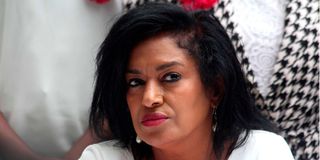
Nairobi County Woman Representative Esther Passaris.
Photo credit: Bonface Bogita | Nation Media Group
Another significant charge is the alleged lack of transparency in how funds from the National Government Affirmative Action Fund (NGAAF), allocated to her office, have been used.
The fund is intended to support vulnerable groups, including women and youth.
The petitioners claim the MP has resisted calls to publish audited reports or provide even basic information on fund allocation and spending, raising serious concerns over accountability and potential misuse of public resources.
The petition also accuses the legislator of spreading disinformation in public forums, misleading citizens on key policy matters and misrepresenting her legislative contributions.
The activists contend that these actions amount to violations of multiple constitutional provisions, including Articles 10, 35, 73, 75, 95, and 232 — which address principles of governance, access to information, conduct of state officers and public service values.
They also invoke Chapter Six of the Constitution, which outlines the principles of leadership and integrity, asserting that she has failed to meet the ethical standards expected of public office holders.
Beyond the legal arguments, the petitioners describe their initiative as both symbolic and civic-minded, aimed at rekindling public agency and holding elected leaders accountable.
The Nation made several attempts to reach Ms Passaris for comment regarding the recall petition. Text messages were sent to her phone asking whether she was aware of the petition, whether she had received a copy, her thoughts on the alleged constitutional violations, and her view on the motivation behind the effort.
However, by the time of going to press, Ms Passaris had not responded to the messages or returned calls.
For Ms Wafula, the lead petitioner, the move is about more than just one individual but about reviving the public’s constitutional power.
“I’m actually very confident that when we start collecting signatures, it will be possible to get more than one million. Despite filing the petition under my name, I represent many voices — people in social justice networks, online communities, and our neighbourhoods. We have the numbers. What I am more concerned about is the murkiness of the recall process itself,” she said.
Should the IEBC validate the petition, the petitioners will be required to collect at least 750,000 valid signatures — representing 30 percent of Nairobi’s 2.5 million registered voters.
These signatures must also reflect support from at least 15 percent of voters in at least half of Nairobi’s wards.
Once collected, the IEBC will have 30 days to verify the signatures. If verification is successful, the Commission must notify the Speaker of the National Assembly, who is then required to call a recall election within 90 days.
For the recall to succeed, at least 50 percent of all registered voters must participate in the election, with the majority voting in favor of the recall.