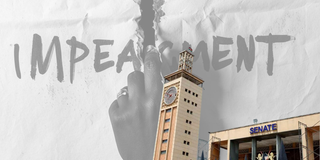
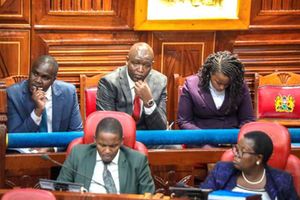
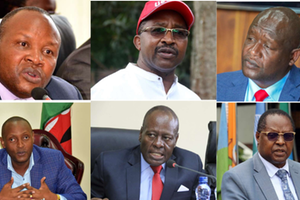
A dark cloud of impeachments hanged ominously throughout the year with three governors taken through the political guillotine as political battles between governors and MCAs characterised the year.
Kericho Governor Erick Mutai, his Isiolo counterpart Abdi Guyo and Nyamira Governor Amos Nyaribo made headlines as their turf wars with their ward representatives resulted in attempts at removing them from office by impeachment.
On November 25, Governor Nyaribo – who is fast becoming a poster boy of failed ouster motions at the assembly – once again faced his political adversaries, third of such an attempt since his re-election in 2022.
Nairobi City County Governor Johnson Sakaja when he appeared before the Senate’s County Public Investments Committee at Bunge Tower in Nairobi on July 21, 2025.
Photo credit: Dennis Onsongo | Nation Media Group
Nairobi Governor Johnson Sakaja also survived a bid to remove him from office by impeachment in September following the intervention by President William Ruto and the late ODM party leader Raila Odinga .
The plot was looking ominous after 87 MCAs appended their signatures to the ouster bid, forcing a politically-shaken Sakaja had to quickly employ the help of former Westlands MP Fred Gumo and Suna East MP Junet Mohamed – a close confidant of the former premier – to reach out to Odinga to save him from an imminent removal from office.
The first time governor, who has been accused by the MCAs of being inaccessible, was suddenly reachable and available for the meetings as he intensely lobbied, putting up a spirited fight for political survival.
However, it took a series of meetings for the county legislators to be prevailed upon to shelve the ouster plot and save Mr Sakaja the ignominy of being the fourth governor to be impeached since the 2022 elections.
For Governors Mutai and Guyo, their ouster bids succeeded at the assembly level only to be thrown out at the Senate due to technicalities.
Isiolo Governor Abdi Guyo when he appeared before the Senate in Nairobi on November 14, 2024.
Photo credit: Dennis Onsongo | Nation Media Group
For Dr Mutai, it was the second time he was surviving an impeachment at the Senate on a technicality, casting the spotlight on county assemblies and their conduct of impeachments.
Governor Guyo had also a month earlier escaped an imminent removal from office on a technicality after the MCAs could not prove that a sitting happened leading to the Senate ruling that an impeachment process is as important as the outcome.
The failed bids have exposed the hurried nature of some of the ouster motions, with some pointing to political witch hunts in the process.
The ugly political showdowns, most characterised by battle for multi-billions controlled by governors and succession politics, are threatening to turn county assemblies into theatres of “impeachments to nowhere”.
Apart from the two failed bids at the Senate, several governors have also been saved by the court over the shambolic nature of impeachment motions advanced by county assemblies.
The Senate has handled at least 20 impeachment proceedings since the advent of county governments in 2013.
Of the 20 cases, in eight instances, the Senate has found the charges against a State officer to have been substantiated and has confirmed the impeachment.
However, the bulk of the instances have been cases against Martin Wambora – the former Embu governor – who became a “poster boy” of impeachment survival during his 10-year tenure at the Mt Kenya East county.
Embu governor Martin Wambora in jubilation after the court reinstated him as Embu governor on April 16, 2014. Mr Wambora has lost his bid for Embu senatorial seat.
Photo credit: George Munene I Nation Media Group
Mr Wambora faced a record four impeachment attempts but challenged each in court and emerged victorious, even after the Senate upholding resolutions by the Embu County Assembly.
The two-time governor quickly earned the moniker a “governor with nine lives” but Governor Mutai is fast inheriting the nickname from Mr Wambora.
In nine instances, the Senate has found the charges not to be substantiated and has not confirmed the impeachment against the State officers.
The other three instances have seen the impeachment motions terminate on a technicality for failure to meet impeachment threshold and other grounds of the law.
Interestingly, since 2022, the Senate has handled at least five impeachment motions against three governors with only one being successful.
The other two impeachments have been for deputy governors for Siaya and Kisii where only the latter succeeded.
The other deputy governor to face the Senate was Bernard Kiala (Machakos) who in 2020 escaped impeachment after Senators rejected a report by a special committee.
Between 2013 and 2020, there were five attempts to send governors home by MCAs. However, the Senate upheld only that of Mr Wambora but even that was thrown out by the court.
Seen as a tool of governance and accountability, the two cases continue to show how county assemblies have weaponised the impeachment motions into tools of witch-hunting.
Consequently, MCAs have turned into lynch mobs with some governors finding themselves in trouble because of differences with the ward representatives, some of them dancing to the whims of the governors’ political rivals.
Kirinyaga Senator James Murango said that for the Senate to confirm the impeachment of a governor, everything, including the process and evidence, must be beyond reasonable doubt.
He challenged the MCAs to stop overlooking the process of impeachment as the law is keen on the threshold being met.
“When you impeach a governor, you have condemned them to some political oblivion and so the reasons must be beyond and one of the important things is the process,” said Mr Murango.
When the late former Nyeri Governor Nderitu Gachagua was impeached by MCAs in 2016, senators rejected all the charges brought against him, saying the charges did not meet the threshold for impeachment.
Taita Taveta Governor Granton Samboja.
Photo credit: File | Nation Media Group
Fast forward to 2019, former Taita Taveta Governor Granton Samboja was impeached by MCAs, but survived at the Senate.
However, a report by an 11-member special Senate committee found the particulars of the allegations against the governor did not meet the threshold for impeachment.
“MCAs are handing over a poisoned chalice to the Senate, expecting it to process it. We are saying that they need to get it right from the procedure,” added Homa Bay Senator Moses Kajwang’.
Most ouster motions accuse governors of corruption, harassment, and abuse of office, while the affected leaders maintain that they are victims of politically motivated witch hunts.
But the Council of Governors boss Ahmed Abdullahi decried the misuse of impeachment by MCAs, saying most are driven by politics, factional wars and succession fights rather than genuine accountability concerns.
He argued that most ouster motions are a result of political struggles in counties and not based on impeachable misconduct.
“A lot of these impeachments have got to do with the toxic politics in our Counties; there are factional struggles, succession plan issues, and it is not always about mismanagement,” said the Wajir Governor.
He stressed the ambiguity surrounding the legal framework for impeachment, noting that the line between legal and political grounds for impeachment remains unclear.
While criticising misuse of impeachments to settle political scores, the second term governor said an impeachment should serve as a last resort and not the first weapon in political battles or disagreements.
“Impeachments should be a safety valve when things don’t work; it shouldn’t be the first arsenal that you throw at someone. We don’t even have a threshold for abuse of office, gross misconduct, and violating the Constitution? Even lawyers don’t agree whether impeachment is a legal or political process,” Governor Abdullahi said.
Alarmed, Senate Speaker Amason Kingi said he has called for a meeting with his counterparts from the assembly in a bid to streamline the impeachment process with a view to eliminating "unconstitutional" ouster motions, which often fail on technicalities, from finding their way to the Senate.
Senate Speaker Amason Kingi at the Senate in this picture taken on Wednesday, May 3, 2023.
Photo credit: Dennis Onsongo | Nation Media Group
Mr Kingi said impeachments are guided by law which MCAs must follow before attempting to remove anyone from office by impeachment.
“We can talk all we want but if we don't follow the law, then any impeachment will go nowhere. We must ensure we follow the law guiding impeachment so that the motion doesn't fall at the Senate,” said Speaker Kingi.
“But if this is not followed, then the governors will continue going Scot-free. That's why I have called for a meeting with all speakers in the country to wrap our heads around this issue by ensuring we follow the law and each step is adhered to,” he added.
Kakamega Senator Boni Khalwale said that going forward, there is an urgent need for the Senate to develop a manual that can guide MCAs to tick off.
“MCAs tend to focus more on the reasons for impeachment while putting less weight on the process. So it is very difficult for senators to condemn a governor when the process was bordering on illegality and so they will fall flat when it comes to the Senate. Example is the case of Kericho,” says Mr Khalwale.
However, Narok Senator Ledama Olekina said the Senate should do away with the issue of technicality to allow senators to listen to the substance of such motions.
“MCAs are doing their job and they should be supported. We must disregard the technicality and trust our institutions in accordance with Article 159(2) of the Constitution.”