The death of Raila Odinga has not only marked the end of a political era but also thrust his daughter, Winnie Odinga, into the center of Kenya’s national political stage.
Long positioned on the periphery of her father’s formidable political machinery, Winnie has now emerged as an important figure in the emotional and symbolic response to his passing.
In the days following Raila’s death, her calm composure and commanding presence—from India, where she had accompanied him, to the moment she returned to Nairobi—have transformed her from a supporting actor into a defining presence in the unfolding political landscape.
Winnie Odinga's touching tribute to her father Raila
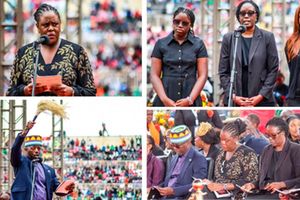
At Nyayo National Stadium and in Bondo, where the funeral service drew a sea of mourners, Winnie’s voice rose above the choir of grief. She didn’t sound like a young politician trying to be heard.
She sounded like someone who had always been listening, and now, finally, was ready to speak. “The king is dead,” she declared. “But long live the crown.”
The words rippled through the stadium like a verdict. She listed her father’s nicknames — Tinga, Jakom, Nyundo, Baba — each one a chapter in a long, unfinished book.
She mimicked his laugh, spoke of service over power, and then, as though to summon the memory into the present, she began to sing one of his favorites: Harry Belafonte’s Jamaica Farewell.
Winnie Odinga speaking during the State funeral of former Prime Minister Raila Odinga at Nyayo National Stadium on October 17, 2025.
Photo credit: Lucy Wanjiru | Nation Media Group
The crowd, thousands strong, followed her lead. “Down the way, where the nights are gay,” they sang, not as a farewell but as a promise. When Winnie changed the line to “I have to leave a little girl in Bondo town,” the little girl was both memory and mantle.
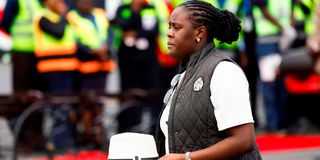
In Bondo, Winnie chose to say little – and thank Jakom’s staff. Yet it was her face the country remembered—firm, unsmiling, clutching her father’s iconic hat on the airport tarmac. In that moment, she was no longer a supporting figure in the Odinga story; she became its frame.
The hat, so often perched on Raila’s head at rallies, carried the weight of decades of rebellion and resilience. When Winnie handed it to Ida Odinga, the gesture transcended personal grief: she was not merely a mourning daughter, but a political symbol in real time.
The Odinga name has loomed over Kenyan politics for more than half a century. But what Winnie seems to carry is not the dynasty in its old form — not Jaramogi’s stately defiance, not the family’s ancestral claim to opposition politics — but the Raila brand. Baba.
The street chants, the songs, the hat, the cadence of a man who built a political identity that existed somewhere between myth and memory. She grew up fluent in that language. While many political heirs arrive swaddled in history but untested by its storms, Winnie has been in the crowd, not just above it.
During the Azimio la Umoja protests in Nairobi, she wore jungle pants, a half-jacket, and boots, and marched. When her phones were hacked, she didn’t retreat behind press officers. She posted, “All electronics hacked! All completely unusable, all dead! Meet me in the streets.”
It wasn’t scripted. It was raw — the kind of raw that makes a crowd believe you’re one of them. When police targeted her car, Raila himself condemned it. His outrage was both paternal and political, drawing a line between a father’s daughter and a movement’s heir.
Winnie had already entered formal politics in November 2022, when she was nominated to the East African Legislative Assembly by the Orange Democratic Movement. Then, it seemed like the kind of quiet nepotism that Kenyan politics has perfected: a famous last name opening a door. But death has a way of rearranging narratives.
In the days after Raila’s passing, Winnie stopped being a footnote in the dynasty and became its most vivid paragraph.
ODM named Oburu Odinga party leader, a gesture toward continuity. But the crowd — the real, sweating, chanting crowd that made Raila who he was — didn’t chant “Oburu.” They chanted “Baba.” And in the absence of Baba, their eyes turned to the person holding his hat.
This is the strange and potent nature of the Raila brand. It isn’t bureaucratic. It isn’t even institutional. It’s emotional. It lives in symbols and stories, in the call-and-response of rallies, in the collective memory of a man who seemed indestructible until he wasn’t.
Winnie, perhaps more instinctively than strategically, has leaned into that emotional current. She doesn’t speak as the heir to an Odinga throne. She stands as the keeper of Raila’s language — the songs, the jokes, the sharp quips, the moral cadence of service before power. And in Kenyan politics, that kind of symbolism is often more powerful than a title.
Winnie Odinga places the trademark headgear, synonymous with the style of the former Prime Minister, Raila Odinga, on his casket. His body is expected to arrive at JKIA from India at 9:30 am.
Photo credit: PCS
But symbolism is not strategy. Winnie faces the jagged reality that comes after the chants die down. The ODM party is thick with veterans who have waited decades in Raila’s shadow. Governors, senators, MPs — men and women with their own ambitions.
They will not yield to a thirty-something woman whose political résumé consists of a nomination and a famous last name. If she wants to lead, she’ll have to earn it in the blood sport of Kenyan elections. The Raila brand can open the gate, but it cannot walk her through it.
Still, she is uniquely positioned. Kenya’s youth — restless, disillusioned, and weary of the same faces — see in her something they do not see in the party elders. Not polish, not policy, but familiarity.
A kind of proximity to power that doesn’t feel alien. When she speaks, they don’t hear a politician reaching down from a podium; they hear someone raised in the protest tent, someone who learned politics not from books but from the front row of rallies.
And she has something else: timing. Kenya’s opposition has been left with a vacuum that no one else can fill. Raila’s shadow was too long, his myth too thick. William Ruto governs, but Raila’s absence defines the opposition space more than anyone else’s presence. Winnie doesn’t have to build a movement from scratch. She only has to keep it from crumbling.
Family of the late former Prime Minister Raila Odinga, led by his wife Mama Ida Odinga, daughters Rosemary Odinga and Winnie Odinga and son Raila Odinga Jr, at Nyayo National Stadium on October 17, 2025, for his state funeral.
Photo credit: Lucy Wanjiru | Nation Media Group
Her strategy may not follow the predictable script. She could seek an elective seat — a parliamentary constituency in Nyanza, perhaps — to build legitimacy. Or she could stay where she is, neither fully in power nor out of it, becoming something less tangible but more dangerous to the establishment: a lodestar. The person who can summon crowds with a phrase, who can keep Baba alive not as a statue but as a story.
The Raila brand has always belonged to the people more than to the party. It is not a lineage. It is a rhythm. Not “Odinga” — which belongs to history, to family — but “Raila,” the name the crowds chant.
Winnie understands this distinction, whether she says it out loud or not. She does not need the family name to move people. She only needs the hat, the song, the voice that carries a memory they all recognize.
This is both her opportunity and her peril. If she inherits Raila’s hat, she will too inherit her father’s enemies. In Kenya, power does not tolerate heirs lightly – and Raila knew that quite well and had to fight to make his brand outside the Jaramogi factor.
Winnie will move lightly through this moment, as though aware but not overwhelmed. Her words might be measured. Her appearances might be few like a person who knows that in politics, silence can speak louder than speeches, that myth thrives best in suggestion, not declaration.
From left: Raila Odinga's sister Ruth Odinga, daughter Winnie, Prime Cabinet Secretary Musalia Mudavadi and Interior Cabinet Secretary Kipchumba Murkomen alight from the KQ flight that ferried the remains of the former Prime Minister at JKIA in Nairobi on October 16, 2025.
Photo credit: BILLY OGADA | NATION
In the end, Winnie Odinga may or may not want to lead. But leadership has a way of finding those who carry symbols. She carries Raila’s hat. The crowd still chants “Baba.”
And somewhere in the hush between mourning and ambition, a young woman is learning to wear a legacy not like a crown, but like a second skin. Now that she literary carried Raila’s hat, will she throw it into the ring?