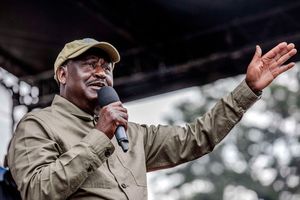
For former Prime Minister Raila Odinga, who died on Wednesday in India, nothing was ever left to chance. Every gesture, every word, every appearance was a calculated move, meticulously planned and executed. His presence, both commanding and charismatic, left indelible marks wherever he went.
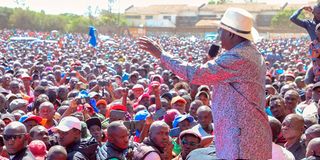
Azimio la Umoja leader Raila Odinga addresses a political rally at Jacaranda grounds in Nairobi County on January 29, 2023.
Photo credit: File | Nation Media Group
From his fashion choices and walking style, to his cadence in speech, signature dance and sartorial adaptations to suit his audience, the Luo supremo wielded his image as a potent tool of communication. His brand became unmistakable, woven into the fabric of Kenyan public life.
Here, the Nation reflects on 10 of Odinga’s enduring trademarks that shaped his lifestyle and profoundly influenced his supporters.
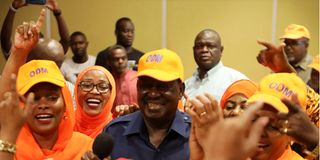
ODM leader Raila Odinga (centre) is mobbed by coast women leaders during an ODM meeting in Mombasa on October 13, 2024.
Photo credit: Kevin Odit | Nation Media Group
Whenever the now-famous chant “Haiya, Haiya” rang out, it heralded Raila's arrival on stage, primed to impart his wisdom. This synchronised call-and-response with the crowd transcended mere theatrics; it was a ritual that inspired anticipation. More than a greeting, it was a conversation, a coded affirmation of loyalty between leader and people.
Bishop Prof David Kodia of the Anglican Diocese of Bondo captured this spirit during Mr Odinga’s funeral service at Nyayo National Stadium: “If Raila was here, he would start by saying ‘Haiya, Haiya’, and everything would go well.”
True to form, Raila Odinga Jr began his tribute in the same way, echoing his father's unmistakable voice.
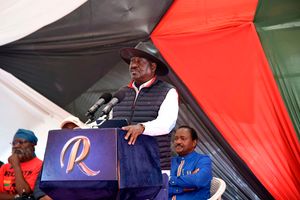
Azimio la Umoja Coalition presidential candidate Raila Odinga with his running mate Martha Karua campaign in Kawangware, Nairob, on July 16, 2022.
Photo credit: Pool
Raila’s use of riddles (kitendawili) was not mere flair - it was a cultural bridge and rhetorical art form. With these riddles, he distilled complex political ideas into accessible, memorable tales that resonated with millions. His mastery earned him the moniker "Yule mtu wa Kitendawili" - the man of riddles - even from his one-time rival, now President, William Ruto.
Far beyond political gimmickry, the riddles allowed Mr Odinga to communicate in a language deeply embedded in Kenyan oral tradition, evoking thought, wit, and laughter in equal measure.
3. Historian, Storyteller, Living Library
Former Prime Minister Raila Odinga reads a copy of his father Jaramogi Oginga Odinga's book "Not Yet Uhuru" at his Karen home in Nairobi.
Photo credit: File | Nation Media Group
To his friends, Mr Odinga was not just a politician, he was an encyclopedia of lived history. His close friend, Mzee Olang’o Nyabola, lamented:
Mr Odinga's passion for books and history was well known. A voracious reader and supporter of public libraries, he believed deeply in the transformative power of knowledge. His stories, laced with historical references, gave his speeches weight and dignity.
President William Ruto looks former Prime Minister Raila Odinga's daughter, Winnie Odinga, hands her father's white fedora hat to her mother, Mama Ida Odinga, at the Jomo Kenyatta International Airport, Nairobi on October 16, 2025.
Perhaps no accessory was more synonymous with Raila than the Panama hat - light-coloured, breathable and timeless. Also known as a Jipijapa or toquilla straw hat, it became a staple of his wardrobe, pairing perfectly with his linen suits.
One poignant moment came when his daughter, Winnie Odinga, brought his favourite hat back from India and knelt to present it to her mother. The hat now rests atop his casket, a symbol of the man’s enduring elegance.
Following his death, traders in Nairobi and Kisumu began selling Panama hats en masse. Others dusted theirs off in tribute, donning them in honour of a fallen icon.
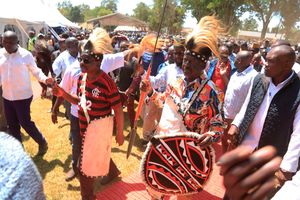
Former Prime Minister Raila Odinga (second left) and other leaders pay their last respects to former Education CS Prof George Magoha at Odera Akang'o grounds in Yala, Siaya on February 11, 2023.
Photo credit: File | Nation
In Luo tradition, the orengo, a fly whisk made from a cow's tail, is a revered symbol of authority. For Mr Odinga, it was more than ceremonial; it was an extension of his identity. He carried it at cultural ceremonies and funerals, signalling not just his status, but his deep-rooted connection to tradition.
Azimio la Umoja leader Raila Odinga (right) and the spouse, Mama Ida Odinga, join in a dance during the 30th memorial anniversary of Kenya's first Vice President Jaramogi Oginga Odinga at Ofafa Memorial Hall in Kisumu on January 20, 2024.
Photo credit: Ondari Ogega | Nation Media Group
Where others danced to the beat, Mr Odinga danced to his own rhythm. His unmistakable slow-motion jig, complete with hand gestures, eye rubs and a playful twist to the ground, was instantly recognisable. DJs across Kenya would call upon revellers to “dance like Raila,” and they would obey with joy.
Even in mourning, many may choose to honour him with one last dance, his iconic jig serving as a timeless echo of the man himself.
Raila sings his favourite reggae song - Jamaican Farewell
Raila didn’t just love music; he lived it. His dance moves complemented every rhythm and his appreciation for lyrics made him a musical figure in his own right. Supporters fondly called him “Baba”, and his playlist became a soundtrack to political rallies and national moments.
Since his passing, his favourite song - Jamaican Farewell by Harry Belafonte - has played widely in tribute. Other favourites included Unbwogable by Gidi Gidi Maji Maji, Kigeugeu by Jaguar, Iron Lion Zion by Bob Marley, Lucky Dube’s Nobody Can Stop Reggae and Emmanuel Musindi’s Lelo ni Lelo. Every track became an anthem when it passed through his hands, just like King Midas, every song he touched turned to gold.
Former Prime Minister Raila Odinga.
Photo credit: Sila Kiplagat | Nation Media Group
Mr Odinga’s love for football was legendary. Though not a professional sports pundit, he would often employ football metaphors to illustrate political strategies and national issues. On the campaign trail, he cast himself as the captain, scoring the “winning goal” for the people - a goal that, metaphorically, always eluded the presidency.
His figurative commentary made politics relatable, turning complex matters into captivating narratives that enthralled his audience, whether in dusty village fields or city stadiums.
9. Gor Mahia, Arsenal – The Teams of His Heart
ODM leader Raila Odinga hands over the SportPesa Premier League trophy to Gor Mahia players on September 30, 2018.
Photo credit: Tonny Omondi | Nation Media Group
Mr Odinga’s football loyalties were clear: Gor Mahia locally, Arsenal internationally. These two clubs, already boasting massive fanbases, found even greater loyalty among his supporters - who began calling them Timu ya Baba (Baba’s team).
His love for the game became their love too. In the days following his death, an unverified but widely circulated message purporting to be from Arsenal paid tribute to him, underscoring how deep this connection ran.
Former Prime Minister Raila Odinga pays tribute to the former President Daniel arap Moi during his funeral service at Kabarak grounds on February 12, 2020.
Photo credit: File | Nation
In Luo culture, “Jowi!” - meaning buffalo - is an exclamation of strength and mourning. It signifies bravery and charge qualities Mr Odinga embodied in the eyes of many.
As his casket journeyed through crowds, cries of “Jowi!” pierced the air, young and old, men and women, all invoking the spirit of the buffalo to honour their departed warrior. Over time, “Jowi!” evolved into more than a chant; it became a collective cry of hope, defiance and remembrance.