It has been a defining week for Dr Oburu Oginga, the elder brother of former Prime Minister Raila Odinga , and now the man at the centre of Kenya’s political recalibration.
Since Raila’s death in India while receiving treatment on October 15, the Orange Democratic Movement (ODM) — once synonymous with Odinga — has been forced into transition.
And at the heart of this new phase stands Dr Oginga, the seasoned politician and senator of Siaya, who now carries the family mantle, community stewardship role and the delicate task of guiding ODM through uncharted waters.
At 82, Dr Oburu is no stranger to power. He has lived through Kenya’s entire post-independence political arc — from the defiant nationalism of his father and Kenya’s first Vice-President Jaramogi Oginga Odinga —to the populist firebrand politics of his brother, Raila.
Yet never before has his role been so consequential. In the wake of Raila’s death and burial in Bondo on October 19, ODM’s National Executive Committee (NEC) designated Dr Oburu as the interim party leader. He received the endorsement of the party’s Central Management Committee (CMC) on Monday — a move seen as both symbolic and strategic. The senator chaired the meeting in Nairobi.
Dr Oburu is expected to meet ODM’s partner in the broad-based arrangement, President William Ruto’s United Democratic Alliance (UDA). Prior to that, delegations of MPs, governors, and MCAs streamed to Bondo to pledge loyalty to him.
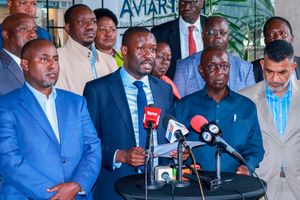
Orange Democratic Movement (ODM) Party leader and Siaya Senator Oburu Oginga (second right) and Secretary-General Edwin Watenya Sifuna address members of the press in Nairobi on October 27, 2025.
Photo credit: Dennis Onsongo | Nation Media Group
Dr Oburu found a busy in-tray in Nairobi. His handlers said that more politicians and businesspeople are booking appointments to meet him.
ODM co-deputy party leader Abdulswamad Nassir said Raila’s demise has left big shoes to fill, not only in the party, but also in his Nyanza backyard and the country at large.
“…the ODM NEC designated the Senator of Siaya County, Hon Dr Oburu Oginga, to be the acting party leader until the top party organs elect a substantive leader to fit in the big shoes left by our departed leader,” said Mr Nassir.
Other sources said that the decision to settle on Dr Oburu was influenced by three factors: lineage, loyalty, and legacy. It was also pushed largely by the pro-broad-based group.
“He represents continuity. In this moment of grief, the party needed a unifying figure — someone whose loyalty to Raila and ODM’s ideals was unquestionable,” said a senior ODM official who requested anonymity.
Dr Oburu has since assumed the role of custodian of the broad-based government — a delicate arrangement that was formed months before Raila’s death.
The deal, initially perceived as a political truce, has evolved into a platform for power-sharing and national stability. And, Dr Oburu, by virtue of his new role as interim ODM leader, now acts as the bridge between the two political formations. It’s a role that demands tact and maturity.
Raila’s departure left a vacuum — not just in ODM, but in Kenya’s broader opposition politics. His death softened partisan lines, paving the way for what insiders describe as “a negotiated coexistence.”
Dr Oburu’s task, therefore, is to safeguard ODM’s political relevance without appearing to surrender its independence.
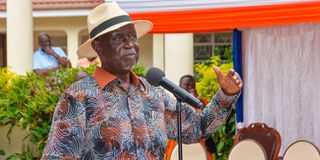
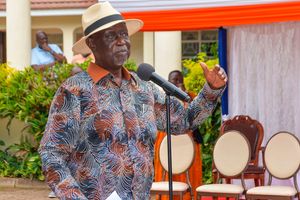
ODM party leader Oburu Oginga.
Photo credit: Reuters
A senior ODM official said: “Oburu is playing a stabilising role. The country is healing, the party is reorganising, and he’s the one person everyone — from the grassroots to the government — can talk to without suspicion.”
In recent days, Dr Oburu has held meetings with key figures in the government and in ODM. And for many within ODM, his new role evokes the enduring legacy of the Odinga family.
From Jaramogi’s days to Raila’s decades of opposition leadership, the Odingas have been central to Kenya’s political history.
Dr Oburu has often operated behind the scenes — as a trusted and influential adviser, a strategist, and a custodian of the family’s political ideology.
“The bond between Raila and Oburu was so tight that if you were clever, and needed something from Raila, you’d first toss it with his brother to make it easier for you,” Raila’s widow, Ida Odinga, said during his burial.
Dr Oburu once served as Assistant Minister for Finance under the Grand Coalition Government, which exposed him to the workings of statecraft.
Analysts say his deep understanding of both government and party politics now makes him a natural choice to steer ODM during this transition.
Yet, even as ODM politicians rally behind Dr Oburu, questions linger about succession and renewal. Young Turks are positioning themselves as heirs to Raila’s political empire.
Siaya Senator Oburu Oginga eulogises his brother Raila Odinga during the funeral service at Jaramogi Oginga Odinga University grounds in Bondo, Siaya County on October 19, 2025.
Photo credit: Sila Kiplagat | Nation Media Group
He says questions about succession were misplaced, insisting that the party has many able leaders ready to take charge when the time comes.
“Some people have been asking how I will steer this party at my age and how we shall handle succession. I told them that any of the existing ODM leaders has the capacity to lead,” he said in Bondo last Friday.
He likened leadership emergence to the natural growth of mushrooms, saying, “Leaders emerge just like mushrooms grow. You just wake up one morning and find them grown. That’s how God works by elevating leaders.”
Dr Oginga noted that even his late brother Odinga was never formally appointed by the Luo community but rose through his own political strength and vision.
“There was never a meeting to elect Raila as the Luo leader. He just emerged, and that was it,” he said.
He reaffirmed ODM’s commitment to the broad-based government arrangement, saying Odinga left the party within that framework.
“This government is the best for our people. We hope that come the next election, we shall fully sit in it. At the moment, we cannot claim much because we did not vote for it,” he said.
At the CMC meeting on Monday, the party announced its commitment to President William Ruto's broad-based government until 2027.
Leaders Oburu Oginga and Raila Odinga during a Christmas service at St Peter ACK Church in Bondo on December 25, 2018.
Photo credit: File | Nation
“We reiterate the commitment of the Party to the broad-based government until 2027, a relationship guided by the 10-point agenda entered into for the sake of peace and stability of the Country,” the party said in a statement read by Secretary-General Edwin Sifuna, a fierce critic of the arrangement with Kenya Kwanza.
Party insiders say Dr Oginga’s interim leadership could provide a cooling-off period before ODM convenes a national delegates’ conference to elect a substantive leader.
For now, Dr Oginga’s priority is to keep ODM intact. The party risks fragmentation from within as factions emerge — those favouring continued collaboration with government, and those calling for a return to opposition politics.
Dr Oginga has tried to strike a balance. Speaking in Bondo after Odinga’s burial, he said, “We will not abandon Raila’s dream of a just and prosperous Kenya. But we must also embrace dialogue and unity. Kenya cannot progress when we are constantly at war with each other.”
Those words signalled a pragmatic shift — an acknowledgement that the old confrontational politics may no longer serve ODM in this new era.
Political analyst cum advocate Chris Omore observes, “Oburu’s leadership will likely be transitional.
Leaders Oburu Oginga and Raila Odinga during the Jaramogi Oginga Odinga Silver Jubilee Anniversary service at the St. Stephens ACK Cathedral in Kisumu on February 17, 2019.
Photo credit: File | Nation
His role is to protect the legacy, manage the mourning phase, and prepare ODM for a generational handover.
But in the meantime, “he’s become the de facto power centre — both in ODM and in the wider reform movement Raila built.”
For years, Dr Oginga was known more for his family name than for his political ambitions.
But in the days following Odinga’s passing, his tone and posture have shifted. In public appearances, he exudes a mix of solemn authority and calm confidence.
His statements are carefully measured — neither confrontational nor submissive — and his meetings with both ODM and UDA figures suggest a man aware of the weight history has placed on him.
As the ODM realignment unfolds, many believe Dr Oginga’s leadership could either solidify his late brother’s legacy or mark the beginning of ODM’s redefinition.
The next few months will be decisive — not just for the party, but for Kenya’s political balance.
He now stands where history has once again placed the Odinga name — at the crossroads of power, loyalty, and transition.
And as ODM adjusts to life after Odinga, it is Dr Oginga — the once-quiet brother — who has become the new centre of gravity, holding together a movement built on struggle, sacrifice, and hope.