On June 22, 1986, football legend Diego Maradona astonished football lovers during the World Cup quarter-final between Argentina and England.
His first goal, later immortalised as the “hand of God”, remains one of the most debated moments in sporting history.
Maradona would later jest that the goal was scored “a little with the head of Maradona and a little with the hand of God.”
In Kenya’s political theatre, a similar metaphor has long defined the life and legacy of Raila Odinga , the man whose symbolic “hand” shaped the destinies of countless politicians.
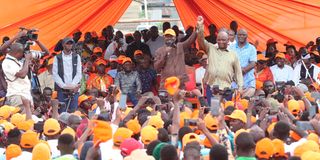
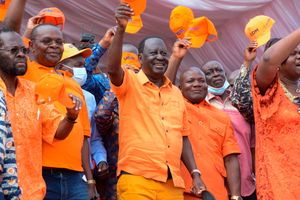
For decades, Odinga’s gesture of lifting a candidate’s hand before a jubilant crowd was more than an endorsement; it was an anointment, a touch that bestowed legitimacy, even divinity, in the eyes of millions of his followers.
Those who received the gesture were rarely defeated at the ballot box. Like Maradona’s infamous goal, Odinga’s “hand” blurred the line between earthly skill and divine favour and its absence is now reshaping Kenya’s political landscape.
As the clock ticks towards the 2027 General Election, the void left by Odinga's passing is being felt deeply within the Orange Democratic Movement (ODM), the party he founded and led for more than two decades.
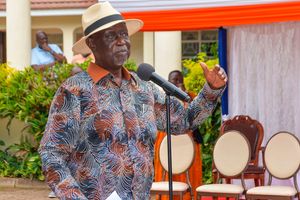
Former ODM leader Raila Odinga endorses Gladys Wanga to run for Homa Bay governorship at Agoro Sare High School on July 3, 2022.
Photo credit: George Odiwuor | Nation Media Group
His “word”, whether proclaimed at a rally or whispered in backroom negotiations, could make or unmake a political career.
Political commentator Samuel Owida notes that Odinga’s mere presence at an event acted as a springboard for aspiring leaders.
“Raila lifting a politician’s hand would instantly transform how people perceived that person. It was often enough to guarantee victory,” he said.
According to Mr Owida, the gesture could sway up to 50 per cent of the votes in a politician’s favour across constituencies in Nyanza.
“A lot of people owed their political survival to the former prime minister. His death will certainly disrupt that order. There will be a paradigm shift in how politics is conducted,” he added.
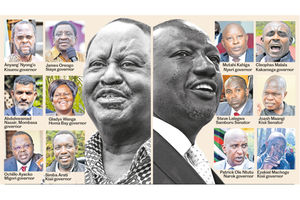
During the 2022 elections, that influence became institutionalised through direct party nominations, an approach that drew both criticism and admiration. In Mombasa, ODM directly handed certificates to Mishi Mboko (Likoni), Badi Twalib (Jomvu), Omar Mwinyi (Changamwe), Rashid Bedzimba (Kisauni) and Masoud Machele (Mvita).
The same pattern played out in Nyanza, where James Orengo (Siaya), Prof Anyang’ Nyong’o (Kisumu), Ochilo Ayacko (Migori), and Gladys Wanga (Homa Bay) were crowned without contest. Others who benefited included Opondo Kaluma (Homa Bay Town), Dr Otiende Amollo (Rarieda), Millie Odhiambo (Suba North), Dr Lilian Gogo (Rangwe), and Dr Eve Obara (Kabondo Kasipul).
These direct endorsements were seen as Odinga’s ultimate show of faith, a political benediction that transcended internal party competition. For many, it was the equivalent of Maradona’s divine hand: controversial, decisive and game-changing.
Now, without the former PM, the ODM machinery faces an identity crisis.
During a church service in Kisumu on Sunday, his sister, Ruth Odinga, captured the prevailing uncertainty.
“At the moment, there are too many stories; people are asking who is aligning with whom. Everybody is confused; even we, the politicians, have no one to hold our hands," she said.
ODM party leaders Wycliffe Oparanya (left) and Hassan Joho endorse Mr Raila Odinga as the party's 2017 flag bearer, on September 10, 2016.
“It is high time the boys were separated from the men, people believed that once you had an ODM ticket, victory was automatic. That myth is gone," he cautioned.
Mr Sungu expressed confidence in Odinga’s elder brother, Dr Oburu Oginga, who now steers the ODM ship.
“Dr Oburu is capable and will lead us. But times have changed. Leadership will now come from the people, not from one man’s hand,” he remarked.
In the years before his death, Odinga’s physical presence at rallies was more than symbolic; it was transformative.
Candidates jostled, sometimes literally, for the privilege of standing beside him, of being seen as his chosen one.
Homa Bay Bunge la Mwananchi leader Walter Opiyo believes that this culture deprived voters in the lake region of a genuine democratic choice.
“Different people interpreted Raila’s gesture differently. He never explicitly told people who to elect, but his act of lifting a candidate’s hand carried enormous weight; it influenced how people voted," he said.
Mr Opiyo, however, warned that leaders must now work harder to earn re-election.
Suba North ODM chairperson Narkiso Tuko, agreed, saying that only the truly popular candidates will survive the next electoral cycle.
“This will affect both nominations and the General Election,” he said.
The former premier’s hand built a generation of politicians, some loyal, others opportunistic. His charisma and populist energy transformed ODM from a mere party into a movement, a cultural identity for millions of Kenyans.
However, political analyst Peter Ogallo argues that this influence also bred complacency.
“Many leaders built their careers around Raila’s name rather than their development records. Now that he’s gone, they can no longer hide behind that shadow," Mr Ogallo said.
He further noted that the common campaign slogan pledging to “help Raila at the national level” no longer resonates.
“That message died with him. Voters now demand roads, hospitals and jobs. It’s no longer enough to say you stood with the late Odinga; now you must stand for something," he said.
Some party insiders suggest that the forthcoming by-elections in Kasipul and Ugunja will serve as a litmus test. Without Odinga’s physical endorsement, candidates will have to persuade voters through ideas and action, a radical shift in a region where loyalty once outweighed merit.
“Odinga’s presence used to tilt elections instantly; now, candidates must build their own networks and engage directly with the electorate. The days of waiting for the lifted hand are over,” said Mr Owida.