Gideon Moi is not a man of political rallies and fiery speeches. His is a politics of quiet corridors and closed doors – a game of silence, calculation, and soft leverage.
When he walked into State House, Nairobi, this week and later withdrew from the Baringo senatorial by-election, it wasn’t an act of surrender.
It was a bargain – a deal struck not before cheering crowds but in the low hum of power, where dynasties and presidencies whisper to each other.
It was the moment a house that once ruled from the peak of Kenyan politics chose to negotiate its place in the new order rather than challenge it.
Gideon inherited two names that once shaped the nation’s destiny: the Moi name – a dynasty stitched into the fabric of Kenya’s political memory – and Kenya African National Union (Kanu), the once indestructible pillar of post-independence power. Both have dimmed with time, but their symbolic capital remains potent, especially in the Rift Valley.
A Moi candidacy in Baringo would not have been a simple race. It would have been an invocation – a summoning of old loyalties, buried emotions, and a hint that the dynasty may still hold echoes of thunder.
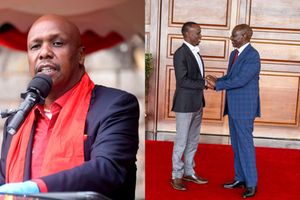
Kanu chairman Gideon Moi.
Photo credit: File | Nation Media Group
For William Ruto, whose authority in the Rift Valley is the cornerstone of his political empire, this was a storm he could ill afford.
By-elections, in Kenya’s political language, are less about numbers than they are about narrative. And Gideon’s entry would have rewritten the script.
But Gideon, who had mobilised his supporters, did not step into the arena. He stepped aside. In doing so, he handed Ruto something worth more than votes – a stage without resistance, a political prize wrapped in silence. And in return, he secured something just as valuable: a soft landing for the Moi empire, a guarantee that the House of Kabarak would not be left exposed to the cold winds of state hostility.
The Moi family once ruled from the very summit of power. Daniel arap Moi, was not just a president; he was the system. His rule stretched from State House to the village chief’s hut, from military barracks to provincial administration, from the corridors of Parliament to the smallest corner of local government.
The Moi era was a time when the family’s name could shift the political landscape with a single nod. For years, their businesses – from Moi High School Kabarak and Moi Educational Centre to Kiptagich Tea Estates and Standard Group – flourished behind the shield of power.
But dynasties built around personalities, not institutions, eventually face a reckoning. When the patriarch exits, the shield vanishes.
The Moi family has spent the years since 2002 adjusting to this reality and fighting court battles. Gideon, the youngest but most politically prominent of Moi’s sons, understands that the days of unchecked power are long gone.
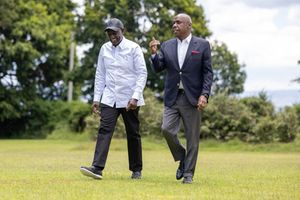
President William Ruto and Kanu party leader, Gideon Moi during a meeting with Baringo locals in Kabarak, Nakuru County on October 10, 2025.
Photo credit: Boniface Mwangi | Nation Media Group
His politics has therefore never been about roaring from a podium; it has been about preserving space, ensuring that the Moi name remains relevant, even if not dominant.
His business empire explains much of this calculation. From Kencont Container Freight Station, linked through Siginon Group, to Sosian Energy – the Moi family’s geothermal energy venture – Gideon’s interests run deep into Kenya’s strategic economic arteries. But in recent years, these ventures have faced uncomfortable scrutiny.
Kencont has been accused of illegally occupying prime railway land in Mombasa, while Sosian Energy’s licence was revoked by a Nakuru court.
Such moments are not isolated. In Kenya, they are signals – reminders that without political cover, even the largest empires can be made to sweat.
Gideon has always understood the marriage between business and politics. In the late 1980s, long before he entered Parliament, he teamed up with Ketan Somaia and Ajay Shah to establish Trust Bank.
Those were the days when parastatals like the National Social Security Fund (NSSF), Kenya National Trading Corporation (KNTC), and National Hospital Insurance Fund (NHIF) were quietly steered to deposit their billions in politically aligned banks.
That was how wealth was built in Moi’s Kenya – through a system where state power was not merely an enabler of business but its very backbone. Gideon was raised inside that ecosystem.
But unlike his father, Gideon was never a creature of the hustings. His entry into politics in 2002 was less a war than a coronation.
Party Leader Gideon Moi makes his address on October 10, 2025 after President William Ruto visited Kabarak Home in Nakuru County.
Photo credit: Boniface Mwangi| Nation Media Group
He inherited the Baringo Central parliamentary seat unopposed after rivals like Juma Kiplenge quietly stepped aside. He entered Parliament not as a scrapper but as a prince.
That gentle ascent, however, came with a weakness: he never learned the grit and fury that Kenyan politics often demands. His Swahili was hesitant, his oratory stiff, his rallies small. In an environment that rewarded men like Ruto – fighters who clawed their way up – Gideon remained distant, polished, and patrician.
When he took over the chairmanship of Kanu in 2013, succeeding Uhuru Kenyatta, the party was a relic. It had been dethroned in 2002 and hollowed out by defections and shifting alliances. Kenya’s political tempo had changed: it was fast, loud, and populist.
Gideon, elegant and reserved, was out of rhythm. His 2022 loss to William Cheptumo for the Baringo senatorial seat was more than just an electoral defeat.
But dynasties do not always end in defeat. Some adapt. Some bargain. Gideon’s visit to State House and his decision to bow out of the by-election was such a moment. Ruto needed a clean win in the Rift Valley – a stage without discord.
Gideon needed protection for his sprawling empire. The handshake between the prince and the president was quiet, but it was a high-stakes political and economic settlement.
Kanu Chairman Gideon Moi.
Photo credit: File | Nation Media Group
For Ruto, Gideon’s withdrawal removed a potential flashpoint and reinforced the narrative of total control over his backyard. For Gideon, it was a message: the Moi name would no longer be treated as an alternative pole of power but as a discreet partner within the fold.
This wasn’t merely about one senatorial seat. It was about breathing room for businesses, the preservation of a family legacy, and ensuring that the Moi name remains an institution in the shadows, if no longer on the throne.
He has mastered the art of folding dynasties into his orbit. First came Raila Odinga – the unlikely ally whose handshake with the president reshaped Kenya’s political geography.
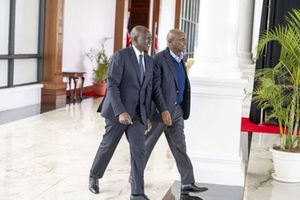
President William Ruto and Kanu chairman Gideon Moi after a meeting at State House, Nairobi.
Photo credit: PCS
Then came a quiet, symbolic meeting with former President Uhuru Kenyatta, signalling a thaw with the Kenyatta family. And now, the Rift Valley’s original political house has followed suit. One by one, Ruto has done what few before him achieved: turned Kenya’s political titans into allies or at least non-combatants.
It is a lesson in consolidation. Kenya’s dynasties – Moi, Kenyatta, Odinga – have for decades been power poles around which politics swirled. To neutralise them or co-opt them is to stabilise one’s throne.
Ruto, the outsider who once challenged these dynasties, now presides over a coalition that embraces them. It is less a political marriage than a strategic absorption. Each handshake, each quiet nod, each symbolic meeting strengthens his fortress.
For Gideon, this is not about ambition; it is about insurance. His family’s empire sits atop sectors where government goodwill is not optional – energy, logistics, education, land, agriculture. A confrontation with the state would invite scrutiny, possibly hostility, and potentially erosion.
An alliance, however, ensures that the Moi businesses are treated not as vestiges of the past but as fixtures of the present. This is how dynasties survive – not always by fighting, sometimes by aligning.
The real story is not the entry of Gideon into Ruto’s fold, but rather how Ruto has managed to bring three dynasties to heel without breaking them.
Raila, Uhuru, Gideon – three pillars of Kenya’s post-independence political family tree – now orbit around State House. For Ruto, the once-sidelined hustler, this is the apex of strategic statecraft: to build a coalition not merely of numbers, but of legacies. To control both the present and the weight of the past.
For Gideon, the benefits are clear. The Moi businesses, once exposed to the vagaries of a political environment they no longer controlled, may now enjoy the protection of proximity.
In exchange, Gideon surrenders the option of political confrontation. It is a trade-off that may not excite crowds but ensures continuity – of wealth, of influence, of name.
This is not the end of the Moi dynasty. It is its transformation. It is the adaptation of power to new circumstances – the way old houses survive in new republics. The Moi name, once synonymous with the state, is now a quiet shareholder in the architecture of power.
President William Ruto at Kanu Chairman Gideon Moi at his Kabarak home on October 10, 2025.
Photo credit: PCS
And so, in the theatre of Kenyan politics, Ruto stands at the centre, flanked not by enemies but by dynasties that once defined the state. Gideon sits among them, not as a combatant but as a prince of survival, guarding his house through alliance.
The man who once inherited power without a fight has now chosen not to fight to keep it, but to negotiate to preserve it.