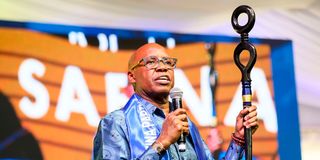
Businessman-turned-politician Jimi Wanjigi has formally taken over the leadership of Safina Party, promising to breathe new life into the 30-year-old political movement.
Mr Wanjigi took over the reins of the party during its National Delegates Conference (NDC) in Nairobi on Thursday, replacing its founding leader, Paul Muite.
Safina Party founder Paul Muite (right) hands the Safina Party flag to new Party Leader Jimi Wanjigi during the leadership transition ceremony at Ngong Racecourse in Nairobi on September 18, 2025.
Photo credit: Bonface Bogita | Nation
The transition marks a generational shift in the party that was born in 1995 at the height of Kenya’s clamour for multiparty democracy.
Safina Deputy Party leader Willis Otieno speaks during the leadership transition ceremony at Ngong Racecourse in Nairobi on September 18, 2025.
Photo credit: Bonface Bogita | Nation
Mr Wanjigi, flanked by lawyer Willis Otieno who assumes the role of deputy party leader, declared that Safina is committed to ushering in a new era of economic liberation and political accountability in a country he said is drowning in debt and crippled by corruption.
“The nation is in a deep crisis,” Mr Wanjigi told party members and supporters. “Our children’s future is mortgaged. Families cannot afford food or shelter, jobs are scarce even as taxes rise, and freedoms are under attack. Kenya is once again in bondage, but this time the coloniser is within.”
Safina Party Leader Jimi Wanjigi with his wife Irene Nzisa during the party's leadership transition ceremony at Ngong Racecourse in Nairobi on September 18, 2025.
Photo credit: Bonface Bogita | Nation
His ascension to the Safina helm has been months in the making. The billionaire, who previously sought the presidency on an ODM ticket in 2022 before breaking ranks with the Orange Party leader Raila Odinga, has since styled himself as a political outsider fighting entrenched cartels.
His move to Safina gives him both a party platform and a vehicle to mount a more structured political challenge ahead of the 2027 general election.
In his fiery acceptance speech, Mr Wanjigi invoked Kenya’s history of colonial exploitation and linked it to what he called the “new slavery” of corruption and state capture.
Safina Party Leader Jimmy Wanjigi speaks during the party's leadership transition ceremony at Ngong Racecourse in Nairobi on September 18, 2025.
Photo credit: Bonface Bogita | Nation
Comparing today’s leadership to the colonialists who dispossessed Kenyans a century ago, he said: “They told us to close our eyes and pray, but when we opened them, our land and resources were gone. Today, while Kenyans closed their eyes, corruption thrived. When Gen Zs rose to demand freedom, they were killed.”
He unveiled The FIST Agenda —shorthand for fighting for your wallet, your family, and your future—pledging to end unfair debt, guarantee free education and universal healthcare, lower taxes, and unlock credit for small businesses.
He called for a lean, efficient state restricted to core functions such as defence, policing, justice, and trade, leaving the rest to citizens and private initiative.
Guests during Safina Party’s leadership transition ceremony at Ngong Racecourse in Nairobi on September 18, 2025
Photo credit: Bonface Bogita | Nation
Safina—Swahili for “Ark”—was founded by Mr Muite and other pro-democracy activists on May 13, 1995, as a refuge for reformists frustrated by the slow pace of change under former president Daniel arap Moi’s regime.
The party’s mission was to challenge corruption, abuse of power, and ethnic division. For years, the party was hounded by the state, with registration delayed and its leaders frequently harassed.
Despite these hurdles, Safina played a role in the reform struggles of the 1990s and 2000s, aligning with civil society and opposition movements that eventually pushed through the 2010 Constitution.
Its philosophy has always been rooted in social liberalism, social democracy, civic nationalism, non-violence, and championing equal opportunity for all Kenyans regardless of tribe, gender, or age.
Safina Party founder Paul Muite during the party's leadership transition ceremony at Ngong Racecourse in Nairobi on September 18, 2025.
Photo credit: Bonface Bogita | Nation
Handing over the mantle to Mr Wanjigi, Mr Muite reminded Kenyans of Safina’s founding vision. “We founded this party because we believed every Kenyan has a right to life, to education, to healthcare, and to freedom,” he said.
“This new generation of leadership must act now. The only language this regime listens to is maandamano. Elections are not just about Election Day; they start now, with the fight against voter suppression and corruption.”
Mr Otieno, the new deputy party leader, promised that Safina would be the people’s shield against police brutality and political oppression.
“If education has a board, and health has a board, then policing must also have People’s Boards drawn from communities to hold police accountable,” Otieno argued, adding that the police should serve the people.
Safina Party Leader Jimi Wanjigi speaks during the party's leadership transition ceremony at Ngong Racecourse in Nairobi on September 18, 2025
Photo credit: Bonface Bogita | Nation
The party also unveiled a revamped leadership line-up: Patrick Birya as chairman, Nelson Osiemo as director of elections, Joakim Simiyu as deputy secretary-general, Diana Belta as chairperson of the Equality Council, Caroline Ntinyari as deputy chairperson of the Women’s Council, Bishop Peter Mwangi Chege as secretary of the Board of Trustees, and Batuli Swali as deputy director of elections.
The leadership said the expanded leadership reflects Safina’s attempt to broaden its base and inject youthful energy while retaining the gravitas of its veteran founders.
For years, Mr Wanjigi operated in the shadows as a political fixer and financier. He takes pride in having helped to forge the alliances that have defined Kenya’s political landscape. He backed former president Uhuru Kenyatta in 2013, before joining Mr Odinga in the 2017 election.
Guests during Safina Party’s leadership transition ceremony at Ngong Racecourse in Nairobi on September 18, 2025
Photo credit: Bonface Bogita | Nation
But his fallout with Mr Kenyatta in 2017, thrust him into the public eye as state operatives raided his Muthaiga home.
By 2021, Mr Wanjigi had repositioned himself as a reform candidate, launching an audacious bid to wrest the ODM presidential ticket from Mr Odinga.
Although the attempt failed, it marked his public debut as a political aspirant rather than a backroom operator.
His alignment with Safina now positions him to build a party machine outside the traditional ethnic blocs.
Safina Party founder Paul Muite (right) hands the Safina Party Constitution to new Party Leader Jimi Wanjigi during the leadership transition ceremony at Ngong Racecourse in Nairobi on September 18, 2025.
Photo credit: Bonface Bogita | Nation
Political analysts say Mr Wanjigi’s takeover of Safina mirrors a broader realignment in Kenyan politics, where small parties are increasingly seen as launchpads for ambitious outsiders.
Central to Mr Wanjigi’s rhetoric is the country’s ballooning debt, now estimated at over Sh12 trillion, and the rising tax burden that has sparked protests, especially among young Kenyans. He has openly courted Gen Z, the demographic that led street demonstrations in 2024 and 2025, framing them as the new Mau Mau in the fight for economic freedom.
“Just like the coloniser killed those who demanded liberation, this regime has killed our youth,” he charged, referring to the deaths of protesters during last year’s demonstrations. “But our eyes are now open.”
Safina Party Leader Jimi Wanjigi (centre) engages with youths during Safina Party’s leadership transition ceremony at Ngong Racecourse in Nairobi on September 18, 2025.
Photo credit: Bonface Bogita | Nation
His agenda of reducing government size, freeing credit, and cutting taxes echoes populist economic messaging that resonates with a frustrated middle class and unemployed youth. Yet, critics argue that it lacks clear details on how debt repayment and essential services would be sustained.
With less than two years to the next general election, Mr Wanjigi’s challenge will be to transform Safina from a small, struggling outfit into a serious national player. The party has no governors, senators, or MPs, and its brand has faded since its heyday under Mr Muite in the late 1990s.
“While Wanjigi brings money and a strong anti-establishment message, building grassroots structures will require more than rhetoric. Safina will have to recruit candidates across the 47 counties, form coalitions, and convince voters that it can deliver on its ambitious promises,” argues Dismas Mokua.