Leaders affiliated with the Linda Mwananchi faction on Monday sharply criticised President William Ruto’s planned address to the Tanzanian Parliament, terming it meaningless and inappropriate, given what they described as a deteriorating human rights situation in the neighbouring country.
President Ruto is scheduled to make a historic address to Tanzania’s Parliament on Tuesday, where he is expected to speak on the growing bilateral relations between Kenya and Tanzania, as well as challenges facing the East African Community (EAC).
No sitting Kenyan President has ever addressed the Tanzanian Parliament since the country gained independence in 1961.
In contrast, former Tanzanian President Jakaya Kikwete addressed a joint sitting of Kenya’s National Assembly and Senate on October 6, 2015, impressing lawmakers with his fluency in Kiswahili after initially delivering his speech in English.
In a statement, the Linda Mwananchi group, a breakaway faction of ODM, claimed that both Kenya and Tanzania are increasingly undermining democracy and the rule of law, arguing that President Ruto’s address holds little significance for citizens of either country.
“The recent grave developments in Tanzania make this address not only a betrayal of the Tanzanian people, but also a betrayal of the fundamental principles of democracy and freedom that Kenyans hold dear,” the statement read.
The statement was signed by 16 leaders, including Siaya Governor James Orengo, Vihiga Senator Godfrey Osotsi, ODM Secretary General Edwin Sifuna, and Embakasi East MP Babu Owino.
“We are compelled to speak out because the Kenyan Presidency is a symbol of our nation’s sovereignty, and its holder should not wield that authority arbitrarily,” the leaders added.
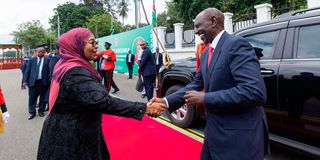
President William Ruto is received by his Tanzanian Counterpart Samia Suluhu at State House, Tanzania on May 04, 2026.
Photo credit: PCS
The group also criticised the administration of Tanzanian President Samia Suluhu Hassan, citing last October’s general election, which they claim failed to meet the standards of a free and fair poll. President Samia was declared the winner with 98 percent of the vote by the Tanzanian Electoral Commission on November 1.
The results triggered widespread protests, which led to significant destruction of property. Opposition leader Tundu Lissu was barred from participating in the elections and remains in detention, while reports of harassment of other opposition figures have also emerged.
On April 23, a commission of inquiry led by retired Chief Justice Mohamed Chande Othman reported that 518 people were killed during the protests.
“We can confidently state that the threshold of democracy and fairness was not met, especially given that opposition representatives were detained,” the statement continued.
“By addressing the Tanzanian Parliament, President Ruto risks appearing to legitimize a contested regime and electoral process.”
The leaders further cited concerns raised by United Nations human rights experts and Secretary-General António Guterres over alleged extrajudicial killings, enforced disappearances, and mass arbitrary detentions of protesters and opposition figures before and after the elections.
They also referenced findings by the African Union Election Observer Mission, which stated that the elections did not comply with AU principles and international standards.
Observers from the Southern African Development Community (SADC) noted low voter turnout, instances of ballot stuffing, and the disqualification of key opposition candidates, which they said created an uneven political playing field.
Additionally, a coalition of 17 Western missions, including the United Kingdom and France, criticized the electoral process and called on Tanzanian authorities to release the bodies of those killed during the unrest, citing credible reports of concealment.
Linda Mwananchi team led by Nairobi Senator Edwin Sifuna, Siaya Governor James Orengo and Embakasi-East MP Babu Owino arrive at Mazembe Grounds in Nakuru on April 19, 2026.
Photo credit: Boniface Mwangi | Nation Media Group
Even as they distanced Kenya from the address, the leaders expressed confidence that such electoral irregularities would not occur in Kenya, which is approximately 14 months away from its next general election.
The Linda Mwananchi group has recently intensified its criticism of President Ruto, even as it contests control of ODM with a rival faction led by Siaya Senator Oburu Oginga.
The leaders argued that the planned address should not take precedence over Kenya’s domestic challenges, including unemployment, the high cost of living, and declining public trust in governance.
“Kenya’s leadership must be anchored in accountability, integrity, and an unwavering commitment to the will and welfare of its people, as well as citizens of the EAC region,” the statement said.
“The country’s moral standing in the region must take precedence over what we consider flawed or unclear geopolitical strategies.”