President William Ruto is deploying a calculated mix of political and administrative strategies to bring Kenya Kwanza affiliate parties under the United Democratic Alliance umbrella, a move aimed at consolidating his political base and strengthening his re-election prospects ahead of the 2027 General Election.
Insiders reveal that the overarching strategy is to craft a tightly knit and powerful political machine capable of countering mounting opposition pressure, particularly from the Rigathi Gachagua-led United Opposition and other rival forces.
Nation has established that President Ruto has held multiple meetings with leadership across Kenya Kwanza parties, promising them key positions within UDA, State appointments, and election support to ensure victory against opponents.
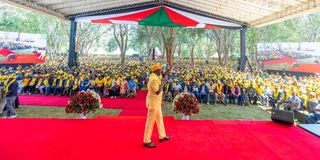
President William Ruto during the UDA National Governing Council meeting at State House, Nairobi on January 26, 2026.
Photo credit: PCS
The Kenya Kwanza Alliance brings together a diverse mix of political parties, including the ruling UDA, Democratic Party of Kenya and Farmers Party which have since joined the United Opposition, Forum for Restoration of Democracy – Kenya (Ford-Kenya), and the Communist Party of Kenya.
It also features the National Agenda Party of Kenya, United Democratic Movement, Economic Freedom Party, and Chama Cha Mashinani.
Other members are Amani National Congress which has since dissolved, Devolution Party of Kenya, Maendeleo Chap Chap Party, Grand Dream Development Party, and The Service Party, as well as Chama Cha Kazi, Tujibebe Wakenya Party, Pamoja African Alliance, and Umoja na Maendeleo Party.
These overtures to these parties, coupled with behind-the-scenes coordination, form the core of Dr Ruto’s strategy to unify the coalition under UDA banner.
In a sharp onslaught against the opposition, President Ruto, for the third day running, criticised the United Opposition for relying on “empty sloganeering instead of presenting a clear policy agenda to Kenyans.”
“I want to ask the people of Busia: we removed one from office over corruption, and another is linked to bodies dumped in River Yala — on what moral ground can they now claim to lead?” he charged on Monday.
The Head of State hinted at a broader plan to counter the opposition ahead of the polls, highlighting the quiet, strategic moves underpinning his re-election campaign.
Nation has also established that in his drive to absorb affiliate parties, President Ruto has courted the late Raila Odinga’s Orange Democratic Movement (ODM) powerhouse, seeking alliances to reinforce UDA’s dominance in key regions ahead of 2027.
Even though several Kenya Kwanza Alliance affiliates are still listed among registered parties at the Office of the Registrar of Political Parties, they have agreed to back UDA in the coming election.
Senate Speaker Amason Kingi, the founder of Pamoja African Alliance (PAA) has confirmed that while his party has not formally dissolved, it will not field candidates in the 2027 General Election.
A member of the United Democratic Alliance votes during the party's grassroots elections at Uasin Gishu Primary School Polling Station in Turbo Constituency of Uasin Gishu County on March 14, 2026.
Photo credit: Jared Nyataya | Nation Media Group
Instead, PAA will throw its weight behind UDA, with candidates who would have vied under PAA now running under the UDA banner.
“In 2022, we toured this region extensively, campaigning for our Party PAA candidates across various positions,” Mr Kingi said on Monday.
“Since then, we have had strategic meetings with the President in Nairobi on how to approach the next election as a united front. After consultations with grassroots leaders and the president, we have agreed that PAA will not field candidates in 2027. Our team will now consolidate under the United Democratic Alliance banner,” he went on.
Political analysts see this as part of a deliberate effort by President Ruto to streamline candidate management under one brand, reducing conflicts and internal rivalries that often plague coalitions.
The absorption of Amani National Congress (ANC) into UDA has been one of the most consequential moves in the consolidation plan, reshaping Western Kenya’s political landscape and Prime Cabinet Secretary Musalia Mudavadi’s personal political calculus.
“PCS Musalia Mudavadi was the first party leader to publicly support President Ruto’s candidature in 2022 through his earthquake moment. His decision sent a strong signal that gave momentum for other party leaders to back Ruto, which ultimately contributed to his 2022 presidential win,” Mr Mokua said.
The dissolution of ANC into UDA, has however faced criticism, with a section of leaders from Western region saying it meant the loss of an independent bargaining platform for Mr Mudavadi.
They say that once a leader controls a party, he can negotiate coalition terms, demand concessions, or even threaten to exit if agreements fail.
By folding ANC, they opine, Mr Mudavadi surrendered that leverage, despite securing a high-profile role as Prime Cabinet Secretary and Cabinet Secretary for Foreign and Diaspora Affairs.
President William Ruto, his deputy Prof Kindiki Kithure and Foreign Affairs Cabinet Secretary Musalia Mudavadi arrive for the UDA National Governing Council meeting at State House, Nairobi on January 26, 2026.
Photo credit: PCS
For instance, Lamu Governor Issa Timamy, the former ANC deputy party leader who briefly served as acting party leader after Mr Mudavadi was appointed Prime Cabinet Secretary, was absorbed into UDA as the party’s second deputy leader alongside Deputy President Prof Kithure Kindiki.
Similarly, former ANC Secretary-General Omboko Milemba, now the Emuhaya MP, took a step down to become UDA’s deputy secretary-general, while ANC’s former national chairperson, Kelvin Lunani, was relegated to the position of deputy chairperson — a reshuffle that underscored the loss of seniority and influence for ANC officials within the larger ruling party.
Some Luhya leaders have criticised Mr Mudavadi, accusing him of sacrificing the community’s bargaining power.
Bumula MP Jack Wamboka declared, some regional leaders were only out to “enrich themselves,” at the expense of the community.
Moses Kuria’s Chama Cha Kazi (CCK) party is another affiliate that started navigating the merger process before he was kicked out of the cabinet and rescinded.
In October 2022, Mr Kuria initiated steps to integrate CCK into UDA.
Political commentators argue that folding Kenya Kwanza affiliates into UDA is a rational move to streamline candidate management, enhance cohesion and consolidate power.
President William Ruto and UDA Party leaders when the Head of State hosted UDA grassroots leaders from Nyeri County at Sagana State Lodge, in Nyeri on January 17, 2026.
Photo credit: PCS
“Managing one party under a unified brand is smoother than juggling multiple coalition candidates competing for the same seat, which can lead to internal disputes and predictable electoral losses,” argues Mr Mokua.
He adds that; “A single party brand prevents conflicts over messaging and ensures consistent communication to voters, while absorbing affiliate parties prevents MPs and local leaders from leveraging coalition numbers as bargaining chips, centralising authority within UDA.”
Political commentator Ishmael Oyoo notes, “A fragmented Kenya Kwanza coalition weakens UDA. Consolidation is necessary to secure a critical number of parliamentary seats and prevent affiliate MPs from challenging central leadership.”
While the absorption of ANC for instance secures Mr Mudavadi a high-ranking government role, analysts say it comes with long-term political costs.
President William Ruto addresses UDA grassroots leaders from Nyeri County at Sagana State Lodge, in Nyeri on January 17, 2026.
Photo credit: PCS
ANC’s distinct identity — is diluted, and its supporters must now navigate the larger UDA hierarchy.
“We chose strategy over shortcuts. Dissolving ANC was deliberate and forward-looking. We are fully inside UDA and there is no turning back,” he said. He called for mass registration under UDA, framing it as “home” for his supporters.
Despite a January 2025 court ruling nullifying the merger, Mr Mudavadi insists the process followed constitutional and legal procedures. “We are fully compliant and fully integrated into UDA,” he said.
The consolidation of Kenya Kwanza affiliates under UDA signals a shift toward centralised control, mirroring the former Jubilee Party model.
“While it may deliver short-term electoral advantages, it also risks alienating communities accustomed to independent political vehicles,” argues advocate Chris Omore.
Former President Uhuru Kenyatta has cautioned that such mergers could undermine multiparty democracy.
Labour Cabinet Secretary Alfred Mutua has also been fighting off a plot by some of his Maendeleo Chap Chap members from ditching the outfit to join UDA.
A simmering row between Dr Mutua and Kibwezi West MP Mwengi Mutuse has burst out in the open after the MP led a faction of party leaders in ditching the outfit.