Across Western Kenya, the move is increasingly viewed as a surrender of bargaining power to President William Ruto ’s United Democratic Alliance (ANC) — and as pressure mounts for a Luhya presidential bid in 2027, the ghosts of ANC are returning to haunt him.
These ghosts now appear to be complicating his standing at home, weakening his bargaining power nationally, and casting fresh doubt on his long-held presidential ambitions.
He is firmly on the UDA side of the table, a senior government insider — but also a guest in a political house whose keys are held by President Ruto.
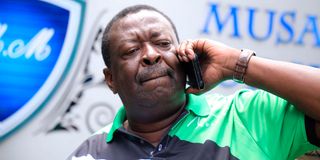
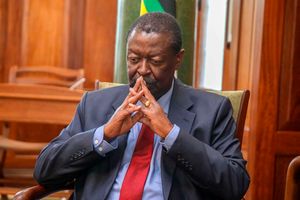
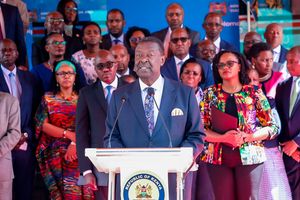
Prime Cabinet Secretary Musalia Mudavadi.
Multiple politicians from Western Kenya now say that ANC was not just another political outfit, but was built painstakingly around Mr Mudavadi’s personal brand — his image as a moderate, reform-minded, compromise-seeking national leader with deep roots in the region. Its green colours, symbols and ideology gave his supporters a sense of identity and ownership.
“Dissolving it meant surrendering that distinct political vehicle in exchange for absorption into a larger, more dominant party with its own culture, priorities and internal hierarchies,” argues Mr Chris Omore, an advocate-cum political analyst.
That loss of identity has come at a cost. Within UDA’s crowded ecosystem, Mr Mudavadi must now compete with long-standing insiders for influence, nominations and strategic space. The ideological nuance he once projected — moderation, institutionalism, reform without disruption — is easily diluted.
Control of a party allows a leader to negotiate coalition terms, demand concessions, and threaten exit when agreements are breached. By dissolving ANC, Mr Mudavadi gave up that leverage.
While he secured the powerful post of Prime Cabinet Secretary and Cabinet Secretary for Foreign and Diaspora Affairs, his allies — MPs, aspirants and grassroots organisers — now have to fight for space within UDA structures.
His allies were only incorporated into the UDA party leadership as deputies, with no critical roles.
For instance, Lamu Governor Issa Timamy, the former ANC deputy party leader who briefly served as acting party leader after Mr Mudavadi was appointed Prime Cabinet Secretary, was absorbed into UDA as the party’s second deputy leader alongside Deputy President Prof Kithure Kindiki.
Lamu County Governor Issa Timamy.
Photo credit: File | Nation Media Group
Similarly, former ANC Secretary-General Omboko Milemba, now the Emuhaya MP, took a step down to become UDA’s deputy secretary-general, while ANC’s former national chairperson, Kelvin Lunani, was relegated to the position of deputy chairperson — a reshuffle that underscored the loss of seniority and influence for ANC officials within the larger ruling party.
UDA Deputy Secretary-General Omboko Milemba.
Photo credit: File | Nation Media Group
In their new political home (UDA), tickets are no longer guaranteed, loyalty is constantly tested, and influence depends on proximity to the party centre rather than historical allegiance.
Political analysts note that once a party dissolves, its leader’s negotiating position weakens irreversibly. There is no independent platform to fall back on if relations sour or if succession politics turn hostile.
Former deputy president Rigathi Gachagua has repeatedly cited this as one of Mt Kenya region’s 2022 fault I backing president Ruto’s UDA. He has since formed the Democracy for the Citizen’s Party (DCP).
Perhaps the most immediate fallout has been at the grassroots. ANC had cultivated loyalty across parts of Western Kenya, especially among voters who saw it as a Luhya-owned vehicle with national ambitions. Folding it into UDA confused that base.
Some supporters quietly drifted to rival outfits, including DAP-K, Ford Kenya AND Orange Democratic Movement. Others retreated into voter apathy. Symbols matter in Kenyan politics, and the disappearance of ANC’s colours, offices and structures hollowed out networks that had taken years to build.
The backlash has been increasingly vocal. During the burial of former Lugari MP Cyrus Jirongo at Lumakanda in Lugari, Kakamega county on Tuesday, Luhya leaders from across the political divide took aim at Mr Mudavadi, accusing him of betraying the community’s collective bargaining power.
Bumula MP Jack Wamboka led the charge, accusing Luhya leaders in government of enriching themselves while the community remained economically marginalised.
“You leaders in power are only enriching yourselves, but we have a clear plan in 2027 to field one of our own as a presidential candidate,” Mr Wamboka said.
The message from Western Kenya is sharpening: run now, or risk irrelevance. Leaders argue that any attempt by Mr Mudavadi to contest in 2032 — after serving under President Ruto — would be politically futile.
DAP-K leader Eugene Wamalwa and Saboti MP Caleb Amisi echoed the call, insisting the community must unite behind a presidential candidate in 2027 to remain politically relevant.
“We are in political competition and as a community, we should be united and field a presidential candidate in 2027,” Mr Wamalwa said.
Kakamega Senator Boni Khalwale went further, branding the dissolution of ANC an act of betrayal and urging renewed Luhya unity to reclaim political leverage.
Not all ANC officials benefited from the merger. Some lost positions, others lost visibility, and several felt short-changed. The result has been simmering resentment, occasional court threats, and defections — classic symptoms of a party merger gone sour. Such internal fractures undermine the image of cohesion Mr Mudavadi needs as a national leader. They also reinforce perceptions that he sacrificed long-term community interests for short-term proximity to power.
Former President Uhuru Kenyatta added another layer to the controversy, warning that the folding of parties threatens the spirit of multiparty democracy.
“We need not kill the spirit of multiparty democracy but cherish a vibrant system that steers the country forward,” Mr Kenyatta said, in remarks widely interpreted as a critique of the Kenya Kwanza–ODM rapprochement and ANC’s dissolution.
Uhuru's full speech at Jirongo's burial in Kakamega
Mr Mudavadi hit back sharply, accusing Mr Kenyatta of hypocrisy, noting that Jubilee itself was formed through the dissolution of multiple parties, including TNA, URP and UDF.
“It is dishonest for the former President to speak of protecting parties when he presided over mass dissolutions and forced mergers,” Mr Mudavadi said.
Mr Mudavadi maintains that coalition politics is Kenya’s inevitable future. He argues that no single party can win national power alone and that alliances are essential for stability and unity.
“There is no fear in folding parties to form coalitions. Azimio was a coalition, Kenya Kwanza is a coalition, and partnerships are the future of our politics,” he said.
Former Cabinet minister Noah Wekesa agrees, arguing that coalition-building has been the reality since 2003 and will define future elections.
“No political party will win alone in 2027. Leadership will come through alliances,” Dr Wekesa said.
Mr Mudavadi’s decision will ultimately be judged on outcomes; whether his supporters gain lasting influence within UDA, whether Western Kenya feels empowered, and whether he can still mount a credible future presidential challenge.
“The ANC dissolution remains a double-edged sword — delivering short-term power but creating long-term uncertainty. As 2027 approaches, Mr Mudavadi must confront a hard truth that without ANC, every move he makes is filtered through UDA’s interests,” argues Mr Omore.
The ghosts of ANC, he says, are not going away any time soon; “they will follow him into the next election cycle, shaping perceptions of his courage, his ambition and his place in Kenya’s political history.”