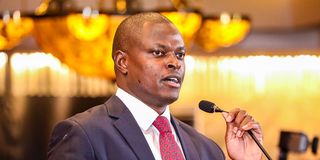
Kiharu MP Ndindi Nyoro has formally broken ranks with President William Ruto’s United Democratic Alliance (UDA), announcing the formation of the People’s Party of Kenya and declaring that he will work with opposition leaders to chart what he described as a new political and economic direction for the country.
Speaking at the ceremony held at Safari Park Hotel in Nairobi on Monday night, Mr Nyoro said he had spent months consulting political leaders across the divide before arriving at the decision, which he said was guided by the interests and aspirations of Kenyans.
The announcement effectively ends months of speculation about the legislator’s political direction, placing him in the opposition camp as the country heads towards the 2027 General Election.
Mr Nyoro stopped short of making an outright declaration that he would contest the presidency, but repeatedly spoke of what his team would deliver “after the August 2027 election” and invited Kenyans to consider the leaders of the People’s Party as those capable of taking the country forward.
He also unveiled an expansive policy blueprint covering education, healthcare, jobs, agriculture, infrastructure, debt management, governance, tourism, manufacturing, energy and the digital economy.
“My heart has been burdened for many months. I have been praying that whatever political decision I make, Kenyans will be at the centre of it,” Mr Nyoro said.
“It is actually easier to campaign than to govern. After we won the last election, I realised the real battle was not the campaign but delivering on our promises. Unfortunately, we engaged in a lot of trial and error, especially in the early years.”
Mr Nyoro’s announcement marks a significant political departure for a politician who emerged as one of the most influential young voices within the Kenya Kwanza administration.
But on Monday night, he declared that the relationship had effectively ended.
“It is obvious we left the government long ago. For the record, we disengaged with UDA and the wheelbarrow government long ago,” he said.
“From today, Peoples’ Party of Kenya. We have today joined the opposition.”
Mr Nyoro said the party would immediately work with other opposition formations and leaders, stressing that his decision was not motivated by personal political ambitions.
“All members have agreed that the People’s Party joins the opposition immediately,” he said.
He said he had consulted several opposition figures including Democracy for the Citizen’s Party leader Rigathi Gachagua , Jubilee presidential candidate Fred Matiang’i and Wiper Patriotic Front Chief Kalonzo Musyoka among other opposition leaders.
“I have taken time to consult almost all the opposition leaders,” he said. “I have sat down with Peter Munya, Martha Karua and James Orengo. You know Sifuna is my brother. I have sat down with Rigathi Gachagua and Kalonzo Musyoka . I want to confirm to you, I have had almost a year-long consultation with most of them, including Dr Fred Matiang’i.”
Mr Nyoro devoted much of his address to outlining his vision for Kenya, saying political leaders must provide concrete solutions to the hardships facing ordinary citizens.
“Kenyans are literally fighting for survival,” he said.
Mr Nyoro proposed free basic education, including free secondary education, beginning in January 2028. His proposed funding model would involve Sh10 billion from the NG-CDF, Sh10 billion from county governments and Sh15 billion from the national government.
He said the Sh35 billion would cover the country's 9,500 senior secondary schools and about 3.5 million learners, while also supporting school meals.
He proposed that schools diversify their menus and source food from local farmers, turning institutions into reliable markets for agricultural produce.
Mr Nyoro also called for the establishment of a national commission, similar to the Teachers Service Commission, to harmonise the salaries and management of Early Childhood Development Education teachers.
He said universities should have their tax arrears waived and that the government should facilitate payment of statutory obligations and debts.
Mr Nyoro criticised what he termed patronage, inadequate funding, staffing problems and poor quality in the health system.
He proposed creating a government-owned system for managing healthcare and establishing a Kenya Doctors and Healthcare Workers Commission to manage the employment, placement and welfare of health professionals.
He also proposed cutting the amount Kenyans contribute to the National Social Security Fund by half and redirecting the money to healthcare.
According to his proposal, the move could release about Sh40 billion for the health sector.
“One can only enjoy a pension when they are healthy and alive,” he said.
The additional funding, he argued, would help address chronic illnesses, upgrade hospitals and improve the supply of medicines and equipment.
The Kiharu legislator also proposed attracting foreign expertise and investment, including bringing Indian medical institutions to Kenya to serve both the local and regional market.
On employment, Mr Nyoro said job creation should become a responsibility shared across government.
He proposed that every Cabinet secretary be given specific employment targets in their sectors, with data on net jobs created published monthly or quarterly.
He also called for economic growth driven by agriculture, manufacturing and the services sector.
Agriculture, he said, should be guided by a coherent national policy focused on productivity, value addition and markets.
He proposed better seeds, subsidised fertiliser, irrigation, reduction of post-harvest losses and greater investment in value addition.
Kenya should also shift from commodity production to speciality tea and coffee while identifying crops with the highest economic value for different regions.
He said diplomatic missions should play a greater role in finding overseas markets for Kenyan agricultural products.
He said public debt had surpassed Sh13 trillion and warned that continued borrowing threatened the stability of the economy.
He proposed an audit of public debt immediately after the 2027 election, reduction of wasteful expenditure and restructuring of domestic debt.
Mining and oil, he said, could provide new sources of economic growth but must not be captured by political elites.
“We therefore cannot allow a few politicians to take off with our minerals,” he said.
Mr Nyoro proposed upgrading 5,000 kilometres of low-volume roads to all-weather bitumen roads at an estimated cost of Sh200 billion.
He suggested redirecting part of existing road, housing and development-related levies towards road construction and involving the National Youth Service and Kenya Defence Forces to reduce costs.
He also proposed greater use of concrete roads in areas with steep terrain and heavy rainfall and called for an end to what he described as wasteful murram-road construction.
On industrialisation, he called for lower and more reliable electricity costs, the expansion of Special Economic Zones and the transformation of coastal counties into major export-oriented manufacturing hubs.
Mr Nyoro said Kenya should target 10 million international tourists annually, arguing that the tourism sector could generate millions of jobs.
He proposed aggressive international marketing, diversification of tourism products and easier investment procedures.
In the financial sector, he called for policies that would strengthen Kenyan banks and encourage local financial institutions to expand across Africa.
Mr Nyoro’s vision came against the backdrop of President Ruto’s attack on the opposition for lacking agenda for the country.
Mr Nyoro’s declaration, therefore, was more of an attempt to establish a governing agenda ahead of the 2027 election while positioning himself as the better option within an increasingly crowded opposition field.
Mr Nyoro said the new People’s Party of Kenya would work with all like-minded leaders and train candidates for elective positions across the country.
“A progressive and growing Kenya serves all of us. A united Kenya pulls in the same direction. Let us all hold hands and move forward together,” he said.
His announcement now adds another layer to an opposition landscape already populated by figures including Mr Gachagua, Dr Matiang’i, Mr Musyoka, Ms Karua and Linda Mwananchi Leaders including Nairobi Senator Edwin Sifuna.
The event was attended by Siaya Governor James Orengo, Wundanyi MP Danson Mwashako and Nyamira Senator Okong’o Omogeni, all members of the Linda Mwananchi movement.
Mr Orengo welcomed the move, saying Kenya needed leaders capable of building on the constitutional foundation laid in 2010.
“I believe Nyoro is capable of doing that. I look forward to working with you, Ndindi Nyoro,” Mr Orengo said.
He accused the Kenya Kwanza administration of abusing public resources, saying the money being distributed by the government belonged to Kenyans.
“The money Ruto is dishing out is our money, not his money. This is State capture. Even Mobutu never did that,” Mr Orengo said, referring to former Zaire President Mobutu Sese Seko.
He urged opposition leaders to intensify their political mobilisation ahead of next year's election.
“We must make Kasongo’s life very difficult now, now next year,” Mr Orengo said, using President Ruto’s nickname.
The Siaya governor also cautioned Kenyans against viewing the 2027 presidential election through a regional lens.
“When electing a president, we are not doing it for a region but for the whole country,” he said, adding that Kenya needed a leader capable of providing “an enduring and lasting solution”.
Mr Orengo said the last time Kenyans had made such a broad national choice was during the election of former President Mwai Kibaki.
Senator Okong’o Omogeni welcomed Mr Nyoro into the opposition, saying he was attending the event on behalf of the people of Nyamira and conveyed Dr Matiang’i’s greetings.
“I’m here on behalf of the people of Nyamira and Jubilee Deputy Party Leader Dr Fred Matiang’i,” Mr Omogeni said.
He called for unity among opposition leaders, invoking the popular maxim, “unity is strength”.
Mr Mwashako, meanwhile, praised Mr Nyoro for what he described as a bold political decision.
He said Kenyans had been waiting for such a moment and urged political leaders to focus on the interests of citizens rather than personal political calculations.
The gathering therefore offered an early glimpse of the possible alliances that could emerge in the opposition ahead of the 2027 presidential contest.
According to political analyst Mixson Warui, Mr Nyoro is entering an already crowded political field both in Mt Kenya and nationally, and how he navigates his way to prominence will be the critical question.
The PPK does not enter an empty room. Mt Kenya’s political market is already crowded with parties such as Rigathi Gachagua’s Democracy for Citizens Party (DCP), former President Uhuru Kenyatta’s Jubilee Party, Peter Munya’s Party of National Unity and Mwangi Kiunjuri’s Service Party.
Others Justin Muturi’s Democratic Party, Martha Karua’s People’s Liberation Party and Kawira Mwangaza’s Umoja na Maendeleo Party, all seeking to position themselves as the voice of the mountain.
Mr Nyoro’s entry, therefore, injects a new player into the scramble for the Mt Kenya vote and the battle to establish the region’s political kingpin, an endeavour that has historically been fiercely contested.
“By naming his special-purpose vehicle the People's Party, Mr Nyoro is invoking the Kibaki-era nostalgia, making a direct pitch: Remember free primary education, tarmacked roads and a stable economy? I am bringing that back,” said political analyst Festus Wangwe.
Mr Wangwe said Mr Nyoro was entering the political scramble not as a protest candidate but as a technocrat seeking to inherit the Kibaki mantle.
For a 40-year-old MP better known for his budget speeches and economic arguments, the move marks a dramatic shift from Parliament to grassroots political mobilisation.
Mr Nyoro, however, said he was interested only in a progressive political debate aimed at giving Kenyans a governance reprieve and improving their quality of life.
"I have completely left the government side and express my desire to see a new liberation government coming to power after next year’s General Election," he said.
He said his party would offer political asylum to all potential aspirants committed to opposition politics.
Mr Wangwe, however, cautioned that registering and launching a political party was the easy part. Running one, he said, was an entirely different battle.
“Mr Nyoro must build structures in all 47 counties. He must convince governors and MPs to jump ship without looking like a rebel. He must pay agents, and he must convince voters that PPK is not just another briefcase party designed to divide the opposition vote,” he said.
He also reminded Mr Nyoro that Mr Kibaki won the presidency in 2002 largely because the opposition was united, meaning the new party will inevitably be judged through the prism of whether it is helping to unite or split the opposition.
Mr Nyoro now faces three tactical options: going national and building PPK into a formidable political force, eventually fronting a presidential candidate.
He could position himself as a kingmaker, use the party to stake a claim to the Mt Kenya kingpin position and negotiate entry into a larger coalition on his own terms or he could grow the party over the next year, win several seats and enter post-election negotiations from a position of strength.
“This navigation will define whether this is legacy or miscalculation. The opportunities are there, and the risks are also there. It depends on the script he is reading from and the odds at play,” said political scientist John Okumu.
“My record in Kiharu on roads, schools and bursaries gives me tangible results, not rhetoric,” he said.
“If voters expect Kibaki but Mr Nyoro offers chaos, PPK will be dismissed as political cosplay,” he said.