The death of Raila Odinga has exposed the soft underbelly of Odingaism. For the first time since independence, Kenya is staring at a political landscape without a towering Odinga figure at its centre.
The man who for decades embodied resistance, negotiation, and power-broking is gone, and with him goes the gravitational force that held together one of the country’s most enduring political movements. What happens next will not only determine the fate of Odingaism but may also reshape the architecture of Kenyan opposition politics itself.
First, there is the Ruto factor. No sitting president has had the kind of opportunity William Ruto now has. With Raila gone, the single-largest opposition force is leaderless. Ruto could use appointments, development projects, and patronage to neutralise Luo opposition, pulling elites into his orbit and weakening any attempts at collective resistance. How aggressively or subtly he moves will determine the shape of Luo politics for the next decade. A smart co-optation strategy could leave Odingaism a shadow of its former self.
To understand the present uncertainty, one must return to the beginning. Odingaism was not born out of formal ideology or structured organisation. It emerged from political rupture—the break between Jaramogi Oginga Odinga and Jomo Kenyatta in the mid-1960s. Jaramogi had been central to the nationalist struggle and independence coalition. But once in power, Kenyatta moved quickly to consolidate control and marginalise left-leaning voices in his government. Jaramogi became the most prominent of those voices—a vice president who would not bow quietly to the pragmatic, pro-Western trajectory the state was taking.
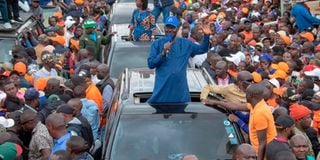
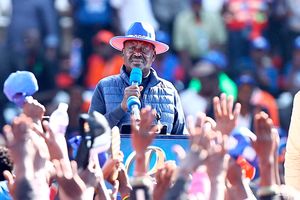
Azimio La Umoja Presidential Candidate Raila Odinga address supporters at Moi International Sports Centre Kasarani on August 6, 2022 during their last Campaign rally before elections.
Photo credit: File | Nation
The confrontation began with the establishment of the Lumumba Institute in 1964. Named after Patrice Lumumba, the slain Congolese nationalist, the institute was presented as a training ground for party cadres. But behind the formal charter lay something far more radical: a plan to build an ideological base aligned with socialist and pan-Africanist principles, but fiercely loyal to Jaramogi. The institute was financed by Moscow, taught by Russian lecturers, and positioned as a counterweight to the Western-backed state machinery. For the Kenyatta government and its British allies, it was a red flag—both literally and figuratively.
The British and Kenyatta’s allies saw in Jaramogi’s project not just a challenge to Kenya’s foreign alignment but a direct threat to their grip on power. Intelligence reports, propaganda, and political intrigue followed. Within a year, the Lumumba Institute was shut down, its students dispersed, its organisers jailed or exiled. That moment was more than the end of a school. It was the birth of Odingaism—a political tradition forged in resistance to state power but never fully separated from it. Jaramogi would become the nation’s first great political outsider: excluded from formal power, yet permanently woven into its calculations.
Raila inherited that script decades later and perfected it for a multiparty era. While Jaramogi had fought his battles in the early years of independence, Raila fought his in the crucible of one-party authoritarianism under Daniel arap Moi. Detained, exiled, persecuted, Raila emerged from the 1980s and 1990s as the face of pro-democracy resistance. But he was also a master negotiator. Whether joining the coalition that unseated Moi in 2002, entering the Grand Coalition Government in 2008, or forging the “handshake” with Uhuru Kenyatta in 2018 , Raila consistently positioned himself at the centre of Kenya’s political chessboard without ever capturing the presidency.
Then president Uhuru Kenyatta and ODM leader Raila Odinga at the KICC in Nairobi during the Jubilee Party's National Delegates Conference on February 26, 2022.
Photo credit: PSCU
That was the essence of Odingaism: a movement that did not need formal power to shape the political landscape. Its power was relational, not institutional. It operated through the pull of a name, the loyalty of a community, the symbolism of resistance, and the art of strategic accommodation. Raila could stand outside State House and still set the national agenda. His word could mobilise the streets, tilt alliances, or bring a government to the negotiating table. No other figure in Kenya’s post-independence history managed that feat so consistently, for so long.
But Odingaism was always built around a person, not a structure. Its organisational vehicles—from Kenya People's Union to Orange Democratic Movement—were never truly institutionalised. They revolved around the Odinga family, with leadership flowing not through open contestation but through deference. This gave the movement coherence and loyalty, but it also made it vulnerable to succession crises. Raila’s death now exposes that fragility. Without him, the movement has no clear pivot.
Luo politics has, for six decades, been defined by unity around the Odinga name. When Jaramogi spoke, the community rallied. When Raila moved, the party moved with him. His charisma, moral authority, and skill as a dealmaker bound together a coalition of local elites, party loyalists, and national allies. But his absence leaves no obvious successor. Winnie Odinga carries the family name but not yet the weight. Oburu Odinga is too old to make a difference. Unless they tap on young turks, the Nyanza politics will for the first time lack a kingpin. James Orengo and Peter Anyang’ Nyong’o are well respected, but have not yet built national political structures. Without a single centre of gravity, Luo politics is likely to splinter.
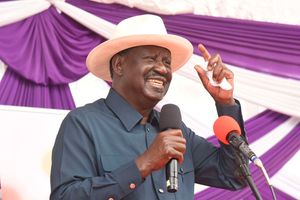
Cord leader Raila Odinga addresses a rally at Mama Ngina drive in Mombasa on September 10, 2016.
Photo credit: File | Nation
This splintering will take several forms. Some leaders will align with William Ruto’s government, seeking access to state resources and patronage. Others will cling to Raila’s oppositional legacy, attempting to rally loyalists around a nostalgic idea of resistance. Still others—governors, senators, MPs—will build personal fiefdoms anchored in devolved power and local patronage networks. What was once a unified bloc may devolve into competing silos. And for the first time since independence, there may be no single Odinga voice to speak for the loyal supporters.
Odingaism has for decades acted as the spine of Kenya’s opposition politics. Even those who disagreed with Raila often defined themselves in relation to him. He was both a rallying point and a reference point—a figure whose presence structured alliances and antagonisms across the political spectrum. Without him, opposition politics risk becoming fragmented, regional, and personality-driven. Figures from Mt. Kenya, Western, and the Coast will likely jostle to fill the vacuum, but none may replicate Raila’s combination of mass appeal, credibility, and political theatre.
The future of Odingaism now rests on whether it can transform from a family franchise into a movement with shared leadership and clear principles. One possible path is institutionalisation. Luo leaders could coalesce around a common agenda—equity, devolution, inclusion, and national reform—and build a collective leadership structure. This would mirror political movements in parts of West Africa that survived their founders by transforming into structured political blocs. But this would require breaking a long tradition of personalism and loyalty politics. It would mean building institutions where once there were personalities.
The second, more likely, path is fragmentation and decline. Across the continent, movements built around charismatic figures have struggled to survive their founders. When Kwame Nkrumah fell, his movement splintered. When Hastings Kamuzu Banda died, his party collapsed into irrelevance. If Odingaism follows this pattern, it may linger as a memory, a once-powerful force that shaped Kenya’s political narrative but faded with its patriarch.
A third possibility is reinvention. A younger generation—more digitally native, less beholden to old loyalties—could take up the Odinga legacy and translate it into a language that resonates with today’s Kenya. The likes of Babu Owino might or Edwin Sifuna could step in and this would mean shifting away from ethnic mobilisation toward issue-based politics: economic justice, governance reform, climate action, and youth empowerment. It would mean replacing stadium rallies with digital mobilisation, traditional party structures with flexible networks. It would mean turning Odingaism from a name into an idea.
But this path is also the hardest. It demands leadership that can both honour a legacy and break from it. It requires Luo leaders—and their allies—to confront entrenched patronage structures, to risk their own power for a bigger vision. The movement would need to broaden beyond the Odinga family to survive in any meaningful way.
External forces will also shape this transition. Devolution has changed Kenya’s political map. County governments now control substantial resources and wield independent political clout. Governors and senators can no longer be easily whipped into line by a single party leader. Their calculations will shape whether Odingaism consolidates or fragments. Digital politics is another factor. Raila’s power was built in the era of rallies, marches, and oratory. The next era belongs to hashtags, digital organising, and issue-based campaigns. The old machinery of mobilisation may simply not work in the same way.
Yet Odingaism has always been surprisingly resilient. It survived Jaramogi’s marginalisation, the collapse of the Lumumba Institute, the banning of KPU, years of detention and exile, the violence of the one-party era, and repeated electoral defeats. It survived because it was more than a party. It was an attitude—a stubborn refusal to be silenced, coupled with a pragmatic instinct for survival. Jaramogi endorsed Moi when it suited him. Raila shook hands with Uhuru when it served his strategy. This combination of resistance and accommodation is why Odingaism lasted longer than most personality-driven movements in Africa.
But strategy alone is not enough when the strategist is gone. Raila was the glue. His charisma, oratory, and symbolic weight held contradictions together—the reformist language and the transactional politics, the populist rallies and the elite negotiations. Without him, Odingaism is both unmoored and exposed. The ODM party, for all its years of existence, was never designed to outlive its founder. It was designed to serve him.
Kenya has seen other political movements rise and fade. But Odingaism was different. It shaped not only opposition politics but the political rhythm of the entire republic. For six decades, it haunted presidencies, redefined alliances, and forced the state to reckon with its existence. It was undemocratic internally but expanded democratic space nationally. It was built on loyalty but could mobilise millions. It was a movement both of the streets and of the backroom. That paradox gave it life. It may also shape its afterlife.
If Odingaism dies with Raila, it will mark the end of a long era in Kenyan politics. But if it reinvents itself, it could herald a new kind of political force—less tied to personalities, more aligned with principles, more attuned to a youthful, digital, and economically restless generation. Whether that happens will depend less on what Raila left behind and more on what Luo leaders and their allies choose to build now.
The stakes are high. Odingaism has never been just a Luo story; it has been a national story. Its absence will reshape how power is contested and distributed in Kenya. For the first time in sixty years, the presidency may not have to navigate the gravitational pull of the Odinga name. For the first time, the opposition will have to find its footing without its most formidable figure.
But one thing is certain: Kenyan politics after Raila will not be the same. Odingaism’s next chapter will reveal as much about the country’s political maturity as it does about the legacy of a name that shaped its destiny for more than half a century.