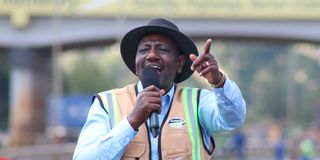
President William Ruto has drawn first blood in the long march to 2027.
His United Democratic Alliance (UDA) swept the latest by-elections in Mt Kenya, Western region and in Isiolo, tightening its grip on key battlegrounds and delivering a psychological blow to a “fragmented” opposition still searching for cohesion.
President Ruto described the victory of UDA party in four by-elections on Thursday and the November 27 ones as a demonstration of confidence in the government’s development record.
He said the opposition’s lack of a clear agenda for the country has proven to the people of Kenya that they had nothing to offer, giving the broad-based alliance an easy path to victory in the next General Election.
UDA wins four by-elections as Mohamed Tubi (7,352) bags Isiolo South MP seat; Peterson Njeru (3,207 - Muminji ), Duncan Muratia (7,853 - Evurore) and Elphas Shalakha (3,317 - West Kabras) win ward seats.
Photo credit: David Muchui, George Munene, Rushdie Oudia | Nation
“We have defeated them in Kakamega, Isiolo and Embu. I suggest we just focus on delivering our development agenda and ignore the opposition. They will only waste our time,” he said.
“I beat you in the places where you claimed to be the principal. How do you then claim that you will defeat me (in 2027)? How? I beat you even in your own polling station. I think we should just ignore these people,” the president said.
Dr Ruto spoke yesterday when he inspected the construction progress at the Bomas International Convention Complex in Nairobi County.
Ruto taunts Opposition after by-election victories
Political analysts say that the Thursday by-elections may have filled only a handful of seats, but politically they carried heavyweight implications.
As UDA celebrated what it termed a “decisive and domineering” victory, the Rigathi Gachagua-led United Opposition was left confronting an uncomfortable question: Is Dr Ruto’s machine simply too well-oiled—or are they fighting the wrong battle?
To UDA Secretary-General Hassan Omar, the results were more than local victories. They were a political statement.
“With valour and gallantry, the ‘Yellow Army’ has once again felled the ‘paper tigers,” Mr Omar declared in a scathing attack on opposition leaders he branded “rudderless, clueless, visionless.”
The February 26 mini-polls delivered the Isiolo South parliamentary seat and two ward seats in Mbeere North, Embu County, to UDA, alongside a fiercely contested win in West Kabras Ward in Kakamega County.
In Isiolo South, Mohamed Tubi, 36, secured 7,352 votes, comfortably defeating Jubilee Party’s Bina Mohamed, who managed 634 votes. The contest drew national attention due to the sibling rivalry and the symbolism of UDA consolidating ground in a region with fluid political loyalties.
Mohamed Tubi of the United Democratic Alliance (UDA) party declared the winner of the Isiolo South by-election, having received 7,352 votes.
Photo credit: David Muchui | Nation
The National Economic Development Party candidate, Mr Isaack Fayo, who dropped out of the race, received 44 votes.
Mr Omar said the poll outcome was proof that voters were rejecting “hot-air politics” in favour of tangible policy promises.
“The voters are emphatically rejecting politics whose currency remains hollow microphone gymnastics, noise without substance, and rhetoric without responsibility,” he said, while accusing the opposition of stoking ethnic divisions rather than offering solutions.
He added that the results reflected growing faith in the implementation of the UDA manifesto, known as “The Plan”, and in the administration’s broader socio-economic vision.
“The Kenyan message emerging from the just-concluded by-elections speaks unmistakably to the growing public faith in the implementation of the UDA manifesto… aimed at uplifting Kenya from Third World status toward First World prosperity, the Singapore-style development trajectory,” Mr Omar said.
In Mbeere North, UDA swept both Evurore and Muminji wards, posting commanding margins. In West Kabras, Mr Eliphas Kainanga Shalakha edged out Democracy for Citizens Party (DCP) candidate Mr Bramwel Wasike Khaemba in a tense race marked by allegations of voter bribery and sporadic violence.
Returning officer Salim Abdala declares Elphas Shalakha of UDA West Kabras MCA-elect.
Photo credit: Rushdie Oudia | Nation
In total, of the 28 by-elections held since 2022, parties aligned to the broad-based government have won 22 seats — a statistic UDA is keen to amplify as proof of sustained electoral dominance.
While the opposition framed the contests as localised and downplayed their national implications, UDA treated them as high-stakes political tests.
But DP leader Justin Muturi dismissed the “win”, saying that 2027 will be different.
“The whole exercise became ‘soko huru’ (free market). The results are not an indication of any political choice. 2027 will be totally different, and the country has been through such before,” Mr Muturi told the Nation.
Senior government figures, including Cabinet secretaries and regional kingpins, were deployed to campaign. Deputy President Kithure Kindiki camped in parts of Mt Kenya in the days leading up to the vote. Digital strategist Mr Dennis Itumbi reportedly spent weeks mobilising voters.
The strategy contrasted sharply with what observers described as minimal opposition presence in some areas, particularly in Mbeere North.
Mr Omar accused UDA’s rivals of engaging in “microphone gymnastics” while UDA focused on tangible mobilisation.
“The voters are emphatically rejecting politics whose currency remains hollow rhetoric,” he said.
The Mountain region has been politically sensitive since the impeachment of former Deputy President Rigathi Gachagua. Analysts had questioned whether President Ruto’s support base there was eroding.
The by-elections were a blow to the opposition, considering that in the November 27, 2025 mini- polls, UDA won three parliamentary seats — Mbeere North, Banisa (Mandera) and Malava, while Orange Democratic Movement (ODM), the ruling party’s partner in the broad-based government, won Ugunja, Kilifi South and Kasipul. On the other hand, in the November 27 polls, DCP won in Kariobangi North, Narok Town and Kisa East Wards.
UDA’s clean sweep in Mt Kenya is being interpreted within party ranks as evidence that President Ruto has stabilised his foothold in the vote-rich region. It also sends a signal to emerging outfits linked to Mr Gachagua that UDA’s grassroots machinery remains formidable.
However, the relatively strong showing by DCP in West Kabras indicates that alternative formations are making incremental inroads, even if not yet enough to dislodge UDA dominance.
Former Nairobi Governor Mike Sonko’s National Economic Development Party saw its candidate George Musini Mukhwana emerge third with 199 votes, followed by Mr Shivokha Masini of Democratic National Alliance Party with 79 votes and Democratic Action Party of Kenya’s Nivah Musa Khisa with 65 votes. Mr Edward Inzofu Indimuli of ODM, who withdrew from the race a few days to the by-election to support of the UDA candidate, came last, managing a paltry 30 votes.
The total valid votes cast in the 25 polling stations were 6,330, while the voter turnout was 56.4 per cent in a by-election that was marred by pockets of violence, voter bribery, intimidation and technical hitches.
In Isiolo South, turnout was affected by the Ramadhan season, drought-induced migration and voter apathy. Some polling stations recorded as low as 14 to 16 per cent turnout by midday, according to observers.
An entire polling station’s results were invalidated after discrepancies emerged between Form 35A and Keims kit data.
While UDA celebrated the victories, critics argue that low turnout tempers the narrative of overwhelming public endorsement.
For the opposition — particularly formations positioning themselves as alternatives ahead of 2027 — the results are sobering.
After UDA won key seats in the 2025 mini-polls, the latest contests reinforce a pattern: the ruling party is outperforming rivals in by-election mobilisation.
The opposition’s failure to mount vigorous campaigns in this week’s contests has raised questions about strategy, resource allocation and message clarity.
Some analysts are left asking: Are they conserving energy for 2027? Or are they struggling with coordination and funding?
“By-elections often reflect local dynamics more than national mood. But politically, they shape perception — and perception shapes momentum,” argues advocate Chris Omore.
For the opposition, the defeats highlight the risks of fragmentation. With multiple parties jostling for space and leadership within anti-Ruto ranks, coherence remains elusive.
The central question emerging from the mini-polls is whether UDA’s dominance stems from superior organisation and message discipline — or from an opposition yet to find its footing.
However, analysts warn that the by-elections may not predict 2027 with precision. Yet, politically, the symbolism is unmistakable.
Reporting by Ndubi Moturi, Gitonga Marete, Rushdie Oudia, David Muchui, George Munene, and Justus Ochieng