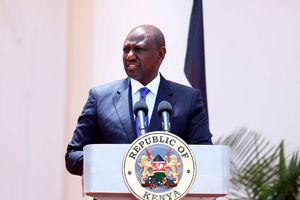
President William Ruto has 24 months to correct his administration’s errors and fulfil lofty promises made to Kenyans during the campaign period.
He promised to improve the well-being of low-income earners, create millions of jobs, make healthcare and education accessible and build thousands of decent houses.
Corruption and a deteriorating human rights record are among the many ills blamed on the administration. The brutal crackdown on protesters mid-last year and in June-July this year has brewed resentment, especially among young Kenyans.
How the government deals with corruption and wastage of public resources will influence politics in the next two years.
During the campaigns, Dr Ruto said his presidency would offer “constitutional democracy, institutionalised politics and open the doors of opportunity to all”.
Many of the promises, according to most Kenyans, remain just that – promises.
Since being sworn in office on September 13, 2022, Dr Ruto has found himself trying to push through ambitious reforms while facing public pressure over crippling taxes and a struggling economy. While he insists that taxes are necessary, frustration over the rising cost of living threatens his re-election.
Photo credit: Nation Media Group
Dr Ruto’s supporters say he deserves a second term, hailing him for populist programmes such as the Hustler Fund , the affordable housing project and the Social Health Authority (SHA).
They say Kenya Kwanza has steered the country through debt and global economic uncertainties, stabilised the shilling and implemented reforms in education, health, agriculture and other sectors.
However, critics accuse him of burdening struggling Kenyans with more taxes while failing to rein in allies who continue to flaunt wealth by spending millions of shillings on “empowerment programmes” despite most Kenyans living in squalor.
The critics say that despite a drop in inflation, the cost of living remains high.
Salaried Kenyans have experienced a fall in their take-home pay following the introduction of new taxes, including the 1.5 per cent Housing Levy, a 2.7 per cent Social Health Insurance Fund (SHIF) levy and increased National Social Security Fund (NSSF) deductions.
Additional tax measures in the Finance Bill, 2024, triggered nationwide youth-led protests, forcing the president to withdraw it.
“Even the president knows he has failed in almost every promise made to Kenyans. All his programmes – from SHA, affordable housing, university funding, to the most recent E-Procurement – have rubbed millions of Kenyans the wrong way and made life more difficult for the would-be beneficiaries,” Kitui Senator Enoch Wambua told the Daily Nation.
“Insecurity has become worse. The people of Kitui will tell you that even during the days of the shifta war during the presidencies of Jomo Kenyatta and Daniel Moi, the situation was much better than it is today.”
Dr Ruto and his allies continue to paint a rosy picture, saying the Kenya Kwanza administration is on the path to improving the living standards of all through the bottom-up economic model.
President Ruto pledged to increase the yearly supply of new housing to 250,000 and of affordable housing supply from two per cent to 50 per cent.
He said that would be realised by structuring affordable long-term housing finance schemes to guarantee the offtake of houses from developers.
After he assumed office, the figure was revised to 200,000 units a year. By this time, the government should have completed building at least 600,000 units.
Housing and Urban Development PS Charles Hinga described the project as a game-changer, saying it would offer dignified homes to many and create jobs.
“It has revolutionised Kenya’s housing economy. Citizens design, construct, supply and own the homes. It now stands as a national accelerator for job creation, artisan empowerment, manufacturing, construction sector growth and urban transformation,” Mr Hinga said.
Complete government affordable units in Bahati Sub-county, Nakuru County on June 11, 2025.
Photo credit: Boniface Mwangi | Nation
He added that more than 161,000 housing units are under construction. Some 11,000 units in institutional housing programmes are underway for police, prison officers and the Kenya Defence Forces.
According to the government, 4,888 homes are already advertised for public sale via Boma Yangu while 177,686 student beds – equivalent to 50,767 housing units – are to be delivered.
The PS said at least 320,000 construction jobs have been created. The government is also in the process of building at least 480 modern markets across the country, he said.
During the campaigns, Dr Ruto pledged to improve the living standards of poor Kenyans through a bottom-up model.
His first budget, however, made life more expensive through new taxes. The administration increased VAT on petroleum products from eight to 16 per cent.
Allies say Dr Ruto took office when the country was emerging from the devastation of the Covid-19 pandemic, a long drought, high interest rates and crippling debts.
State House Spokesperson Hussein Mohammed said Dr Ruto launched “bold reforms that laid a strong foundation for far-reaching socio-economic transformation”. He said Kenya’s economy is growing faster than the world average – five per cent compared to the global average of 3.3 per cent and 3.8 per cent in Africa.
State House says GDP hit Sh17 trillion in May, positioning Kenya as the largest economy in East and Central Africa and the sixth largest in Africa, while inflation fell from 9.6 per cent in October 2022 to 4.1 per cent in July 2025.
But Prof XN Iraki, a lecturer at the University of Nairobi, says the best way to gauge the state of the economy is to ask how many new jobs have been created and if people have money.
“It’s a question of forests versus trees. Looking at the economy from macro level (forest); things are rosy – low inflation, stable exchange rate and GDP growth. At the micro level (trees), things are not that rosy,” Prof Iraki said.
“Inflation is low because Kenyans have no money to spend. Money is taken up by unpaid bills and deductions. The shilling is stable because of subdued economic activities.”
Said the Kenya Kwanza coalition in its manifesto: “We will commit Sh50 billion a year to provide MSMEs with 100 per cent access to affordable finance and venture capital, equity funds and long-term debt for start-ups and growth-oriented SMEs.”
The Hustler Fund was launched on November 30, 2022, and made available through mobile money service platforms, with a promise to allocate Sh50 billion annually for the next five years.
The significance of the Hustler Fund was that the government became a micro-lender.
Photo credit: Nation Media Group
The allocations to the Fund continue to fall as borrowers fail to repay. According to State House, some 26 million Kenyans have accessed at least Sh74 billion from the Fund. Another Sh5 billion has also been saved through the platform.
Mr Mohammed said seven million blacklisted Kenyans have been delisted and restored to the credit system.
Kenya Kwanza is committed to bridging the teacher shortage gap of 116,000 within two financial years and reviewing the exam-based system of academic progression.
It also pledged to improve the capacity of day secondary schools and guarantee access to quality education, reduce the cost of learning and establish the National Skill & Funding Council.
President Ruto introduced a new university funding model, which was immediately rocked with challenges. The government is also struggling to finance learning in public schools.
State House says the reforms in education are on track, with 76,000 teachers already hired.
“This has enhanced the teacher-to-learner ratio to 1:29 from 1:45 in 2022. By the end of 2027, Kenya is projected to hire an additional 40,000 teachers and attain the Unesco-recommended teacher-to-learner ratio of 1:25 for primary school,” Mr Mohammed said.
State House highlights doubling of university funding from Sh45 billion to Sh82 billion in the 2025/26 financial year.
According to Machakos Deputy Governor Francis Mwangangi, the reforms have frustrated the smooth running of learning institutions.
“Schools are not getting money on time. Private and public universities are struggling. Admissions have gone down as parents can no longer afford to take their children to school,” he said.
“After failing to keep their promises, they have resorted to handouts in the name of economic empowerment.”
The administration embarked on the implementation of mandatory social health insurance through SHA. However, the transition from the National Health Insurance Fund (NHIF) has been characterised by hiccups.
Despite monthly premiums, which have shot up for a majority in formal employment, patients cannot access timely treatment.
Social Health Authority (SHA) signage at Mutuini Hospital in Dagoretti South Sub-County, Nairobi, on August 27, 2025.
Photo credit: Wilfred Nyangaresi | Nation Media Group
A December 2024 survey by the Rural and Urban Private Hospital Association of Kenya (RUPHA) revealed that nine out of 10 private and public hospitals were struggling to meet their operational costs due to delayed SHA payments.
“Some 25.5 million Kenyans are under the public health insurance scheme – TaifaCare – achieved in less than a year. This is more than triple the seven million covered by the NHIF,” Mr Mohammed said.
Dr Ruto promised to transform two million farmers from food deficit to surplus producers through input finance and extension support.
The target was to generate a minimum productivity target of Sh50,000 per acre. The government said the exploitation of farmers made agricultural production expensive.
State House says 7.1 million farmers have been registered digitally to ensure a more accurate mapping and eliminate fraudsters.
A worker offloads bags of subsidised fertiliser from a truck at the National Cereals and Produce Board in Elburgon, Nakuru County on December 21, 2024.
Photo credit: John Njoroge | Nation Media Group
“The Russian government donated to us 40,000 tonnes of fertiliser. Another 30 tonnes was given to these men, who blended and sold it to the government,” Mr Gachagua said recently.