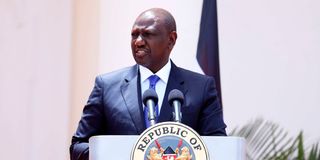
President William Ruto is either navigating the second half of his presidency with the wind in his sails, or consumed by a constant storm the storm — depending on who you ask.
Since taking power nearly three years ago on a promise to transform Kenya through a bottom-up economic model, Dr Ruto has launched a flurry of policies and programmes across nearly every sector. The President and his supporters style this as ambitious and audacious; critics call it chaotic and controversial.
As his administration crosses the halfway mark, the question hanging in the air is whether he describes as “bold vision” is laying the groundwork for transformation or has messed up Kenya’s most important sectors.
His key projects and policy shifts include the Affordable Housing Programme, Universal Health Coverage, the Hustler Fund, affordable fertiliser, the new university funding model, privatisation of State corporations, government-to-government fuel supply, jobs placement abroad, moving payments for all government services to the eCitizen platform and Electronic Travel Authorisation among others.
Dr Ruto, however, is not coy about his achievements.
Dismissing chatter that he’s destined to be a one-term president, he has struck a defiant tone, pointing to what he calls “measurable, credible progress” across the economy, housing, healthcare, agriculture, education, and youth empowerment.
“What is your plan? It cannot be that your plan is to incite and pay young people to destroy property and burn businesses. That is not acceptable,” the president cautioned his opponents in the opposition on Wednesday.
Dr Ruto has pushed back against mounting calls for his early exit (what critics call half term) or one term, through growing ‘Ruto Must Go’ and ‘Wantam’ (one term) chants in street protests and social media posts.
In an address at the Nairobi Securities Exchange (NSE) on Wednesday, the Head of State questioned the motivations behind the calls for his early departure, saying all Kenyan leaders have eventually exited office.
“Just like those who were there before me, my time will come and I will go,” the President said. “But, respectfully, sirs and madams, what are your reasons for this ‘Ruto must go’?”
Dr Ruto’s Kenya Kwanza administration has been faced with youth-led discontent over various issues, including the high cost of living, taxation, unemployment, official corruption, abductions, extrajudicial killings and contested policy reforms. This led to deadly protests that climaxed in June 2024 and were revived in June 2025.
He campaigned on a platform of reducing the cost of living and championing the right of the so-called “hustlers” — ordinary’ Kenyans — but critics and leading opposition figures, including his impeached former deputy Rigathi Gachagua , have accused him of reneging on their planned agenda.
President Ruto has told parents of Gen Zs that the police are not responsible for raising their children, urging them to do proper “parenting of their children.”
Ruto to parents: Take charge of your children’s upbringing
“He is a very confused person, extremely confused. When the Gen Z protests began in 2024, he called it an attempted coup. Then he blamed NGOs, then the Ford Foundation. Recently, he said it was the church; then the opposition; and just this Sunday, he blamed the parents for poor parenting. William Ruto, can you make up your mind on what ails the country!” Gachagua charged from the US.
While speaking in Dandora, Nairobi, during the recent inspection of the Nairobi River Regeneration programme, President Ruto urged the youth to reject leaders who have no agenda for the country or solutions to tackle unemployment and other challenges.
“Do not accept to be led by leaders who have no plan and those driven by tribalism and hatred,” he said, in an apparent reference to the Gachagua-led ‘united opposition.’
People’s Liberation Party (PLP) leader Martha Karua has accused president Ruto of “blatant abuse of power”, questioning the recent invocation of terrorism charges against anti-government demonstrators.
“Charging peaceful protesters with terrorism is a gross abuse of the legal process and a clear indicator of a rogue regime. It is meant to instill fear and silence dissent,” Ms Karua said. “The Constitution guarantees the right to picket and demonstrate. Kenya Kwanza is now criminalising that right.”
ODM leader Raila Odinga has dismissed ongoing speculation about President Ruto’s chances of securing a second term, insisting that only the Kenyan people can make that determination through the ballot.
In remarks that appear to be both a challenge and a caution to the Kenya Kwanza administration, Mr Odinga said the presidency is not guaranteed and that re-election is earned, not handed.
"It’s not a matter of one term or two. The real question is - who decides? It is the people who hold that power at the ballot," said Mr Odinga.
But Ms Karua, a former Justice Minister, called on Kenyans to prepare for a robust civic defence of the vote in 2027, saying the survival of democracy depended on public vigilance.
“We are not just going to vote in 2027. We are going to guard the vote. Every polling station will be watched. Every result will be verified,” she said. “This regime thrives in impunity. The only way to stop them is through people power.”
However, State House spokesperson Hussein Mohamed says that President Ruto has no time for premature 2027 campaigns, and that he has embarked on a bold economic reform agenda that is stabilising Kenya’s economy and expanding opportunity for millions.
“President Ruto is making the hard choices that others feared to make,” said Mr Mohamed.
“He is reshaping Kenya’s future through bold, necessary reforms,” Mr Mohamed said in a statement.
“Since August 2022, Kenya’s economy has grown at an average rate of 5 per cent — outperforming both the global and regional averages,” Mr Mohamed said. “Inflation has fallen from 9.6 per cent to 3.8 per cent, the shilling has appreciated by nearly 20 per cent against the US dollar, and the Central Bank Rate has dropped from 13 percent to 9.75 per cent, easing borrowing costs for ordinary Kenyans.”
Mr Mohamed noted that foreign exchange reserves had climbed to $11.8 billion, covering five months of imports, up from just 2.5 months previously. “These are not abstract numbers,” he said. “They reflect tangible progress and growing investor confidence.”
On social programmes, the State House spokesperson pointed to the Affordable Housing Programme , which has delivered thousands of homes and created over jobs: “This is social transformation in action.”
President William Ruto launches the 1,080 homes that are a part of the transformative 13,248-unit New Mukuru Housing Estate, the largest real estate site in Kenya’s history.
Photo credit: PCS
He also cited major strides in healthcare. “The Social Health Authority, launched in October 2024, has already registered 24 million Kenyans — up from just 7 million previously — and is delivering on the long-promised dream of universal health coverage,” said Mr Mohamed.
In agriculture, he said food production has risen, with farmers now earning more for their milk, coffee, tea, and sugarcane due to sectoral reforms.
On youth empowerment, he highlighted the Hustler Fund, which he noted has since disbursed Sh70 billion in loans to over 25 million Kenyans. “It’s the first-time millions of Kenyans without payslips or title deeds can access credit,” Mr Mohamed said.
He also pointed to jobs created through the Climate Worx programme. “And over 400,000 Kenyans have secured jobs abroad in health, agriculture, and construction. That’s how serious this administration is about tackling unemployment,” he said.
At the heart of Dr Ruto’s self-assessment is the economy, which he says is doing well while critics point to numbers that do not translate to real-life benefits.
Still, economists caution that macro-stability does not always translate into relief for ordinary Kenyans, who continue to face high living costs and unemployment. The real test, they argue, is whether the growth becomes inclusive and durable.
Dr Ruto’s signature Affordable Housing Programme has perhaps stirred the most visible change and controversy. Apart from discontent about mandatory deductions, questions on the number of houses have also persisted after the President’s original pledge to deliver 250,000 houses every year.
Under the restructured Universal Health Coverage (UHC) framework, the Health ministry says almost 24 million Kenyans have enrolled in TaifaCare. The government says it has weeded out over 3 million ghost beneficiaries from the old NHIF and is now processing claims more efficiently under the new Social Health Authority.
During a recent cabinet retreat, the Head of State noted that SHA has already paid over Sh49 billion in reimbursements and claims. Even then, complaints remain on the funding of SHA and whether it is really an improvement of NHIF.
The Social Health Authority building in Nairobi.
Photo credit: File | Nation Media Group
Still, healthcare workers continue to protest over delayed salaries, staffing shortages, and facility inefficiencies, raising concerns that policy reform has outpaced infrastructure readiness.
Dr Ruto has also framed agriculture as the engine of rural prosperity. Fertiliser subsidies, revived sugar mills, and better prices for coffee and milk have led to an increase in food production and a near-doubling of sugar output, he argues.
Dr Ruto’s education legacy may well hinge on the ongoing transition to Competency-Based Education (CBE), including the hiring of teachers, and the new controversial university funding model.
Dr Ruto’s administration says that public universities, once teetering on the brink of bankruptcy, are reportedly stabilising under a new student-centred funding model. Just like in other programmes, the changes have forced many poor students out of institutions of higher learning.
Dr Ruto's youth agenda — critical to his “hustler” brand — includes the Kazi Majuu programme , which he notes has facilitated overseas job placements, and the NYOTA youth empowerment scheme, backed by the World Bank.
The Hustler Fund has disbursed Sh65 billion to 25 million Kenyans, according to government records. However, the high default rate has led to questions on the programme’s viability. Youths have also been hired through green job initiatives under Climate Worx and digital jobs from constituency ICT hubs.
Still, critics argue that many of these are piecemeal or short-term solutions to a deeply rooted unemployment crisis. Others point to rising frustration among youth as the cost of living remains stubbornly high.
With the clock ticking toward 2027, Dr Ruto is casting himself as a results-driven reformer.
“We can confidently account for the actions we have taken, the lives we have touched. When the time comes for citizens to make their judgment, let them say this administration delivered real transformation,” he said on Thursday.