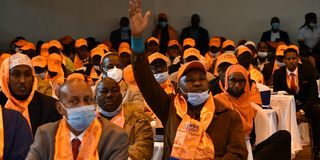
The planned Orange Democratic Movement (ODM) constituency elections are promising to be one of the most consequential battles in the struggle for the control of the outfit ahead of the 2027 General Elections.
Both elected leaders and 2027 hopefuls are some of the individuals gearing up for the party’s constituency elections, whose outcome would have a great bearing on the election of the party’s national officials.
All constituency chairpersons are members of the party’s National Delegates Convention (NDC), the supreme organ with powers to determine party policy as well as the election of national officials.
The Raila Odinga-led outfit has called for the ward and constituency level elections on April 7 and 9, respectively, having conducted grassroots elections at the polling station level in November 2024.
Some sitting MPs are currently serving as constituency chairpersons, and are likely to defend their positions or front allies to retain control of the party in their areas.
Some of the MPs are also county branch chairpersons – like Makadara MP George Aladwa (Nairobi) – and would be keen on those to be elected at the constituency level to help them retain their seats at the county.
Being a party official, especially for those with the ambition to run in 2027, is considered a plus in securing a party ticket. The planned elections are part of Mr Odinga’s grand scheme to strengthen the structures of the party ahead of the 2027 elections.
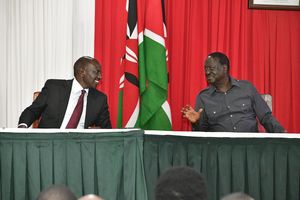
The party could team up with President William Ruto’s United Democratic Alliance (UDA) in the next polls, but is still keen on retaining its identity and influence in some of its backyards, including Nyanza, Western, and Coast.
The thinking is that with a strong presence across the country, the outfit would be able to negotiate as a key player in the next contest.
In the November polling station-level elections, party members elected a total of 30 officials. They include Mainstream (10), Youth League (10) and Women League (10). ODM has four tiers of delegates, drawn from the polling station, Ward, Constituency, and County levels.
The party explained that the 30 officials at the polling station would form delegates for the ward elections, while those elected at the ward would be the delegates at the constituency elections.
“Following the successful polling unit elections conducted on 27th November 2024, the National Elections Coordinating Committee (NECC) wishes to announce that the Sub-Branch (ward) elections will take place on Monday 7th April 2025 at designated centres across the 47 counties.”
“The branch (constituency) elections will be held on Wednesday 9th April 2025, at designated centres across the 290 constituencies nationwide,” said NECC chairperson Emily Awita.
The party seeks to elect 77 officials both at sub-branch and branch levels under the four committees of the mainstream, Women’s League, Youth League, and Disability League.
Under mainstream, the delegates will elect a chairperson, deputy chairperson, Secretary, Deputy Secretary, Treasurer, Deputy Treasurer, Organising Secretary, and Deputy Organising Secretary.
Other positions are Secretary for Women, Secretary for Youth, Secretary for Disability, Special Interest Group representative, and eight additional officials designated as Committee Members.
The party announced that the elections would be conducted through consensus or voting by show of hands.
Further, it said that only delegates elected at the polling unit will be eligible to participate as voters or candidates.
Ms Awita announced that any member aggrieved with the outcome would have 12 hours after the declaration of the results to file their complaints. They would be required to pay Sh15,000 and Sh30,000 for sub-county and county elections, respectively.
Party elections have in the past turned divisive and chaotic resulting in major fallouts, a scenario that has made many outfits in the country avoid holding party elections or resort to consensus.
An attempt by Mr Odinga in 2014 to hold party elections at Kasarani National Stadium was aborted after a group of youth dressed in black famously known as men in black stormed the venue and bungled the exercise.
It later, however, emerged that the youths were hired by some senior party officials to avert what was claimed as an attempt by some external forces to take over the party by planting their proxies in key party positions.
President Ruto’s UDA is also preparing for its phase two polling centre-level grassroots elections in 11 counties on April 11.
Another six counties will have the exercise on April 12, according to the UDA National Elections Board Chairman Anthony Mwuara.
On April 11 the exercise will be conducted in Kitui, Machakos, Makueni, Kajiado, Turkana, Kisii, Nyamira, and Bungoma counties. Others are Migori, Siaya and Kisumu.
On April 12, the party is set to hold the exercise in Garissa, Wajir, Mandera, Marsabit, Isiolo, and Taita Taveta.
The UDA party, which was a near religion in Mt Kenya after sweeping most seats in the 2022 general elections, is currently facing an uncertain future amid growing hostility following the impeachment of Mr Rigathi Gachagua, as Deputy President.
The Office of the Registrar of Political Parties (ORPP) in August ordered UDA to conclude the elections within 180 days.
UDA started the ambitious exercise in April 2024 but was forced to abandon the polls over June nationwide Gen Z protests after concluding the exercise in only two counties Busia and Homa Bay out of the initial five that were scheduled in the first phase.
The party had planned to conduct the exercise in Nairobi, Narok, Busia, West Pokot, and Homa Bay in the first phase.
But constituency-level elections in West Pokot were postponed over reports of possible violence while Nairobi and Narok were postponed following petitions challenging the credibility of the exercise.
“In line with good governance practices and the mandate of this office, the party is hereby directed to finalize the party elections as soon as practically possible but not later than a hundred and eighty (180) days from the date of this letter,” Registrar of political parties Anne Nderitu said in August 2024.