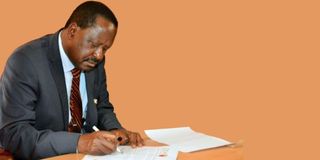
Former Prime Minister Raila Odinga has reaffirmed his commitment to a political partnership with President William Ruto in a new letter that marks a seismic shift in Kenya’s fractured political landscape.
The March 3 letter – obtained by the Sunday Nation - details the extraordinary lengths the President and his government went to in a failed bid to secure the African Union Commission (AUC) chairmanship for Odinga, who lost to Djibouti’s Mahmoud Ali Youssouf on February 15. It’s stamped received on March 4.
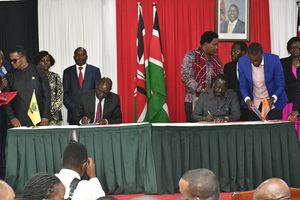
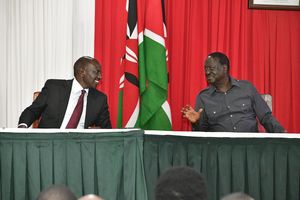
The letter’s unusualness – a public olive branch from a former rival – underscores its significance as a cornerstone of their reconciliation, formalised on March 8 when Odinga’s Orange Democratic Movement (ODM) pledged to support government affairs.
President Willam Ruto and ODM party leader Raila Odinga during the MoU signing event at KICC on March 7, 2025.
Photo credit: Francis Nderitu | Nation Media Group
“Mr President, I wish to acknowledge that you now hold the office within the African Union Commission that is charged with reforming the institution. I am confident that you will rise to the challenges and I assure you of my total support. I pledge to work with you and the newly-elected leadership of the African Union and the Commission to realise the dreams of our founding fathers,” Mr Odinga writes, framing the defeat as a unifying moment rather than a setback.
Mr Odinga's 'loyalty pledge', which has rubbed some of his supporters the wrong way, coupled with his advancing age, has led some to conclude that he may be preparing the ground to roll out the red carpet for the president in the 2027 presidential elections.
A nascent opposition alliance has encouraged him to pullout of the pact with the president to force a regime change.
His ODM party is careful not to be seen as endorsing such a position. Officials say they will consider the options available to them as election day approaches, and in any case, such a drastic move would have to be approved by the party organs. In reality, the organs have never taken a position other than what Mr Odinga wants.
Ruto and Raila sign political cooperation deal
“Very few people can put the interest of the people ahead of their personal interest. My brother Raila, history is going to treat you fairly. A few months ago, I called Raila and told him: You have been my party leader, and today, by God’s grace, I am president: I want you to be treated well,” Dr Ruto said of Mr Odinga.
“And I will do whatever it takes to make sure that you have respect in Kenya…The contribution you have made to Kenya deserves respect and support.”
The two leaders, bitter foes in the 2022 presidential race that split Kenya along tribal and ideological lines, now stand as unlikely allies, their pact a bold bid to heal a nation still reeling from the violent tax protests of June 2024.
The letter offers a rare glimpse into Ruto’s high-stakes AUC campaign, a cornerstone of his post-crisis statecraft to stabilise a nation shaken by last year’s unrest.
Ruto’s stability-first manifesto, honed by last year’s crisis stemming from Gen Z protests against Finance Bill 2024/25, now leans heavily on ODM’s grassroots network, a calculated bid to shore up power as Kenya teeters under mounting pressures mostly from the high cost of living – a rough balancing act indeed.
Ruto deployed government commitment, personally lobbied African heads of state, and enlisted top officials – Prime Cabinet Secretary Musalia Mudavadi for overt diplomacy, the Ministry of Foreign Affairs for coordination, and intelligence chief Noordin Haji for discreet outreach.
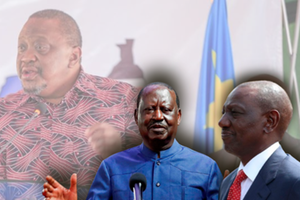
President Ruto’s outreach to Mr Odinga is part of the post-June crisis statecraft to maintain stability, a strategy that has also included outreach to former President Uhuru Kenyatta , signaling a broader elite truce to calm Kenya’s turbulent waters.
“Your early and enthusiastic support and encouragement for my candidature propelled me forward and gave me the impetus to campaign vigorously. You put the entire machinery of the Government of Kenya behind my campaign. The moral and material support that you offered me left no doubt about your belief in my candidacy.”
Mr Odinga also confirms, on record, the role of the National Intelligence Service in the AUC bid perhaps underscoring how serious the government was about the Continental seat and having a Kenyan chair the Commission.
“Mr President, you visited many African Heads of State and made many phone calls on my behalf. You put at my disposal the highest officials of the State including Prime Cabinet Secretary and Cabinet Secretary, Foreign and Diaspora Affairs, Hon Musalia Mudavadi and the Director General of National Intelligence Service, Mr Noordin Haji and their staffs,” Mr Odinga notes in the letter, highlighting Ruto’s charm offensive.
Odinga’s enduring influence across Kenya makes him a linchpin in this statecraft, a fact underscored by his storied political career and the letter’s forward-looking tone. Already, he’s enjoying the handshake dividend after the president named a number of his allies Principal Secretaries, awaiting parliamentary approval.
From Nyanza’s Luo heartlands to urban youth in Nairobi and coastal communities, Odinga commands a broad, loyal base – a reality Kenya’s leaders have long recognised.
Former President Daniel arap Moi invited him into a partnership in 2001; his alliance with Mwai Kibaki secured the 2002 election, ending Kanu’s decades-long rule; the Grand Coalition Government of 2008, where he served as co-principal after the disputed 2007 election, restored stability; and his 2018 handshake with Uhuru Kenyatta reshaped the political landscape.
Odinga has honed a mastery of Kenyan political instinct to the highest levels, turning crises into opportunities with chameleon-like adaptability.
The post-AUC partnership with Mr Odinga, announced a fortnight ago, is an extension of the same statecraft aimed at national stability, allowing Ruto to tackle the economic challenges he faces: a highly expectant populace, a country steeped in cumulative debt nearing 10 trillion shillings (£59bn), and a multiplication of promises to keep.
“Together, we can steer Kenya toward a future of unity and progress,” Odinga writes, casting their alliance as a remedy for a nation craving calm.
Yet Ruto’s stability-first agenda, sharpened by the 2024 tax crisis, walks a tightrope, and this alliance – however promising – carries risks that could unravel its ambitions.
The partnership leverages ODM’s grassroots network to bolster Ruto’s administration, which faces inflation, youth unemployment, and a restless Gen Z still smarting from last year’s unrest.
It also somewhat neutralises a fractured opposition, leaving figures like Musyoka isolated as ODM lawmakers ease Ruto’s legislative battles.
But the pact courts backlash: Odinga’s base bristles at supporting a former adversary, while Ruto’s Kenya Kwanza coalition fears a dilution of its agenda-it smacks of a poisoned chalice.
The economic stakes are immense –Kenya’s debt crisis demands deft handling, and Ruto’s promises of jobs and relief must materialise to sustain public faith.
It’s a rough balancing act, one that tests whether this alliance can deliver tangible gains or merely stokes the tensions it seeks to heal. As the ghosts of 2007 and 2022 linger, the Ruto-Odinga pact must prove it’s more than a marriage of convenience because that appears to the popular view among Kenyans going by public sentiments, a challenge that will define Kenya’s trajectory for years to come.