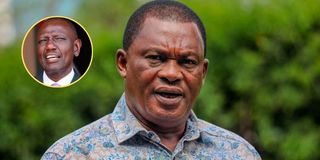
Former CS Justin Muturi says that President William Ruto is unfit to be Head of State.
In this first instalment of a three-part exclusive serialisation of The Fight for Order by Justin Muturi, the opposition leader — a lawyer who previously served as Speaker of the National Assembly, Attorney General and Cabinet Secretary — reveals about his failed attempts to reconcile the President with his former deputy and why he turned into a rebel in Cabinet
It’s the curse of the Deputy Presidency.
It started with the politicians, aides, minions and friends of the president doing things that they knew would rattle the Deputy President, Rigathi Gachagua.
A public slighting here, false accusations there, and open disrespect in public, and sometimes in private. All these things happened as the people around the president, usually his friends, fixers, and opportunists, tested how far they could push the boundaries of respect and protocol.
After his impeachment (in October 2024), Rigathi Gachagua let slip a detail about the humiliation he suffered while serving as (William) Ruto’s second-in-command.
He recalled how his wife, the Second Lady, Pastor Dorcas Rigathi, was regularly asked, formally, to accompany him to presidential events. But once they arrived, the script would flip.
If First Lady Rachel Ruto was not present, Ruto’s aides would sidle up to him, sometimes whispering, sometimes blunt, and tell Gachagua to send his wife home. Her presence, he quoted them saying, “italeta picha mbaya”, or “ruin the optics” for the president.
In Gachagua’s telling, it was one more humiliation in a string of quiet degradations. That even the visibility of his spouse had to be negotiated, trimmed, and managed in deference to force an image of a more polished, curated Ruto presidency.
These petty slights often erupted in public.
We could all see it.
For example, there was a young, foul-mouthed politician who flaunted insane riches, and we all knew that he had made the money by shaking down businessmen as he sold access to the president.
Poorly schooled, the politician publicly lectured Gachagua. He rejected Gachagua’s plea to the political class to go slow in their public exhibition of ill-gotten wealth, at a time when Kenyans were choking under terrible tax laws. Gachagua’s call for empathy and respect for the taxpayers fell on deaf ears.
In that petty theatre of politics, Gachagua also spoke about instances where the president’s aides often barged in to private meetings with Ruto and interrupted the meetings, claiming the Head of State had somewhere else to be.
Those interruptions happened to me one day.
The president, his Prime Cabinet Secretary Musalia Mudavadi and I were huddled in a conversation at State House grounds, working through some policy questions. One of his young friends, a political factotum with no portfolio, walked up to where we were standing, tapped the president on the shoulder, whispered something in the president’s ear and handed him a mobile phone.
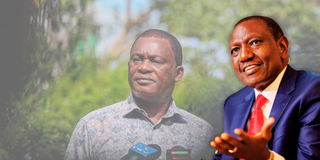
President Ruto claims Justin Muturi was fired for boycotting Cabinet meetings and being unqualified for his roles as Attorney-General and Public Service CS.
And the president, with no apology and no regard for what we were talking about, took the call and stepped away. The young man hovered behind him like a shadow, and that was it, our discussion had been cut short.
“What is this?” I asked Musalia, clearly perturbed that the president’s aide could interrupt an official meeting between the president, the Attorney General and the Prime Cabinet Secretary. What could be the emergency? Or was it a way of kicking us out, the bureaucratic trick to end appointments by purporting that something urgent had come up? After hearing Gachagua’s experience, I got my answer.
I had heard Gachagua complain about unelected and unaccountable presidential aides, who purported to give him presidential orders on what they wanted done. They issued the directions in Ruto’s name. Yet, Gachagua had access to the president. He spoke to the president regularly, sometimes at length. And not once, he said, had Ruto personally issued the orders his handlers so freely attributed to him.
“The problem here is that some people who are friends with the president also want to be my bosses. It is not possible,” Gachagua publicly complained. “I cannot allow people who hang around the president to be my boss. I have two bosses, the people of Kenya and the president of Kenya”.
He went on: “I cannot confuse my boss with his friends. I am not that stupid.”
Those of us in Cabinet, who had worked with Ruto’s predecessor, Uhuru Kenyatta, when Ruto was deputy president, quickly read the room and realised something was going on between the president and his deputy.
We had seen the damage the falling out between Uhuru and Ruto had caused. There was a familiar stink to what was happening between Ruto and Gachagua.
At the same time, the political grapevine was buzzing that the relationship between the two had broken down, and Ruto was exploring the option of working with his then-opposition rival, Raila Odinga. As an elder, who wanted things to work, I was disturbed.
One day, after one of the many meetings at State House where I attended as the Attorney General, I told the president I wanted to see him. He pulled me into one of the private meeting rooms. Tea was served as usual.
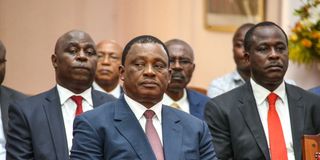
Attorney-General Justin Muturi and other officials at State House, Nairobi, on March 20, 2023, for Shadrack Mose's swearing-in as solicitor-general.
I sipped some. And then I asked: “Boss, you know I have seen you and the Deputy President are going the same way that you and Uhuru went. I am not happy. What is it? If there are problems, I can help solve those problems.”
Ruto looked at me for a moment and then explained how he believed Gachagua had become difficult. He was always pushing back when the president told him to do things. He behaved as if he owned the people of the vote-rich Mt Kenya region, which was politically significant in any national electoral contest.
As I listened to all the reasons that Ruto gave me, I was increasingly disturbed. The government had so much work to do; we had made very bold commitments; there was no room for petty political fights between the top two leaders. They had to find a way to work together. We could not afford a political falling out over territorial claims of the very people whom we had promised a better life.
I shared my fears with my Cabinet colleagues.
One day, Ezekiel Machogu, the politician with a grandfatherly mien, who was the Minister of Education, called me.
“Can we find time and talk to the deputy president about what the problem is between him and the president?” he said.
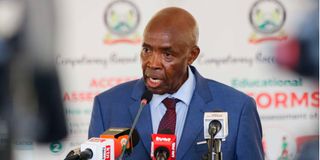
Former Education Cabinet Secretary Ezekiel Machogu.
After hearing out Gachagua, Machogu said we should go and sit down with the president to explain that their fight was making it difficult for us to work and deliver what we had agreed with the people.
Yes, this was politics. It had a messiness about it, but as politicians in power, it was in their interest to work together to keep the country on course. Political upheaval was going to tank the economy.
If Uhuru and Raila could work together after the bitter disagreements of 2017 elections, we reasoned, why not Ruto and Gachagua? The two leaders needed to sit down and fix their issues.
Also Read: Ruto: Why I fired Justin Muturi
As a Cabinet colleague and an elder, I had developed a functional rapport with Machogu. I trusted his judgment and his counsel on many official things. He trusted mine too.
Now, one of the functions of the deputy president is to chair the Cabinet committee, where Cabinet Secretaries can exhaustively discuss their policy ideas before the full Cabinet meeting. That way, the full meeting becomes more of an information session for the president and a quick session to approve some of the policies.
These meetings often happened at the official residence of the Deputy President in the posh Karen neighbourhood in Nairobi.
That week in April 2024, shortly after the Cabinet meeting, Machogu told me that we needed to speak to the deputy president. He also alerted other Cabinet Secretaries – Eliud Owalo, then at the Ministry of Information, Communication and the Digital Economy, and Salim Mvurya, then at the Ministry of Mining, Blue Economy, and Maritime Affairs. He had roped them in on what he wanted to do. Together, we followed Gachagua into his office as we all came out of the conference room.
Gachagua laid out the disrespect, the protocol breaches, and his fears of being treated as a puppet, a plaything, for the president and his aides. He felt that he was unwanted and unwelcome. We listened and empathised with him. We told him that we wanted their relationship to go back to where it was, or to be functional, so that the government functions well. Internal fights would cripple the government.
The meeting concluded and we left.
A few days later, there was a meeting at State House. Just as I arrived, I met (Salim) Mvurya and (Eliud) Owalo, who looked as though they had been rained on, like mischievous students knowing they had been reported to the head teacher.
“What is it? What is wrong?” I asked, alarmed.
They told me they had met Aden Duale, then Defence Minister (now Health Cabinet Secretary), and he had confronted them for meeting with “that mkora” Gachagua. They knew Duale was very close to Ruto, and he is one of those friends who spent much of their time at State House. They feared that if Duale told the president about our meeting Gachagua at his office, our intentions would be misinterpreted.
“There’s nothing to worry about. We have met the deputy president. Now, let us go and complete our mission and meet the president, and find out if there’s anything he can do to repair the relationship with his deputy,” I said.
We had not done anything wrong.
When Machogu came, we briefed him and together we went and spoke with the president. Machogu explained why we thought him and Gachagua had to make up.
The rapprochement never happened. The bad blood continued, and eventually, by October 2024, Gachagua was impeached.
However, something else was rattling the country, and public anger was simmering.
Rebel minister
“The end of a matter is better than its beginning, and patience is better than pride.” Ecclesiastes 7:8
It’s an odd experience to sit in your living room and hear the president of the Republic speak your name on national television, declaring that you were fired for absconding duty, for skipping Cabinet meetings.

Former Attorney General Justin Muturi.
That moment came on the night of March 31, 2025, during a televised interview from Sagana State Lodge. Ruto said I had been relieved of my duties (as Public Service Cabinet Secretary) for failing to attend three consecutive Cabinet meetings. It was, he suggested, a simple administrative matter.
It wasn’t.
I had been working as the Cabinet Secretary for Public Service and Human Capital Development, handling meetings in the office, doing field (visits) in the relevant departments under my docket, and visiting Huduma Centres across the country, encouraging staff to serve Kenyans with dignity.
Huduma Centre is an initiative of the government of Kenya, where citizens have access to various public services such as renewal of driving licences, application of national identification documents and student loans at a single location.
The only thing I had not done was attend Cabinet meetings, because the president and his Cabinet had refused to discuss the abduction of Kenyan children.
And I knew then that silence would be complicity.
I had watched as the people of Embu, who are usually civil at funerals, became irritable and agitated when I said I had a message from the president, William Ruto, to the family of my friend, Lenny Kivuti, the former senator of Embu.
I had been given the message and I showed it to Lenny, and he told me to read it. But when I told the crowd that I had the message from the president, the people booed me. I stopped and said I was going to give the message to the family.
I then spoke about the abductions.
For weeks, I had watched with growing horror as the number of abductions and unexplained disappearances rose. I condemned the state’s silence.
I called for the immediate release of those being held incommunicado and for the prosecution of the perpetrators, no matter how senior, no matter how untouchable. It was, by any democratic standard, a modest ask: Uphold the Constitution.
When I kept at it, the system activated its machinery to silence me. They told me to record a statement about my son’s abduction. This was January 2025, more than six months after the unfortunate and evil abduction of my son. I went and recorded my statement. Some asked me to resign. I refused.
Let’s talk about those Cabinet meetings. The first one of the year took place on January 21 at the Kakamega State Lodge. I reviewed the invitation. The agenda included agriculture, infrastructure, energy and such; simply, every topic except abductions and extrajudicial killings.
This was barely three weeks after the president stood at a rally in Homa Bay, looked the nation in the eye, and declared his government would put an end to enforced disappearances. And now, at the country’s highest decision-making table, he didn’t even list it as an item worth discussing?
I couldn’t, in good conscience, participate.

Former CS Justin Muturi.
So, I wrote to the president through the Secretary to the Cabinet and asked that they put the issue on the agenda or else, I would not attend any meeting.
The second Cabinet meeting came on February 11. I wrote to the president again. This time, directly. I reminded him of my earlier letter. I stated, unequivocally, that I would not return to the Cabinet table until the killings and kidnappings were treated with the urgency they deserved.
The third meeting followed on March 11. I sent one last letter on March 10, reiterating my position. I implored the president to bring this matter before Cabinet. Again, I received no response.
But after every meeting, like clockwork, I received the official dispatch. I saw what was discussed. I saw what was prioritised. And I saw what continued to be omitted.
Then came the interview in Sagana, as he tried to woo the Mt Kenya community. The president smiled into the camera and said the issue of abductions had already been addressed in Cabinet. He said I had simply refused to show up.
It was false.
From the day I spoke out, Cabinet colleagues began whispering that I was disloyal. Some said I was embarrassing the government. Others told me privately that the president wasn’t happy about the factual story that I had forced his hand in my son’s release.
Ministers began publicly calling for my resignation. They used old repressive tactics to try and intimidate withdrawing my privileges, threatening to take me to court for supposedly revealing government secrets and such.
They forgot that as a former magistrate, Speaker of the National Assembly, and Attorney General, I was also a lawyer, with very many friends who gave me legal advice on my personal predicament.
They counselled me on what I could say publicly, and what I couldn’t say. I swore to keep government secrets. I know the boundaries and limits of the oath I took, and I also know the remit of the Official Secrets Act. Belatedly, they realised their threats were useless. They stopped.
Those who had been friendly could not even speak with me on phone, not even on the encrypted messaging platforms, WhatsApp or Signal. They used strange numbers to call me. They didn’t even want to be seen with me.
I was not angry; I was worried about the country we had become; a country ruled by fear. If Cabinet ministers had to choose between obedience and integrity, we were already lost. If silence was the price of inclusion, then the club was not worth joining. I have resolved to fight for a better Kenya, with other like-minded politicians.
That journey continues.
Tomorrow in the Sunday Nation and www.nation.africa: Tower of graft: How incompetence, bureaucracy and corruption inflated the cost of building Bunge Towers by billions of shilling.