Leaders of the United Opposition have narrowed down to four possible names for the new political coalition they are building ahead of the 2027 elections.
The team, whose technical committee has been working behind the scenes to craft a “united opposition” outfit, says the names represent the spirit of change they want to project.
According to insiders in the technical committee, who spoke in confidence, the four names floated are: Muungano wa Ukombozi, Komboa Kenya Alliance, Liberation Alliance Movement, and Mageuzi Coalition.
Members confided to Sunday Nation that the proposed names were chosen after weeks of consultations, with the goal of finding a brand that resonates with Kenyans disillusioned by current economic and political realities.
“Four names were proposed but only three were taken for reservation at the Registrar of Political Parties for possible registration. The proposed Liberation Alliance Movement was knocked out as the team wished to have Swahili names owing to Kenya’s national language,” a source at the technical committee told the Sunday Nation .
People’s Liberation Party boss Martha Karua reads a joint opposition statement.
Photo credit: Lucy Wanjiru | Nation Media Group
This leaves Muungano wa Ukombozi, Komboa Kenya Alliance, and Mageuzi Coalition as the available options.
Analysts say the final choice of name will send a strong signal about the identity and direction of Mr Gachagua’s political camp. Whether the coalition leans on the liberation narrative, the language of reforms, or a unifying front, the decision could shape its public perception and influence other political actors in the run-up to 2027.
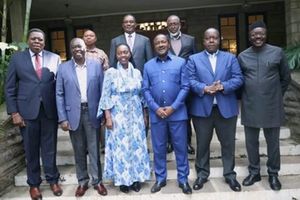
The opposition team comprises key principals, including former Deputy President Rigathi Gachagua , Wiper leader Kalonzo Musyoka, former Interior Cabinet Secretary Fred Matiang’i, DAP-K leader Eugene Wamalwa, Democratic Party chief Justin Muturi , and People’s Liberation Party (PLP) leader Martha Karua.
The team has planned a retreat to address simmering tensions over the 2027 flag bearer and to select their preferred coalition name and officials as proposed by the technical committee.
“The secretariat urged the principals to approve a coalition name and officials for the coalition to kick off,” said a source at the technical committee. “It also noted that the technical team wished to know the kind of approach to be used in regard to the upcoming by-elections, hence the need for the retreat.”
DAP-K party leader Eugene Wamalwa, one of the principals in the opposition outfit, told the Nation of a planned retreat to be held “soon.”
“The retreat is coming so that we can plan our coalition issues. It will be soon,” asserted Mr Wamalwa.
The proposed meeting comes as President William Ruto, backed by ODM leader Raila Odinga, has stepped up a political offensive, leaving Mr Gachagua’s camp under pressure to resolve internal wrangles or risk losing relevance ahead of 2027.
President Ruto has challenged the opposition camp to outline their agenda for Kenyans instead of engaging in “empty rhetoric.”
Speaking at State House, Nairobi, during the recent launch of the Nairobi County Empowerment Programme, President Ruto said his administration is resolute and focused on delivering change across the country.
“We will not, and we will never, succumb to the blackmail and threats of wantam because we know where we are going as a nation,” he stated.
As Mr Gachagua’s camp now seeks to lead a united opposition into 2027, their coalition-building drive echoes two decades of Kenyan politics where alliances have proven decisive in tilting the balance of power.
Coalition politics has defined Kenya’s competitive landscape, often determining who rises to power and who is left in opposition.
Wiper leader Kalonzo Musyoka says their quest is for a Narc-like coalition that will sweep President Ruto out of State House in 2027.
Speaking at the Democratic National Alliance (DNA) party’s national delegates convention early this year, Mr Musyoka had hinted that their movement would field a single presidential candidate.
Opposition leaders (from left) Kalonzo Musyoka, Fred Matiang’i and Rigathi Gachagua address the media in Kisumu on July 3, 2025.
Photo credit: Alex Odhiambo | Nation Media Group
“I want to propose an example of Narc. We shall be discussing the details, and I’m sure we shall get there… All the parties, including DNA, DAP-K, Kanu, PLP, Jubilee and all opposition outfits shall come together and compete, and whoever emerges as the winner, regardless of the political party, shall carry the coalition’s flag because we have a duty to redeem our nation,” Mr Musyoka said.
Political analyst Martin Oloo says that Kenya’s politics has taken a new twist following the political rapprochement between President Ruto’s UDA and Mr Odinga’s ODM.
“For Ruto and Raila to lose in 2027, there needs to be one big coalition of an alternative political juggernaut such as Narc against Kanu in 2002. If the opposition does not come together and front one candidate, Ruto and Raila will sponsor some minority presidential candidates who will, in turn, chip away some of the votes,” Mr Oloo argues.
Prof Gitile Naituli of Multimedia University says that President Ruto faces a complex and narrowing path to re-election in 2027 following the emergence of parties and their resolve to join hands in a larger coalition.
“While incumbency gives him certain structural advantages – state machinery, visibility, and resources – there are several significant stumbling blocks that could undermine his bid if not addressed deftly and strategically,” the professor of management and governance says.