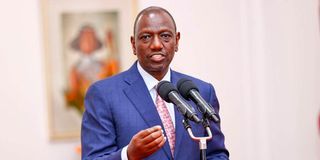
President William Ruto on Sunday vowed to fulfil all his campaign pledges, brushing off mounting public criticism and defending his administration’s performance in the face of rising discontent.
Speaking at AIC Bomani in Machakos County during the installation of Reverend Benjamin Kalanzo as the new head of the African Inland Church, President Ruto said his government was on track to deliver its promises and would not back down in the face of scepticism.
“A lot of people have become doubting Thomases. They try to ridicule us, and they say we lied. Those saying Ruto overpromised, I will shame them. They will realise they were ignorant and you will see for yourselves,” said the President.
The President’s remarks come against a backdrop of growing concern that his campaign pledges were unrealistic, including promises to deliver 250,000 affordable housing units annually, connect all households to electricity, construct dams across the country and address soaring youth unemployment.
To allay fears that he had sidelined the Ukambani region in development plans, Dr Ruto announced that he had set aside several days in August for his first development tour of the region.
“I have been accused of overpromising. But this is not overpromising; it is about raising our ambition as a nation. For too long, we have settled for being average. We must aim higher, and every promise I made, I intend to keep within my term. I have no intention of dropping any of them, and we are determined to change Kenya,” he said.
He cited what he described as significant progress in reviving the economy, transforming agriculture, expanding housing and job opportunities and reforming healthcare under the Social Health Authority (SHA).
Over the past two years, he said, the government has facilitated the export of 400,000 young Kenyans to work abroad, a move he said had increased remittances by USD 1 billion.
He warned county governments against charging patients at level 2, 3 and 4 hospitals, reiterating that under the SHA model, treatment at these facilities should be free.
“They should stop it. We have said that patients should be treated for free as the government will pay through SHA,” said the President.
In a combative tone, President Ruto also challenged his political opponents to move beyond slogans and provide Kenyans with alternative policies and development plans.
“Those planning to challenge me in the polls should have a clear agenda. Chanting ‘Ruto Must Go’ and ‘One term’ is not an agenda. They should tell Kenyans what they will do better than us,” he said.
At the same time, the Head of State addressed the Gen Z-led anti-government protests that have rocked his administration in recent weeks.
He urged parents and religious leaders to take greater responsibility for the moral guidance of young people, whom he portrayed as lacking direction.
In a stern warning to protesters, the President said police would not hesitate to use force, arguing that law enforcement officers were not equipped to provide parental care.
“The police are trained to deal with criminals. They are not trained in parenting. So, if you surrender your children to the police, what do you expect? Let us be responsible,” he said.
The President’s call last week to shoot protestors in the legs has sparked national and international backlash from human rights groups and opposition leaders, especially following the Saba Saba protests, which left at least 38 people dead and many more injured.
On Sunday, the President doubled down, characterising protesting youth as misguided and blaming the demonstrations on poor parenting and political incitement.
“Our children are our biggest resource. We must mentor them. Parenting is a God-given responsibility. As parents, do not abdicate your role. Do not surrender it to the church or the government, and do not let your child be raised in the streets by other people. Talk to your children,” said the President.
He added: “Raising the next generation of Kenya is a collective responsibility. It takes parents, the church, and the government to raise responsible citizens.”