The senators have expressed discomfort with a provision requiring public officers to declare gifts received by family members or relatives within 48 hours and with the inclusion of a broad definition of the term “relative,” particularly the word “affinity.”
The Bill seeks to put in place radical sanctions to discourage public officials from doing business with government to amass ill-gotten wealth, a corrupt practice that has minted overnight millionaires from officers whose salaries do not match their extravagant lifestyles.
The legislation has faced many hurdles since its passage by the National Assembly in November, 2023 before subsequent endorsement by the Senate in June 2024, all with far-reaching amendments aimed at defeating the main objective of the Bill.
Parliament watered down the original Bill leading to the President declining to assent to the piece of legislation, raising issues with some 12 clauses that he said were watered down by Parliament.
Clause 2 of the Bill defines a “relative” as a person who is related to a public officer by birth, marriage, adoption, or affinity.
President Ruto is pushing to entrench the definition in the Bill, arguing that public officers can bypass conflict of interest restrictions by using family members and relatives as proxies, thereby compromising the integrity of the conflict-of-interest framework.
But senators are opposed to the inclusion of the word “affinity” in the definition of a relative, arguing the broad and vague nature of the word can be used for political persecution and intimidation.
The Senate needs a two-thirds majority, in this case 45 out of 67 senators, to defeat the President’s reservations.
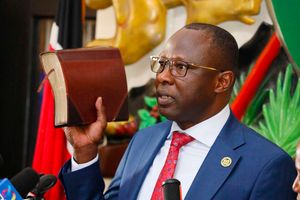
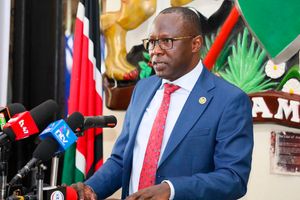
Vihiga Senator Godfrey Osotsi said the amendment will cause problems as it is ambiguous and could be used for political persecution and intimidation of people.
Senate County Public Investments and Special Funds chairperson Godfrey Osotsi.
Photo credit: File | Nation Media Group
“One can have an affinity to many people, including people in this House. You and I have some affinity because we are Senators. So, if I commit a crime, you will be arrested because of me. This word will be used for political persecution,” said Mr Osotsi.
Uasin Gishu Senator Jackson Mandago said the word “affinity" should be deleted as it is wide that it will be open to abuse.
He said the Senate will not be used by financial institutions that want to make it difficult for Kenyans to do business.
“I do not understand what this Bill wants to address. Since we cannot say some of these (enforcing) institutions are immune to being politically weaponized, we should make our definitions very clear,” he said.
Nominated Senator Esther Okenyuri called on the House to provide an alternative way of defining family, relative and affinity, warning that failure to clarify the three might expose innocent people to issues the Bill is trying to curb.
“In as much as we want to curb loopholes in the public sector, if we do not clearly state whom we are targeting, then we might end up exposing people who are very innocent, just because they associate with certain individuals. As a Senate, we need to keenly look at this,” said Ms Okenyuri.
Nandi Senator Samson Cherargei said it is dangerous to have the word in the clause as it assumes that an individual is related to any person they have a liking for, and therefore must be dropped.
He claimed the amendment is being pushed by the World Bank and other foreign entities, which do not understand African culture.
“Does it mean that if I have been your friend for some time and I have a close affinity, then we are related? What this means is that if a public officer is found to have committed an economic crime, people close to him or his associates, which is not properly defined by law, can run into problems,” said Mr Cherargei.
Tana River Senator Danson Mungatana said enforcing the provision will be a challenge because the word “affinity” is so loose that somebody can actually use it to harm people or destroy somebody.
“This means that when they are enforcing anything against a public officer, they can go for any person whom they think has some form of affinity or association with the person of interest,” said Mr Mungatana.
“This means every friend that you stay with, every person you play basketball with, go to church with or even members of your social welfare group. There is a problem here with this word and the intention cannot be to expose people to this extent. It is obviously in conflict with the freedom of association Article in the Constitution,” he added.
Kisumu Senator Professor Tom Ojienda took issue with the inclusion of relatives in the clause, saying most Africans do not even know who their relatives are because of extended relatives.
Kisumu Senator Tom Ojienda.
Photo credit: File | Nation Media Group
“So that definition is problematic because at times, we cannot even define who our relatives are.”
Wajir Senator Mohamed Abass added: “I think by nature nobody commits an offence as a proxy on behalf of somebody else. All adults carry their own crosses. So, wherever your brother is, maybe in another part of the world, you cannot take responsibility for his mistakes. I oppose the amendment.”
The senators also have issues with Clause 16 of the Bill which states that where a public officer has knowledge that a family member or a relative has accepted a gift or favour, the public officer shall, within 48 hours of such knowledge, or, if not on duty, within 48 hours of resumption of duty, make a declaration of the acceptance.
The officer is also expected to give sufficient details of the nature of the gift or favour accepted, the donor and the circumstances under which it was accepted for purposes of assessment of potential conflict of interest, failure to which the officer is deemed to have committed an offence.
“This is another amendment that is very annoying. In fact, the referrals contain amendments, which are even worse than the initial amendments that were there. I want to urge the House to reject these referrals and if possible, delete all the clauses from this Bill,” said Mr Osotsi.
Kitui Senator Enoch Wambua said the definition of a relative and a family member in the African context is so wide that finding out who has received a gift is an impossible task.
“Surely, this must be dead on arrival. Even if you wanted to, you cannot enforce it. How do you enforce this? How do you even do it? Hii wacheni ikae,” said Mr Wambua.
Senator Mandago added: “On the issue of gifts, our problem arises where it says you should know if your relative receives a gift. For heaven's sake, I have relatives all the way from Tanzania to Laikipia, West Pokot and there is even a rumour that I have some relatives in Turkana. How will I tell whether they have received a gift and what value?”