A year ago, Kenyan Gen Z protesters forced the president to his knees. Now, they're setting their sights on the country's new electoral commissioners.
"We broke a whole government with our phones," says 22-year-old law student Cynthia Achieng, scrolling through saved TikTok videos from the June 2024 protests that changed Kenya forever. "Now we're watching these commissioners. Every. Single. Move."
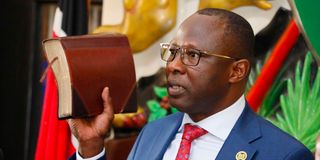
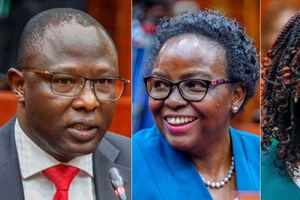
The new team, led by chairperson Erastus Edung Ethekon alongside commissioners Ann Njeri Nderitu, Moses Alutalala Mukhwana, Mary Karen Sorobit, Hassan Noor Hassan, Francis Odhiambo Aduol, and Fahima Araphat Abdallah, arrives 906 days after the previous IEBC team exited office. But this isn't the Kenya that welcomed its predecessors.
When smartphones became weapons
Between June and July 2024, these young Kenyans rewrote the rules of political engagement in real-time. Armed with nothing but smartphones and WiFi, they translated the controversial Finance Bill 2024 into local languages, used ChatGPT to break down complex tax policies, and leaked politicians' phone numbers for mass SMS campaigns. When President William Ruto's government tried to push through punitive tax increases, Gen Z didn't just complain—they organised.
A protester records a video using his smartphone during a youthful protest opposing the 2024/2025 finance bill along Koinange Street, Nairobi on June 20, 2024.
Photo credit: Wilfred Nyangaresi | Nation
The hashtag #RejectFinanceBill2024 exploded across TikTok, Instagram, and X, with protesters live-streaming confrontations with police. Unlike the elite-led demonstrations of Kenya's past, these protests had no traditional leaders, no party affiliations, and no mercy for political sacred cows.
"The people want a voter registration process which is friendly to them," said Dr. Ekuro Aukot, who watched the protests reshape Kenya's political landscape. "But these young people want something previous generations never demanded—real-time transparency."
On June 25, 2024, the unthinkable happened. Protesters stormed Parliament buildings as lawmakers were inside, forcing MPs to flee for safety. At least 22 people died in clashes with police, but the movement didn't break—it evolved. By June 26, President Ruto had withdrawn the Finance Bill entirely, reshuffled his cabinet, and essentially admitted that governing Kenya had fundamentally changed.
The last time vs. this time
When Kenya last appointed electoral commissioners in 2021, today's protesters were university students focused on degrees and job prospects. Many were beneficiaries of free education policies, graduating with hope for the future. Instead, they found a 67 per cent youth unemployment rate and watched politicians live lavishly while ordinary Kenyans struggled with inflation.
"We as young Kenyans, all we want is a system that is transparent, a system that hears our issues and a system that is not controlled by deep state. The new IEBC must work independently," said 24-year-old activist Sammy Oluoch, who participated in the protests that brought down the Finance Bill.
The previous IEBC worked in relative silence, making decisions behind closed doors with minimal public scrutiny. This time around, the commissioners face a hyper-connected generation that has proven they can turn government buildings into global live-streams and make cabinet secretaries household names—for all the wrong reasons.
Constitutional crisis meets Digital Revolution
The timing couldn't be more challenging. The IEBC has been headless for over two years, with courts ruling that the lack of commissioners makes the commission's actions potentially illegal. Real consequences are already visible: constituents in Banisa have been without parliamentary representation since MP Kulow Maalim's death in March 2023 because no by-election could be conducted.
More pressure comes from constitutional deadlines. Kenya is overdue for boundary delimitation—the last review happened in March 2012, meaning the constitutional requirement to review every 8-12 years expired in March 2024. Without commissioners, this essential democratic exercise has been impossible.
The appointment process itself reflects the new political reality. After the Finance Bill protests, President Ruto was forced to accept recommendations from the National Dialogue Committee (NADCO), born from the political compromise needed to end the crisis. The IEBC selection panel was expanded from seven to nine members, with enhanced qualification requirements including 10 years of experience and expertise in accounting or information technology.
President Ruto signed the IEBC (Amendment) Bill 2024 into law on July 9, 2024, in the presence of opposition leader Raila Odinga—a symbolic gesture of the new collaborative approach forced by Gen Z's uprising. The selection panel had 90 days to recruit the new commissioners, who were finally appointed in June 2025.
Zero tolerance generation
But institutional reforms mean little to a generation that has already demonstrated its power to reshape political reality through sustained digital activism. During the Finance Bill protests, young activists didn't just oppose government policy—they created alternative information systems, real-time fact-checking networks, and coordination mechanisms that bypassed traditional media entirely.
"This generation has zero tolerance for incompetence," Achieng emphasises. "We grew up with instant information and we expect instant accountability. Any misstep by the IEBC and we'll be there to call it out—live, in real-time, with receipts."
The protests revealed that approximately 60 per cent of young Africans are dissatisfied with their democracies, yet, traditionally, they participate less in formal political processes than older generations. However, Kenya's Gen Z shattered that pattern, proving that African youth are not disinterested in politics—they're just done with politics as usual.
These commissioners now have the difficult task of rebuilding trust in an institution that has faced intense scrutiny. In the 2022 general election, opposition leader Raila Odinga accused IEBC commissioners of rigging results in favour of President Ruto—allegations the commission denied but which highlighted the credibility challenges facing Kenya's electoral system.
Now they operate under a new social contract. Every decision will be dissected in real-time on social media. Every public appearance will be scrutinised by thousands of digital natives.
The Gen Z protests challenged the established political order and tested traditional theories that power belongs primarily to political elites.
"We are not just the leaders of tomorrow, we are the watchdogs of today," read one placard during the Finance Bill demonstrations. For Kenya's new electoral commissioners, that message isn't just a slogan—it's their new operating environment.