President William Ruto’s decision to appoint six sitting Members of Parliament (MPs) to his Cabinet has cost taxpayers more than Sh550 million in by-election expenses, prompting a lawsuit challenging the constitutionality of such appointments.
The avoidable use of public funds has sparked legal action, with a petitioner seeking to permanently stop President Ruto from making further appointments from the two Houses of Parliament, citing the financial burden on taxpayers.
In his bid to reward loyalists with Cabinet slots and build a broad-based government for political stability, President Ruto selected individuals who were already elected to serve in Parliament.
While the appointments were intended to boost the Cabinet’s profile and bring in influential, recognisable figures for political leverage, they have imposed additional costs and wasted time for voters engaged in by-election campaigns.
Lawyer Lempaa Suyianka, through Mugeria, Lempaa & Kariuki Advocates, has filed a petition in the High Court seeking, among other reliefs, a declaration that appointing MPs as Cabinet Secretaries is unconstitutional.
The petition follows revelations by the Independent Electoral and Boundaries Commission (IEBC) that four 2022 by-elections cost taxpayers nearly Sh500 million.
In Bungoma, voters returned to the polls after Senator Moses Wetang’ula was nominated for the National Assembly Speaker position by the ruling United Democratic Alliance (UDA). The subsequent by-election cost Sh233,153,272.
Cabinet Secretary Lands, Public Works, Housing and Urban Development Alice Wahome.
Photo credit: Dennis Onsongo | Nation Media Group
In Elgeyo Marakwet, the appointment of Senator Kipchumba Murkomen as Roads and Transport CS on September 26, 2022, triggered another by-election that cost Sh143,977,287, according to the IEBC.
Similar appointments of Aden Duale and Alice Wahome led to by-elections in Kandara and Garissa Town, costing Sh49 million and Sh44 million, respectively.
Lawyer Suyianka Lempaa.
Photo credit: File | Nation Media Group
“That on or about December 8, 2022, the Independent Electoral and Boundaries Commission conducted by-elections in the respective constituencies that cost Kenyan taxpayers over Sh471 million,” the petition states.
Two more by-elections in Ugunja and Mbeere North, occasioned by the appointments of Opiyo Wandayi and Geoffrey Ruku to the Cabinet, are projected to cost an additional Sh100 million. These by-elections are scheduled for November 27, with the Ugunja poll alone estimated at Sh54.3 million, according to IEBC CEO Marjan Hussein Marjan.
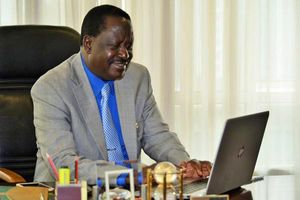
Energy and Petroleum Cabinet Secretary Opiyo Wandayi.
Photo credit: Dennis Onsongo | Nation Media Group
Mr Suyianka’s petition argues that there was no public participation in the affected constituencies before the President appointed the MPs, denying voters their democratic right to choose their representatives.
“Equally, the United Democratic Alliance, without participation from the people, sponsored the National Assembly Speaker immediately after winning the Bungoma Senatorial seat, occasioning an expensive by-election in Bungoma County,” the petition states.
The petitioner seeks a High Court declaration that appointing MPs to the Cabinet, which triggers by-elections, violates Article 201 of the Constitution, which requires prudent and responsible use of public funds.
The petition further contends that such appointments, made without public participation, violate Article 10, which enshrines national values and principles of governance.
It also seeks a permanent injunction restraining the President from appointing sitting MPs to the Cabinet and a declaration that the President’s power to appoint Cabinet Secretaries is not absolute but subject to constitutional limits.
Elections in Kenya remain expensive compared with other countries in the region. For instance, the upcoming November 27 by-elections in 24 electoral areas are projected to cost Sh1 billion. The IEBC also estimates that the 2027 General Election will require at least Sh61 billion, much of it for technology, logistics, security personnel, and temporary election officials.
Public Service Cabinet Secretary Geoffrey Ruku.
Photo credit: Joseph Kanyi | Nation Media Group
According to official IEBC reports, key cost drivers include technology requirements, the high number of polling stations, reliance on satellite result transmission due to weak 3G coverage, ballot security features, transport and logistics, and allowances for temporary officials.
Kenya’s elections are among the most expensive in Africa and globally. In 2017, the per-voter cost was about Sh2,000, second only to Papua New Guinea at Sh6,300. In 2022, the IEBC spent Sh44.18 billion on the general election, translating to roughly Sh2,200 (USD 18–20) per registered voter—far exceeding the international Average Cost per Registered Voter Index benchmark of USD5 (about Sh646).
A 2019 Public Accounts Committee report described the cost of the 2017 general election and repeat presidential poll as “highly inflated.” By comparison, Ghana’s 2016 elections cost USD0.07 (Sh9) per voter, Rwanda’s 2017 polls cost USD1.05 (Sh136) per voter, Uganda USD4 (Sh517), Tanzania USD5.16 (Sh667), and Nigeria USD8.61 (Sh1,112).
In 2019, the Constitution Implementation Oversight Committee visited India to study its use of the Voter Verifiable Paper Audit Trail (VVPAT) system, which allows electronic voting machines to generate paper slips for each ballot cast. The committee noted that Kenya could benefit from adopting similar technology to improve transparency.
The forthcoming by-elections cover 24 electoral areas, including Ugunja, Mbeere North, Banissa, Kasipul, Magarini, Malava, and the Baringo Senate seat. The Baringo seat became vacant following the death of Senator William Cheptumo on February 16, 2025.
Banissa’s vacancy arose after MP Hassan Kullow died in a road accident on March 29, 2023, Magarini’s after the Supreme Court nullified Harrison Kombe’s election on May 31, 2024, and Malava’s after MP Malulu Injendi passed away on February 17, 2025.