Ruto to opposition: Election is not a beauty contest

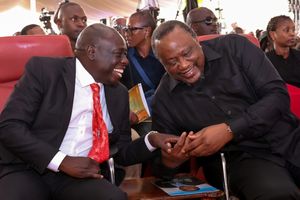
President William Ruto with Kuria West MP Mathias Robi after unveilling a commemorative plaque for the construction of Mabera Modern Market, a Sh372 million investment set to accommodate over 1,000 traders and boost local commerce.

President William Ruto has rebuked opposition leaders for resorting to body-shaming, insisting that such criticism will not deter Kenyans from backing him in the 2027 General Election.
The President maintained that Kenya’s elections are not won on physical appearances, but on a leader’s capacity to deliver tangible change.
“Leaders will be elected based on what they can do. They are not elected based on looks and elections are not won through abuse or tribal politics,” he Head of State warned.


He urging citizens to disregard what he termed as trivial attacks from his rivals. “The opposition should find something better to do. They are busy engaging in divisive politics. We will not allow them to divide Kenyans.”
In recent days, a public war of words has unfolded between the President and members of the opposition, led by former Deputy President Rigathi Gachagua, with both sides trading personal barbs over physical appearance.
Mr Gachagua described the President as having lost weight, prompting a retort from Dr Ruto, who remarked that his opponents should go to the gym to shed some weight.
While the President had earlier vowed to sustain the attacks, he struck a more measured tone on Monday, assuring Kenyans that his physical appearance bears no relation to his performance in office.
He challenged Mr Gachagua to elevate the quality of political discourse, dismissing the attacks as inconsequential.
“Upgrade your thinking,” he remarked.
Speaking during a development tour of Homa Bay County, the President intensified his charm offensive among the youth, highlighting what he described as an enabling environment created by his administration for job creation.
He expressed confidence that his record, ranging from affordable housing initiatives to modern market construction, would ultimately win him public support.
Dr Ruto framed the forthcoming election as a contest between his broad-based coalition and an opposition he portrayed as lacking substance and direction.
In Migori County, the President inspected and launched several projects, including Kegonga Hospital in Kuria East, Mabera Modern Market and the Mabera Affordable Housing Project in Kuria West.
On healthcare, Dr Ruto said the government is undertaking reforms to ease the burden of medical costs, noting that many Kenyans have long been forced to sell assets to settle hospital bills.
Separately, Kenya on Monday flagged off its first consignment of goods to China under a zero-tariff arrangement, in a move expected to boost exports and ease the country’s long-standing trade imbalance with Beijing.
Kenya-China cooperation
The consignment comprising fruits, vegetables and minerals was dispatched from the Standard Gauge Railway (SGR) Nairobi Terminus and flagged off by Deputy President Kithure Kindiki and China’s Vice President Han Zheng.
The export flag-off, Prof Kindiki said, symbolises a new phase in Kenya-China cooperation and focuses on expanding Kenya’s exports, supporting value addition and creating greater opportunities for Kenyan farmers, manufacturers and entrepreneurs.
“Kenya produces the best coffee in the world. Kenya is the largest producer of avocado in Africa, and Kenya is the second largest exporter of macadamia in Africa. And therefore, what this opportunity means is that the Kenyan agricultural sector is going to be transformed,” Prof Kindiki said.
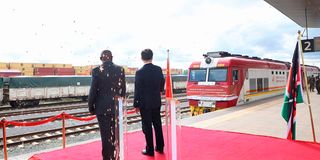
Deputy President Kihure Kindiki (left) and Chinese Vice President Han Zheng during the official flag-off ceremony of the inaugural Zero traffic consignment to China on March 23, 2026 at Nairobi train Terminus.
“There will be more wealth for our farmers and for exporters. Kenya is joining China and the other developed economies in the race towards creating prosperity and growth for its people.”
Kenya exports a variety of agricultural products to the Middle East, including meat, tea, vegetables and flowers. But the market in the Middle East is becoming increasingly uncertain following the raging US-Israel Iran war that is having the entire region on edge.
According to the government data, trade between Kenya and the Middle East, especially the UAE, had more than doubled over the past decade, with the UAE ranking as Kenya’s sixth largest export destination and second-largest source of imports, accounting for 16 percent of Kenya’s total imports.
The shipment marks one of the earliest tangible outcomes of China’s broader policy shift to warms up its markets to African goods through duty-free access.
This comes a month after China announced that it will extend zero-tariff treatment to 53 African countries with diplomatic relations with Beijing starting May 1, this year.
Beyond agriculture, Prof Kindiki said, Kenya was keen to deepen cooperation with China in areas such as manufacturing, agro-processing, renewable energy, digital trade and other industrial value chains.
“On the investment front, Kenya offers Chinese investors a strategic gateway to Africa. Through our membership in the East African Community, the Common Market for Eastern and Southern Africa, and the African Continental Free Trade Area, investors based in Kenya can access a continental market of more than 1.4 billion people with a GDP of USD 2.83 trillion. This makes Kenya an ideal location for production, value addition and regional distribution across Africa,” he said in high-level Kenya-China business forum where he spoke earlier.
DP Kindiki also hailed the cooperation as “both timely and forward-looking, reflecting the realities of our modern trade.”
In recent years, the Chinese Vice President Han Zheng said that the China-Kenya relationship has been growing at a high level.
“Our two countries are working together for high quality belt and road corporation, and to build the China-Kenya community with the shared future for the new era, which attests to the exemplary and leading role of China,” Mr Zheng said.
Kenya’s exports to China in 2024 stood at USD 0.21 billion and imports from China were at USD 4.32 billion creating a trade deficit of around USD 4 billion, according to Prof Kindiki.
Reporting by George Odiwuor, Dominic Ombok and Daniel Ogetta
Follow our WhatsApp channel for breaking news updates and more stories like this.