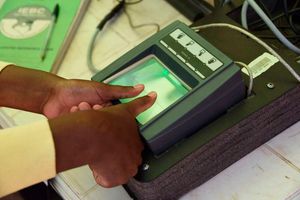
A fierce scramble for the crucial 6.3 million Gen Z votes has erupted ahead of mass voter registration scheduled to begin next week.
President William Ruto and opposition leaders have all joined ‘Niko Kadi’ campaign in rallying the youth to enlist as voters ahead of the 2027 General Election.
"Niko Kadi – which loosely translates to ‘I am a registered voter’ – started off as a youth-driven mobilisation for eligible youths to register as voters.
Allans Ademba, 29, the man behind ‘Uko Kadi?’.
Photo credit: Bonface Bogita | Nation Media Group
The political class has since joined the fray by rallying the Gen Zs to obtain the crucial document as tool to either secure a second term for President Ruto or cause a regime change.
For President Ruto, he is rallying the youth to enlist in large numbers to secure him a second term in office so that he can continue with his development agenda, while the opposition want them to register so as vote out Kenya Kwanza government.
The Independent Electoral and Boundaries Commission (IEBC) set to begin mass voter registration on March 30, 2026. In the 30-day mass voter registration, the commission targets at least 2.5 million.
IEBC has projected to add a total of 6.3 million new voters ahead of the 2027 polls. The number will push the voters’ roll to 28.5 million in the next polls.
Speaking during the launch of the Kisumu–Malaba section of the Standard Gauge Railway (SGR), President Ruto identified with the mass mobilisation for voter registration while expressing confidence that the first time voters would hand him a second term in office.
“To our competitors, Tuko Kadi. We are ready for you when the time comes. We are ready, and we are prepared,” said President Ruto.
But former Deputy President and Democracy for the Citizens Party (DCP) leader Rigathi Gachagua accused Dr Ruto of attempting to hijack the youth-led movement.
This as Mr Gachagua rallied the youth to seize the opportunity to register as a voter. He said it is only by obtaining a voter’s card that they will be able to kick out President Ruto and install a new regime.
“I have seen you are saying ‘Niko Kadi’. I want to ask you Gen Zs to register as voters. That is the only way to send Ruto home.”
“I have seen him try to hijack the slogan by the Gen Zs, but I can tell him that; yes, you have a card, but yours is a red card. You are going home,” said Mr Gachagua.
Former Chief Justice and 2027 presidential aspirant David Maraga also joined the Niko Kadi trend by rallying the youth to enlist as voters.
He said that the country’s biggest tragedy would be to have President Ruto serve for another five years. He described the 2027 as the most defining election in the history of the country.
“This coming election is a defining moment. Please register and vote. One of the greatest tragedies that could befall Kenya is if Ruto is re-elected,” said Mr Maraga.
Former Chief Justice David Maraga.
Photo credit: Bonface Bogita | Nation Media Group
Orange Democratic Movement (ODM) co-deputy party leader Godfrey Osotsi and Embakasi East MP Babu Owino have also joined the fray. The two politicians, who are members of the Linda Mwananchi faction of ODM said asked every eligible Kenya to register.
“I proudly champion the Niko Kadi Initiative as a call to every eligible Kenyan to register as a voter and secure their voice in shaping our nation’s future,” said Mr Osotsi.
Kitui Senator Enoch Wambua has also seized the moment by encouraging eligible youth to obtain the crucial document ahead of the 2027 contest.
“I encourage the young people to get out in large numbers to acquire national IDs and register to vote in the next elections.”
“Their voice will make all the difference in the desired outcome of the next general elections. This is their time to decisively respond to President Ruto’s bad governance. Mimi Niko Kadi.” Said Mr Wambua, a close ally of Wiper leader Kalonzo Musyoka. Mr Musyoka is among opposition leaders who have declared interest to run for the top seat.
The Gen Zs – whose lives and lifestyles have been shaped more by the internet – have in the past been apolitical, giving the politicians a field day in the running of the country’s affairs. Their voter turnout in 2022 was remarkably low, as the post-election report by the IEBC showed.
But the 2024 tax bill jolted them to action. They staged a siege that forced President Ruto to make major concessions, including dissolution of the Cabinet and withdrawal of the Finance Bill.
Born between the late 1990s and 2010, this group of young Kenyans is emerging not just as a voting bloc, but as a cultural and political movement. They have refused to identify with any of the major political players, who have historically rallied the country along ethnic lines.
According to the 2019 Kenya National Bureau of Statistics (KNBS) census, Kenya is a youthful nation with over 75 percent of its 47.6 million people under the age of 35.
In the last election, more than half of the Gen ZS were not adults while a chunk of the remaining did not bother registering or even visiting a polling station if registered as voters.
Four in five of the Gen Zs, or more than 14 million, will be eligible for voting, an increase of 79.4 percent of this cohort that were old enough to register as voters in 2022 when President William Ruto swept to power on the back of youth economic empowerment.
Kenyans aged 18 to 34 will number 17.8 million, reflecting the predominant role they will play in deciding the country’s political trajectory from 2027.
Prof David Mondo, a US-based university lecturer and political analyst, observes that Dr Ruto ‘is carefully trying to coopt the movement, create confusion among the youth and increase apathy within them.’
He notes that Niko Kadi movement is designed to make Dr Ruto a one-term President based on the Gen Z grievances from the 2024 nationwide protests.
“The opposition want to use the Niko Kadi to increase their numbers at the ballot and spread their cross generational networks. This is potentially a game changing movement not only because it threatens to remove the incumbent executive, but the Gen Zs also want to make all legislators that voted for the Finance Bill 2024 - one term,” says Prof Monda.
He says the movement has a potential to galvanize youth on a peer motivational and peer accountability basis, adding that the mobilisation can make Kenya cross the ethnicity Rubicon.
Youths register as voters. The soaring unemployment rates make most youths feel abandoned by politicians and political processes
Photo credit: File | Nation Media Group
“The challenge for Gen Zs is protecting the vote, stopping rigging and keeping up the Niko Kadi momentum till 2027 and beyond,” Prof Monda notes.
Speaking on ‘The Place of Youth and Religious Institutions in Building Democracy’ last week, IEBC Commissioner Anne Nderitu also rallied the youth to use their numerical strength in making decisions at the ballot.
“Young people must move beyond passive observation and actively engage in the democratic process by registering as voters, turning out on election day, contesting for leadership positions, applying for poll official roles and using their influence across social media and creative platforms such as music, poetry and spoken word to promote voter education awareness,” she said.
“The real issue is not numbers, but the gap between potential and actual participation, which ultimately determines electoral outcomes.”