For decades, Kenya’s political history has been written not just by its elected leaders, but by the silent actors operating in the background — the moles.
From the Kanu days of President Daniel arap Moi to today’s multi-coalition age, insiders posing as loyalists have betrayed parties, leaked secrets, and in some cases, helped shape the outcome of presidential elections.
This is the untold story of power’s shadow agents or the moles — shadowy figures planted deep inside rival political camps to leak secrets, record meetings, and whisper to their true masters what strategies are being hatched across the divide.
In Kenyan politics, the mole has never been a myth. From the one-party era of Kanu to the coalition years and the digital intrigues, analysts say political espionage has always been part of the game.
In the current political season, talk of moles has returned to the centre of power struggles — this time amid shifting alliances, broken trust, and a volatile pre-2027 climate.
President William Ruto’s Kenya Kwanza Alliance faces internal wrangles pitting loyalists against allies of former Deputy President Rigathi Gachagua who are still members of the United Democratic Alliance (UDA), but have shifted allegiance to Mr Gachagua’s Democracy for the Citizen’s Party (DCP) and his United Opposition camp.
Mr Raila Odinga’s Orange Democratic Movement (ODM) is also grappling with questions about who is truly committed to the opposition cause, in light of its broad-based working arrangement with President Ruto’s government.
In those formations, Kenya Kwanza, the United Opposition and ODM, among other outfits, suspicions run deep.
Leaders whisper of infiltrations — of spies and informants embedded by rival camps to sow confusion and relay intelligence.
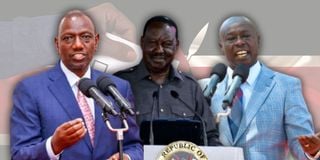
Mr Gachagua on Monday night expressed his frustrations over the politics of “moles” during his interview on KTN. He accused the government of infiltrating his camp.
President William Ruto (left) and former Deputy President Rigathi Gachagua.
Photo credit: File | Nation Media Group
“William Ruto has planted moles in the opposition. He has infiltrated our parties. When I was in office (as DP), he planted very many people on me.”
“When I came out of office I chased them away. Some have gone to Jubilee, and so they are being used by Ruto to cause problems within the opposition,” Mr Gachagua said.
“We have told leaders to be careful,” he said. “If some Ruto moles have left my party, don’t allow them in yours because he will still use them to undermine the bigger United Opposition.”
ODM Secretary-General Edwin Sifuna, who is steering what has become known as the Third Force, dubbed; “Kenya Moja” earlier in the week told off Mr Gachagua over what he termed as negative labelling of others as projects.
“As young leaders we are disappointed by some of the pronouncements coming from some members of the United Opposition. A vast majority of Kenyans want Ruto to be a one-term president. No one wants Ruto gone more than the other. It is therefore unfortunate for some leaders to pretend to gate keep the one- term movement, calling others projects,” Mr Sifuna charged.
He went on: “Some of us were singing, ‘Ruto Must Go’ in 2023 when Gachagua was still with Ruto. So when did he become the sole custodian of the one-term movement? ”
He warned against what he termed as a move to “straight jacket,” Kenyans into thinking they have limited options when it comes to national leadership.
But the same paranoia of moles planted by the State in the opposition is also mirrored within the ruling coalition.
UDA insiders say Dr Ruto’s camp has equally become wary of “double agents, especially from Mt Kenya region,” who attend meetings but secretly align with Mr Gachagua.
“It has become hard to tell who’s genuinely loyal,” said one UDA lawmaker. “Every day someone records meetings, and before long, the information is in the media, either mainstream or social media.”
In the run-up to the 2022 elections, following the fallout between President Ruto, then DP, and his boss Mr Uhuru Kenyatta , divided loyalty reigned high, including in Mr Kenyatta’s own Cabinet. At one time, Dr Ruto, while serving as DP, confessed about his secret meetings with some members of the Cabinet.
He explained how he held secret meetings with CSs sympathetic to his political cause, but who would rather remain anonymous for fear of harassment by State agents.
At the time, South Mugirango MP Sylvanus Osoro claimed there were five CSs and more than 10 Chief Administrative Secretaries (CASs) who had been meeting Dr Ruto at night and vowed to support him.
“There are many ‘Nicodemus’ meeting Ruto at night. Some are governors, CSs and PSs. Everybody is preparing themselves for the next election,” added Elgeyo-Marakwet Senator Kipchumba Murkomen, who is now the Interior Cabinet Secretary.
Mr Gachagua, then serving as MP for Mathira, also confessed that a majority of the CSs and PSs, who were leaning towards Dr Ruto, risked being sacked if spotted in public associating with him.
Former President and Jubilee Party leader Uhuru Kenyatta dances with youths during Jubilee Party Special National Delegates Conference at Ngong Racecourse in Nairobi on September 26, 2025.
Photo credit: Bonface Bogita | Nation
The idea of infiltrating political camps, analysts say, dates back to the early post-independence years.
During President Jomo Kenyatta’s regime, there were reports that intelligence agencies routinely planted informers in opposition groups and student unions to report on dissent.
In the late 1980s and 1990s, under President Daniel arap Moi, the practice became more sophisticated.
Moi’s infamous Special Branch was feared over reports of collecting dossier on politicians, civil servants, and journalists. Defectors were often encouraged — or coerced — to spy on former allies.
Prof Macharia Munene, a historian, once described Moi’s politics as a system where information was power, and moles were the arteries feeding it.
“Even after Kenya’s return to multiparty democracy in 1992, the mole culture never disappeared. Instead, it evolved. Parties became coalitions of convenience, and ideological boundaries blurred. Loyalty was transactional, and infiltration became both strategy and survival,” he says.
“They need to ‘eat’ from both sides. Leaders may even know who they are but they choose to use them for different assignments,” he says.
A former Liberal Democratic Party MP told Sunday Nation how, in 2002, as Mr Odinga led the National Alliance Rainbow Coalition (Narc) that backed Mwai Kibaki, moles reportedly leaked their plans to Kanu strategists, weakening the alliance in its early stages, “even leading to the defection of Simeon Nyachae who later contested against Narc and Kanu. The pattern persisted through the 2013 and 2017 elections.
Mr Odinga has, at times, alluded to infiltration, lamenting that “some people eat with us during the day and dine with our enemies at night”.
President William Ruto during a Presidential Roundtable with the Kenya Private Sector at Emara Ole-Sereni Hotel in Nairobi on August 6, 2025
Photo credit: PCS
President Ruto — known for his sharp political instincts — has since turned intelligence into an art form, opponents say . His political rise from a Kanu youth-winger to the UDA boss was marked by a mastery of information flow — both receiving and planting it.
Sources within UDA say Dr Ruto maintains parallel intelligence channels, blending formal State systems with informal political networks loyal to him.
“It is through these networks that he often anticipates opposition strategies or detects dissent within his camp. He doesn’t rely on official reports alone,” says a senior Kenya Kwanza official. “He has people everywhere — in Parliament, in the opposition, even in the media.”
This network, analysts argue, is what helped Dr Ruto outmanoeuvre, his then boss Uhuru Kenyatta in the tense months before the 2022 election.
Advocate Chris Omore argues that while moles may help their sponsors gain short-term advantage, the practice has damaging effects on party cohesion and democracy.
Former Nyeri Town MP Wambugu Ngunjiri, a former ally of Mr Gachagua, accuses the former DP of engineering the troubles in Jubilee Party.
“Gachagua was behind the plot to break Jubilee (Uhuru party) because he was set to benefit. The party was a threat to him in Mt Kenya region,” he said during an interview on NTV’s “Fixing the Nation” show.
Security experts warn that Kenya’s next election could see the rise of digital moles — operatives who hack rival databases, infiltrate online groups, and manipulate campaign communication systems.