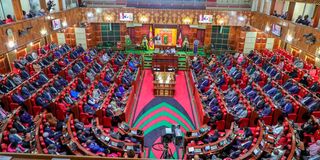
Kenyans could soon be able to remove elected and nominated Members of Parliament (MPs) and Members of the County Assembly (MCAs) following a new directive issued by a Senate committee.
The Standing Committee on Justice, Legal Affairs and Human Rights in its latest report has instructed the office of the Attorney-General, “to develop a policy framework on the grounds and procedure for the recall of directly and specially elected MPs and MCAs.”
The committee chaired by Bomet Senator Hillary Sigei has given the AG’s office a six-month timeline to table a status report to the Senate including public participation and draft bills for Parliament’s consideration.
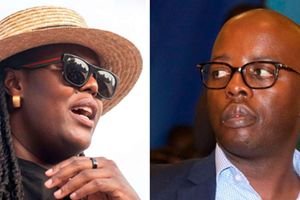
Bomet Senator Hillary Sigei.
The report states that this will be achieved jointly between the AG, the Independent Electoral and Boundaries Commission, the Kenya Law Reform Commission, the National Gender and Equality Commission, the Registrar of Political Parties, the Political Parties Liaison Committee and other relevant stakeholders.
To effect Kenyan voters’ right to remove elected and nominated legislators ahead of the 2027 General Election, the Senate has initiated amendments to Cap 7 of the Elections Act and Cap 256 of the County Governments Act (Cap 256).
“The said legislation to be introduced in Parliament not later than 26th February 2026, whether the policy framework will have been submitted to Parliament or not,” read the committee’s report in part.
In its recommendations, the Senate committee has tasked the AG with spearheading the development of the policy framework on recall provisions for both elected and nominated legislators and informing legislation for enactment by Parliament. “If the said policy framework is not submitted to Parliament on time, the committee undertakes to draft and introduce before the Senate the requisite amendments to the Elections Act (Cap 7) and the County Governments Act (Cap 265) to enable the Kenyan people to exercise the right to recall their leaders in Parliament and the County Assemblies,” stated the committee report.
“This will be done not later than February 2026, at the commencement of the Fifth Session, to ensure that the legislation navigates both Houses of Parliament and is in place ahead of the 2027 General Election.”
The recent developments follow a petition received by Senate Speaker Amason Kingi on October 8, 2024, from one Mr Laban Omusundi regarding the introduction of a framework for recalling nominated MCAs.
Senate Speaker Amason Kingi.
Photo credit: File | Nation Media Group
The petitioner argued that, while there exists legal mechanisms for recalling, impeaching and removing political leaders from their respective constitutional offices, there are no such provisions applicable to MCAs.
Further, he held there is no structure in place for the youth or persons with disability to recall nominated members.
“The Petitioner therefore prayed that the Senate amends the County Governments Act (Cap 265) to provide a framework for recalling nominated Members of County Assemblies through the public initiative.”
Upon consideration of the issues raised, the Committee invited comments from 11 key stakeholders out of which only two presented their submissions; the Office of the Registrar of Political Parties, and the Kenya Law Reform Commission.
Although the petition was specific to legal mechanisms to recall MCAs, the Committee observed that the right of recall currently cannot be exercised to both elected or nominated MPs and MCAs.
This was after a High Court declared sections 45(2)(3) and (6), 46(1)(b)(ii) and (c) and 48 of the Elections Act (Cap 7) and sections 27(2)(3) and (6) and 28(1)(b)(ii) and (c) of the County Governments Act (Cap 265) unconstitutional in its judgment in a case of Katiba Institute & Another v Attorney General & Another [2017] eKLR1.
The County Governments Act Sections 27, 28, and 29 provide guidelines on the recall of MCAs, which are similar to those of recalling MPs and they include: violation of Chapter Six of the Constitution, mismanagement of public resources and conviction of an electoral offense.
The procedure for recalling a legislature is stipulated in the Elections Act and it entails filing a written petition with IEBC, and collection of required signatures from ward voters, after which a recall election is conducted by IEBC if conditions are met.
The electorate's right to recall their MPs is granted in Article 104 of the Constitution for Senate and National Assembly elections which states,” The electorate under Article 97 and Article 98 have the right to recall the member of Parliament representing their constituency before the end of the term of the relevant House of Parliament.”
However, in its submissions, the KLRC observed that “the recall clause does not have grounds on which a member may be recalled since the purported grounds were struck out. The procedure to be followed in a recall petition is no longer clear since some requirements like ‘being a registered voter’ were struck out, and the right of recall is incapable of being exercised through the remaining provisions in both the Elections Act and the County Governments Act since there are not only no grounds for recall but also there exist huge procedural gaps.”
In its recommendations, the Commission called for the formulation of a legal mechanism stipulating the grounds and procedure for recall including how it will be exercised for elected and nominated MPs and MCAs.
The policy framework would inform law amendments to replace the provisions which were declared unconstitutional.