Just over a year ago, Kenya’s national anxiety was economic. The Finance Bill 2024 had ignited countrywide outrage over rising VAT, soaring fuel prices, and the audacity of new levies heaped upon a population already pressed to the wall. The question on every citizen’s lips was “how will I survive this economy?” The question has changed today.
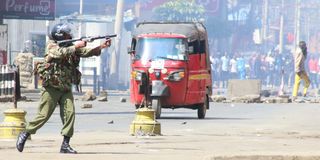
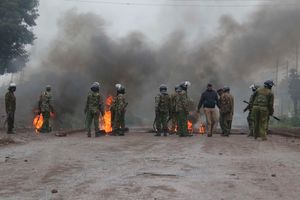
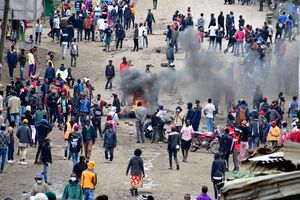
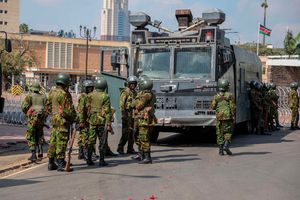
It is no longer about making ends meet; it is about making it home alive. A nationwide survey by Odipo Dev, a research and advisory firm based in Nairobi, reveals a dramatic shift in what Kenyans are most concerned about. While the economy remains a significant source of anxiety for 42 percent of respondents, state repression and violence have become a more immediate concern, with many citizens reporting a fear of injustice (52 percent), abductions (44 percent), and the police (38 percent). These are not theoretical threats in Kenya today. Between June and July, at least 47 Kenyans have died in anti-government protests, hundreds have been injured, and billions of shillings in economic output have been lost. April and May were riddled by reports of abductions and arbitrary arrests of filmmakers, techies and online activists.
Face mask vendor Boniface Kariuki is rushed to hospital by protesters after he was shot by a police officer in Nairobi on June 17, 2025.
Photo credit: Billy Ogada | Nation Media Group
The Odipo Dev research was conducted through a national survey of 1,038 Kenyans across 20 counties that experienced protests on June 25, 2025 to gauge the mood of the nation. The survey was conducted via street intercept interviews.
Of the respondents, 50 percent were between the ages of 18 and 35, 45 percent were between the ages of 36 and 50 and the remaining 5 percent were above the age of 50. The gender split was equal for men and women.
The research also analysed keyword and hashtag data on X (Twitter), for Kenya in 2024 and 2025.
These latest occurrences follow a trend of state brutality that has rapidly become the status quo in the country. Since June 2024, Kenya has endured what is arguably its most visible and methodical campaign of state violence since the Moi era. The Finance Bill demonstrations in June 2024 were met with excessive force. Within weeks, more than 60 people had been killed and scores injured, arrested, or disappeared. More brutal state violence followed in the months after the June protests. A Missing Voices study documented 104 incidents of extrajudicial killings and disappearances in 2024 – a 450 percent surge over the previous year.
Teacher Albert Ojwang who mysteriously died in a police cell.
Photo credit: Pool | Nation
In Kenya, economic hardship has long been the dominant lens through which governance was judged. It is measurable, daily, and universal. But civic priorities are reset when peaceful citizens are shot in the streets, abducted for a tweet, or silenced by surveillance. Fear becomes more immediate than inflation; safety more precious than a tax break.
“Public priorities are never fixed. They are shaped by proximity, visibility, and the immediacy of threat. In stable democracies, civic focus tends to centre on long-term concerns such as education, healthcare, and employment. But in fragile or repressive contexts, the hierarchy of public anxiety can shift rapidly in response to perceived danger. Political theory shows that what citizens worry about most is not always what affects them most but rather what feels most urgent in the moment,” says Darius Okolla , a political researcher and author.
This shift in the priority of citizen concerns is further evidenced by what has dominated national conversation lately, especially online. The report also shows that hashtags agitating for freeing abducted Kenyans and justice for those killed by state forces garnered significantly higher volumes of conversation on social media platforms than any economic topics.
Albert Ojwang's funeral: Mourners storm and burn Mawego Police Station
This was especially evident on June 25th, 2025, when, during the anniversary of the Finance Bill protests, the new Finance Bill 2025 was barely a feature of the protesters' demands. Instead, young Kenyans rallied their outrage towards justice for the death of teacher and blogger Albert Ojwang in police custody under suspicious circumstances. “The 2024 Finance Bill may have sparked the protests, but what followed is a broader, more visceral rejection of a broken system. With youth unemployment surging and 31 killed on July 7 alone, the state’s violent crackdown signals a legitimacy crisis. This is no longer just about bad policy; it’s a generational revolt against exclusion, corruption, and impunity,” says Reuben Wambui, an economist and sustainable finance advisor.
What has taken root in Kenya’s civic life in the last year is a complex, defiant, vigilant, paranoid tension. Everyday life is now dominated by the drama of brutal politics, every day, every hour. The report, which also analysed public data on Kenyan conversations on X, found that words such as "abductions" and "privacy" have gone from relative obscurity to becoming part of everyday Kenyan vocabulary. The Japanese car brand Subaru has become synonymous with the threat of state brutality. Usage of the word “abductions” rose by 326,000 percent, “Subaru” by 2,300 percent and “Privacy” by 735 percent in 2024, further emphasising Kenyans’ increasing concerns around government repression, rogue policing and surveillance.
“Nowadays in Kenya, a Subaru doesn’t just mean speed, it means fear. Since last year, abductions have become so common that pushing hashtags has become part of our morning routine. We are living in a country where being disappeared is one tweet away. Parents instantly tense up when their child does not answer a phone call. And somehow, that’s become normal,” says activist Hanifa Farsafi.
In the same survey by Odipo Dev, 76 percent of respondents reported they don’t feel safe to post political opinions online. 64 percent are now more afraid to attend protests than they were in June 2024. This is a finding that experts say is directly related to the rampant deployment of the Computer Misuse and Cybercrimes Act as a basis for repressing citizens who express themselves online. An analysis in the report showed that at least 22 people have been arrested and arraigned in court over alleged breaches of the act since last year.
These concerns are reordering our elective politics. The 2027 elections are no longer a referendum on economic management alone. They are shaping up to be a contest over the misuse of state power, and opposition leaders have pivoted to the new national narrative. Former Chief Justice David Maraga (who was teargassed himself at the June 25 protests) has openly criticised the weaponisation of the police and called for a constitutional reset. Long-time activist and Senator, Okiya Omtatah, has publicly aligned himself with families of the disappeared and protestors and filed court petitions demanding lawful prosecutions instead of clandestine abductions. Ironically, Fred Matiang’i, once the state’s enforcer of state excesses, has called for restraint, warning against the use of force against peaceful protesters.
Ruto: Attacking or raiding a police station is declaring war
On the other hand, the regime has doubled down under the guise of protecting peace and stability. President Ruto has referred to dissent as “terrorism disguised as protest” and has reaffirmed his government’s unwavering support for the police, even lately instructing to “shoot them in the leg”.
Can the narrative shift back to economic messaging ahead of the 2027 elections? Rueben Wambui finds it unlikely, “The state’s walk-back on tax hikes hasn’t restored calm, because the issue isn’t just economic but political too. Young people don’t just want jobs or training; they know justice and a government that listens is a precursor to that. When trust collapses, economic pledges ring hollow—especially when paired with state violence and elite excess. Until there’s accountability for police brutality, corruption, and tone-deaf leadership, economic fixes won’t land. The protests now demand something bigger: a reckoning with how the country is governed.”
Meanwhile, the economic crisis hasn’t gone away. It has merely been muscled out of the national spotlight. Kenya’s debt situation is especially worrying and unsustainable, according to Kwame Owino, CEO of the Institute of Economic Affairs. “The government needs immense relief from having to pay huge debt obligations. The total obligation is still as high as it was last year. So really, nothing has eased, especially after a year. We've written a paper urging the government of Kenya to consider applying for debt write-offs. It cannot carry this debt indefinitely. It cannot carry the debt servicing obligations that it has indefinitely, especially with the shilling in our view being much stronger than it should be.”
Interest payments on public debt are now consuming roughly one-third of total tax revenue, while over 40 percent of youth remain unemployed, and approximately a million more enter the market annually. Investor confidence is shaky due to the ongoing political instability, and experts caution that domestic borrowing and high lending costs are crowding out private investment. But as Kwame says, there is no separation between the two spheres and the solutions for both are inextricably linked. A wrong move on one end, triggers the other. “The political and economic solutions which are required are not necessarily separate. My view is that the street protests and huge public involvement around finance bills and the budgets in general are telling us that Kenyans actually have the view that there's what I call a political economy constraint on how much taxes the government can take.”
“It's forcing us to have to talk about a government that's going to run public affairs more efficiently with less money. Therefore, contemplating raising taxes to 25 percent, as this administration suggests, is going to be extremely challenging. Not only economically because firms are closing, but also politically because people won't accept it,” Kwame adds.
And yet, even as these economic pressures intensify, they are no longer the loudest threats. A citizen facing police violence is not thinking about interest rates. A parent trying to locate a missing child is not calculating household inflation.