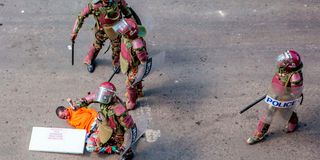
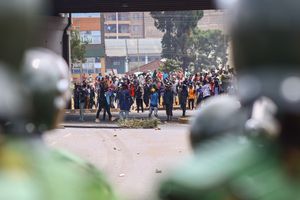
Attorney General Dorcas Oduor is expected to defend President William Ruto in court over his orders to police officers to use lethal force on violent protesters.
The court case filed by rights advocate Dunstan Riziki Makhoha concerns the President's "shoot in the leg" order to law enforcement officers as he reacted to increased anti-government violent Gen Z protests.
The ongoing case also involves the directive of Interior Cabinet Secretary Kipchumba Murkomen to police to "shoot to kill" the protesters.
CS Murkomen tells police to shoot people threatening them
Inspector-General of Police Douglas Kanja has already filed his papers in court denying having received such instructions or command from either the President or Mr Murkomen.
He also says police bear individual responsibility for the use of a firearm and that they are at all times required to obey only lawful commands.
"The petition as drawn and filed discloses no infringement of a constitutional right, it is based on assumptions, innuendos and is incurably defective and a proper candidate for dismissal with costs to the defendants," says the IG through Legal Officer Peter Muriithi in court papers.
According to Mr Kanja, the use of force or a firearm by police is regulated by the law; it is upon an individual police officer to decide when to fire, depending on the surrounding circumstances.
"The second respondent (Inspector General) may only receive directions from the Director of Public Prosecution in relation to investigation of allegations of criminal conduct while the Cabinet secretary responsible for police with respect to matters of policy and those directions must be in writing pursuant to Article 245(5) of the Constitution of Kenya. The second respondent vehemently denies having received any directions, instructions or command in relation to the substratum of the petition and the petitioner is put to strict proof," says the IG.
Advocate Makokha argues that based on the instructions of the President and the Minister to police, the law enforcement officers risk being rogue and acting arbitrarily, thus posing a risk to national security, freedom of movement and right to assemble and picketing.
"The orders are an "illegal" approval for the police officers to transform themselves to an accuser, investigator, prosecutor, judicial officer and enforcer of the law, the police with combine executive authority and judicial function is a precursor to a national disaster. The orders are truncation of right to life and a license to extrajudicial killings," says Mr Makokha.
He believes that the execution of such orders means that Kenyans are bound to lose more people to police brutality and abuse of police powers "vide the orders from those entrusted with both political, legal and policy powers in the Police operation".
Ruto: Attacking or raiding a police station is declaring war
"The 'Shoot to kill' and 'Shoot the leg"' orders will plummet Kenya's Human Rights record, leaving Kenya in a quagmire that could lead to a reprimand by the United Nations (UN) Human Rights Council. The "Shoot to Kill" and "shoot the leg" orders further hamper intelligence collection and detection as a result of erosion of public trust between the public and the members of the Police Service," he says.
He wants the court to declare the orders unconstitutional and bar the Inspector-General of Police, or officers subordinate to him, from executing the alleged instructions pronounced by the President and the Minister.
Asking for the court's intervention, the petitioner says the contested orders amount to a violation of the Constitution and Bill of Rights, suspension of the Constitution and turning the country's constitutional democracy into a police state.
"The issuance of the 'Shoot to kill order' demonstrates the systematic violation and disregard of the constitution and the laws of the land by the top echelon within the security system, a flagrant disregard of the doctrine of command responsibility more so for human rights atrocities committed by execution of such order," argues the petitioner.
The advocate has sued the CS, the Inspector-General of Police and the Attorney-General.
In response, IG Kanja says police officers have the power to use force, including firearms, subject to the conditions set out in the sixth schedule of the National Police Service Act and the National Police Service Standing Orders.
"The use of firearms by police officers under the command of the second respondent (IG) is strictly controlled and regulated by both procedure and legislation and particularly under the sixth schedule of the National Police Service Act and the National Police Service Standing orders," reads the response.
Mr Kanja says police officers who refuse to carry out unlawful orders, including unlawful use of force, are protected under the Act.
According to the IG, police officers are required to use non-violent means first and only use force when the non-violent means become ineffective or have no promise of meeting the intended outcome.
"Use of firearm is purely and strictly an individual decision of the officer concerned after having evaluated the situation and satisfying him or herself that it meets the criteria set out in the Sixth schedule and the National Police Service Standing Orders," he says.
"The officers are trained on channel of command and use of force with an emphasis on individual responsibility and decision making on the use of firearms".