The House of Jaramogi has always lived in that uneasy space between power and its edges. When William Ruto hit the campaign trail railing against “dynasties”, he lumped the Odingas in with the Kenyattas and the Mois. But there was a difference he didn’t say out loud. The Odingas have never actually ruled. They’ve shaped power from the outside, cut deals to sit inside, and left their fingerprints on every regime without ever wearing the crown. It was a dynasty without the throne—yet never far from it.
The Odinga dynasty was born not out of conquest or incumbency, but out of opposition. It was a house that has made its name by shaping power without ever quite holding it, whispering at the edges of the state and yet determining its pulse. For more than 60 years, Kenyan politics has been structured around the power of Jaramogi Oginga Odinga and, later, Raila Odinga to define the boundaries of legitimacy without occupying the presidential chair.
The Odinga story begins at the very dawn of the republic, with a single act that would define a family’s political position for decades to come. In 1963, as Kenya moved toward independence, Jaramogi made a bold and almost romantic decision. He refused to assume national leadership in the absence of Jomo Kenyatta, then still detained by the British colonial authorities. It was Jaramogi who insisted that there would be no independence without Kenyatta. It was a calculated intervention that forced James Gichuru (then Kanu president) and Tom Mboya (then secretary-general) into an uncomfortable position.
That moment was more than political theatre. It tethered the Odinga name not to the spoils of the new state, but to the moral foundation of its birth. By insisting on Kenyatta’s release and elevation, Jaramogi effectively gave away the crown—and in doing so, became its most enduring shadow. While Kenyatta emerged as the founding father and eventual president, Jaramogi became the keeper of the nationalist conscience: the man who had helped make the king but refused to be one.
But beneath this grand gesture lay two very different visions of the postcolonial state. Jaramogi, radical in his politics though not always in practice, leaned toward the socialist camp—closer to Moscow and Beijing than to London or Washington. Kenyatta, pragmatic and business-minded, wrapped himself in the language of “African socialism” but governed like a capitalist, building a state tied to property, private accumulation, and elite networks. The ideological fault line between the two men was clear even before independence was declared. Jaramogi spoke the language of redistribution and social justice; Kenyatta practiced the politics of consolidation and control.
These early tensions were not abstract debates between intellectuals; they were the first cracks in the architecture of the new nation. One man symbolised moral authority without power, the other embodied power wrapped in nationalist myth. In between them lay the future fault lines of Kenyan politics.
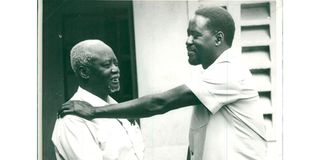
Then vice president Jaramogi Oginga Odinga and president Jomo Kenyatta.
Photo credit: File
Thus, when the post-independence compact between Jaramogi and Kenyatta unravelled, it was not a private falling out between two men; it was the first great fissure in the republic. Jaramogi broke with the government, was expelled from power, detained, and politically exiled. Yet his absence from office did not diminish him. If anything, it amplified him. His opposition became a permanent mirror held up to the state—a conscience it could neither silence nor ignore. He became Kenya’s first great dissident, a political figure defined by exclusion yet central to the national conversation. There were attempts to bring him back to the fold, but succession politics always became the greatest hindrance. Finally, Jaramogi became the face of peripheral politics.
Over the next six decades, the House of Jaramogi perfected this paradox of peripheral centrality. They rarely sat in State House, but Kenyan politics has orbited around them like iron filings around a magnet. This is not a historical accident; it is the result of both strategy and structure.
Strategically, the family has mastered the art of opposition politics. It has learned to transform marginalisation into a source of moral authority, protest into political capital, and electoral defeat into bargaining power. Structurally, Kenya’s political arithmetic—its coalitions, its contested legitimacy, its reform struggles—has always involved the Luo bloc, and by extension the Odingas as its principal interpreters. To govern Kenya is to reckon with the Odingas, whether at the ballot, in the backroom, or in the streets.
Jaramogi’s absence from power was never absence from relevance. He was the voice that haunted the palace: not an insider, but never quite an outsider either. Every administration since independence has had to respond to his challenge, his symbolism, and his enduring capacity to shape how Kenyans imagined power.
Raila Odinga did not inherit the presidency. He inherited a position—that of perennial contender, kingmaker, and arbiter of national politics. His political career reads like a series of pivotal interventions where he stood outside the throne room but held the key to its door.
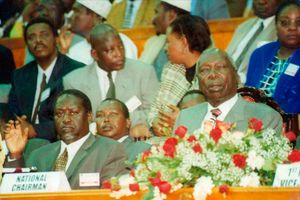
In 1997, after a third-place finish in the presidential election, Raila joined Kenya African National Union (KANU) and helped stabilize Daniel arap Moi’s final years in office. In 2002, with three now-legendary words—“Hata Kibaki tosha”—he helped deliver power to Mwai Kibaki, uniting a fragmented opposition and bringing an end to four decades of uninterrupted KANU rule.
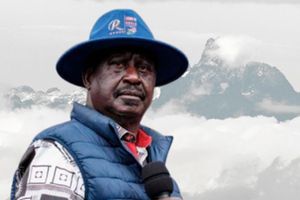
Azimio la Umoja One Kenya Coalition leader Raila Odinga.
Photo credit: Pool
In 2008, after the disputed election and the violence that followed, his entry into the Grand Coalition government saved the republic but did not elevate him to the presidency. Ten years later, his handshake with Uhuru Kenyatta once again stabilised the system without crowning him. And in 2024, after the Gen Z uprising shook the foundations of William Ruto’s government, Raila negotiated yet another broad-based political arrangement — a deal that anchored the regime even as he remained formally outside it.
This repeating pattern is no accident. It reflects how the Odinga brand functions best not as incumbency but as leverage — as a force that conditions, negotiates, and defines power without ever fully owning it. Where others seek the throne, the Odingas have long learned to hold the sceptre’s shadow.
The Odingas pull is not simply about numbers at the ballot box. It is about symbolic capital, accumulated over decades of resistance and dissent. Jaramogi is remembered as the early nationalist and dissident. Raila as the icon of the second liberation, the man who stood against single-party authoritarianism. Together, their name has become shorthand for constitutional reform, opposition politics, and the promise—or threat—of unfinished revolution.
Every regime—Kenyatta’s, Moi’s, Kibaki’s, Uhuru’s, Ruto’s—has had to reckon with the Odingas not just as political actors but as keepers of an alternative national narrative. They are not merely rivals; they are co-authors of Kenya’s political language. Even when they lose elections, they remain indispensable to the process of legitimizing or delegitimizing those who win.
The House of Jaramogi’s power lies not in incumbency but in brokerage. The Odingas act as translators between centre and margin, able to convert public discontent into structured negotiations. Their political home has become a kind of a clinic where governments enter to stabilise themselves; opponents gather there to launch their counter-movements.
Every sitting president eventually courted the House of Jaramogi within State House or contained them in prison. They cooperate and defy in equal measures. This duality explains why the Odingas often appear both radical and pragmatic, oscillating between mass mobilisation and elite pacts. They have perfected the art of turning anger into negotiated settlements, and political exclusion into moral authority. This model has allowed them to remain permanently relevant—neither absorbed nor erased by successive regimes.
Unlike the Kenyattas, who fused family and state, the Odingas have remained outside the formal architecture of executive power. But they have built something just as potent: a parallel moral centre.
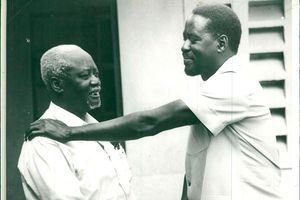
Father and son meet at the elder Odinga’s Bondo home for the first time since Raila was released from detention after five years in February 1988. Raila inherited the phobia that was generated for his father by the CIA and MI5.
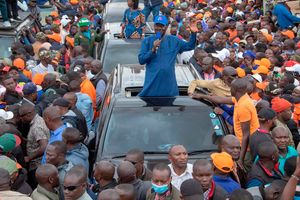
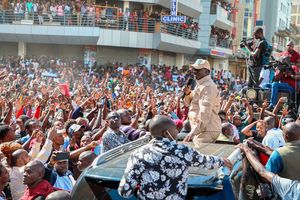
While the state rules, the House of Jaramogi, over the years, haunted it. It was an enduring check—sometimes loud, sometimes silent. But central to their relevance was use of rallies as a symbolic measure of power. For that, the Odingas remained a fixed reference point in Kenya’s political imagination.
With the death of Raila Odinga, the House of Jaramogi lost its most experienced driver. But they remain a dynasty without a throne, yet permanently embedded in the nation’s political bloodstream. Their power was never in the presidency; it was in shaping how the presidency itself was contested, imagined, and remembered.