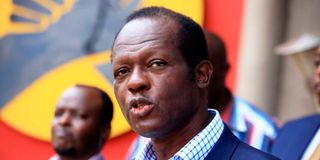
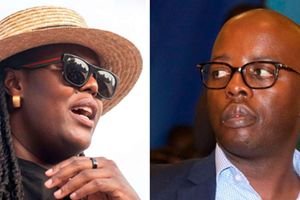
Former Jubilee Party Secretary General Raphael Tuju has officially resigned from the party, bringing to an end a political association that spanned nearly two decades with former President Uhuru Kenyatta.
In a resignation letter dated August 19 and addressed to former President Uhuru Kenyatta, who remains the Jubilee Party leader, Mr Tuju lauded him for the opportunity to serve as the party’s secretary general between 2016 and 2022.
In the letter copied to current Secretary General Jeremiah Kioni, the former Cabinet Secretary described his appointment as an “exceptionally bold political step,” noting that entrusting the powerful post to a member of the Luo community was unprecedented in a party whose political base was largely anchored in the Kikuyu and Kalenjin blocs.
“Naively, many of us in the Jubilee expedition had thought and dreamed that we could build a national party and a country that could make a transition from politics defined by ethnic mobilization and polarization,” Mr Tuju wrote.
He revisited the events following the March 2018 “Handshake” between Mr Kenyatta and ODM leader Raila Odinga, which dramatically altered the Jubilee Party’s internal dynamics.
While defending the handshake as a necessary tool to stabilize a country on the brink of chaos after Mr Odinga’s symbolic swearing-in, Mr Tuju admitted it strained his relations with then Deputy President William Ruto (now president).
“Unfortunately, that handshake brought a lot of hostility between me and President Ruto despite several initiatives to bridge the gaps that the three of us are aware of before my almost fatal accident in 2020,” revealed Mr Tuju.
He noted that President Ruto, after the Gen Z protests of 2024, was eventually compelled to strike his own handshake with Mr Odinga to stabilize his administration—mirroring Mr Kenyatta’s move six years earlier.
The former Rarieda MP traced his working relationship with Mr Kenyatta back to the days of the Party of National Unity (PNU) under President Mwai Kibaki.
Both men, he said, had faced political rejection within their communities for attempting to transcend ethnic politics— Mr Kenyatta for not being “Kikuyu enough” when he first vied for Gatundu South on a KANU ticket, and himself for not being “Luo enough” when he contested Rarieda under PNU in 2007.
He said he remained loyal to Mr Kenyatta as President, party leader, and Cabinet colleague, despite political turbulence and personal trials.
In his letter, Mr Tuju expressed optimism that Kenya’s future lies in moving beyond tribal divisions to confront pressing national challenges, especially unemployment and poverty among the youth.
“The time will soon come when more Kenyans will understand that our enemy is lack of employment and dignified income and not the other tribe,” he stated.
He noted that while he still looks forward to working with Mr Kenyatta in other capacities, he currently sees “no more value” he can add to the Jubilee Party, hence his decision to formally step down.
Mr Tuju's resignation from the Jubilee party marks the latest shifting alliances ahead of the next elections.